
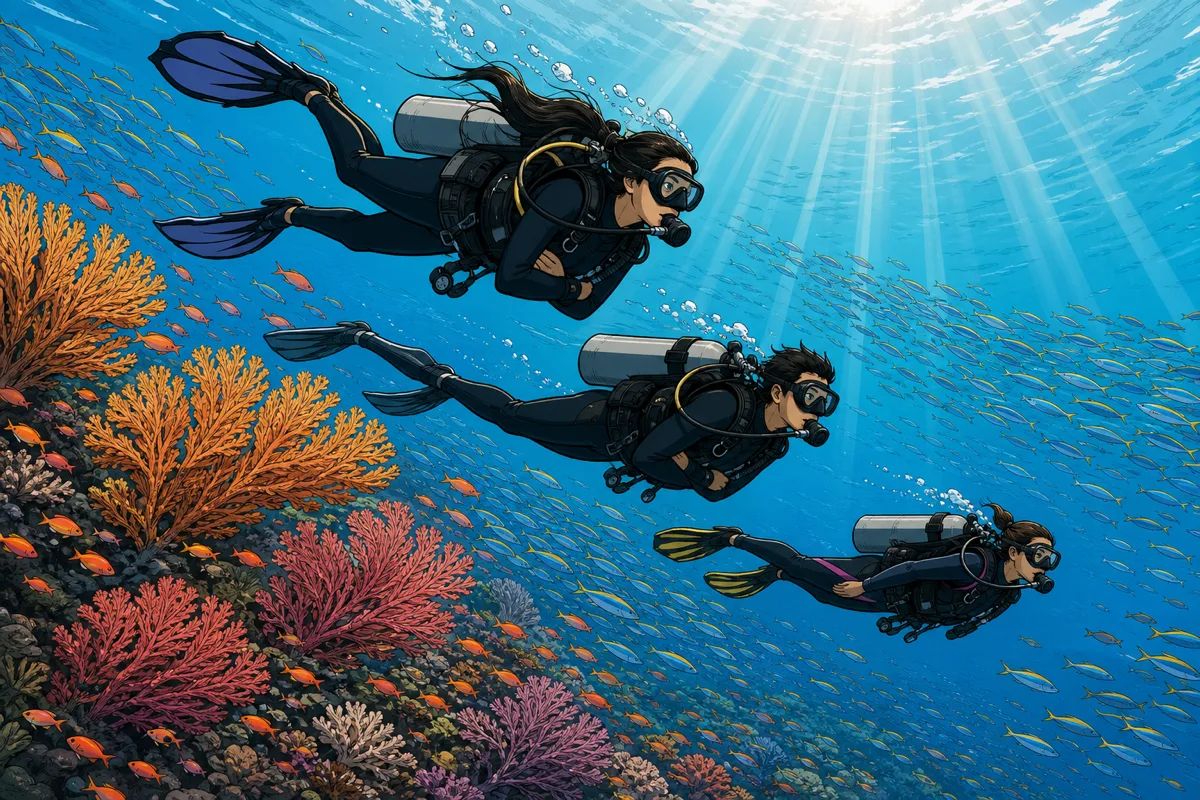
The first proper drift dive of your life usually goes like this: you drop in, exhale, sink to the reef, and then the ocean simply picks you up and carries you. No kicking. No effort. The reef scrolls past like scenery from a train window, fish hang in the flow all around you, and twenty minutes later you check your gauge and discover you have used almost no air because you have done almost no work. Most divers surface from that dive grinning and slightly changed. Drift diving is the signature experience of Bali diving, and around Nusa Penida it is done in some of the most reliable, most exhilarating tidal currents in the diving world. This guide covers everything we teach and everything we wish every visiting diver knew: how drift diving actually works, where Bali's great drift sites are, the skills and gear that matter, the safety rules that are non-negotiable, and how to go from nervous first-drifter to the kind of diver who checks the tide tables with a smile.
One clarification before we start. This article is about how to dive Bali's currents. If you want to understand why Bali has these currents in the first place, the Indonesian Throughflow, the tides, the thermoclines, we wrote a full companion piece on Bali diving conditions that explains the oceanography. Read them together and very little about this island's water will surprise you again.
What Is Drift Diving, Exactly?
Drift diving is any dive where you deliberately let a current carry you along the reef instead of swimming a route and returning to a fixed point. The boat does not anchor. It drops you at the up-current end of a site, follows your bubbles and your guide's surface marker while you fly along the reef, and picks you up wherever you surface. The dive site is not a place so much as a distance: on a good day at Nusa Penida you might cover more than a kilometre of reef in a single tank.
That definition hides how different drift diving feels from ordinary diving. On a normal dive, you are a swimmer. On a drift dive, you are a passenger, and the skill is not propulsion but positioning: holding your depth, your trim, and your place in the group while the water does the moving. Done well, it is the laziest, most fuel-efficient form of diving that exists. Done badly, it is a diver kicking frantically against a mass of moving ocean that outweighs them by a factor of millions, which is a fight with exactly one possible winner.
The golden rule, the one your guide will repeat in every briefing, is simple: never fight the current. You will not win, you will burn your air, spike your heart rate, and end the dive early. Everything else in drift technique is a footnote to that rule.
Why Bali Is a World-Class Drift Destination
Bali sits on the edge of the Lombok Strait, one of the main channels through which the Pacific Ocean drains into the Indian Ocean. Enormous volumes of water squeeze between Bali and its neighbouring islands on every tide, and the reefs of Nusa Penida, Nusa Lembongan, and the Padang Bai channel sit directly in the flow. The result is drift diving with three qualities that are rare to find together:
- Reliability. The currents are tidal, which means they are predictable. Guides here plan dives around tide tables the way pilots plan around weather, and a well-timed drop delivers a smooth, one-direction ride far more often than not.
- Life. Current is food delivery. The same flow that carries you along the reef carries plankton, and plankton is why Nusa Penida has reef fish in walls, manta rays at cleaning stations, and, in season, the surreal Mola mola rising from the deep. The fishiest sites in Bali are the ones that move.
- Range. Not every drift here is a rocket ride. Menjangan offers walls with the gentlest push imaginable, Padang Bai has friendly beginner drifts, and Penida's north coast scales from mellow to sporty depending on the tide you pick. There is a drift in Bali for every certification level, which is not something Komodo or the Maldives can honestly say.
It is worth saying plainly: the current is not an obstacle to diving Bali well. It is the reason Bali is worth diving. Sheltered, still-water sites like Tulamben are wonderful, but the mantas, the mola, the big schools, and the electric sense of a reef at full throttle all live where the water moves.
Bali's Best Drift Dive Sites
Nusa Penida's North Coast: The Classic Ride
The chain of sites along Penida's north shore, Penida Bay, SD Point, Ped, Sental, is the definitive Bali drift and the place most divers do their first one. The reef is a long, gently sloping garden of hard coral in outstanding condition, the visibility is regularly 20 to 30 metres, and the tidal current runs parallel to shore like a moving walkway. On a moderate tide it is pure joy: you drop at one end, settle at 18 to 22 metres, and simply fly, past turtles, over fields of staghorn, through walls of anthias. On a big tide the same sites become genuinely fast, the kind of dive where the group covers a kilometre and the guide's DSMB goes up early. Every Nusa Penida diving day we run includes at least one north-coast drift, and it remains the single best introduction to current diving we know of anywhere.
Manta Point and Crystal Bay: Where You Stop Drifting
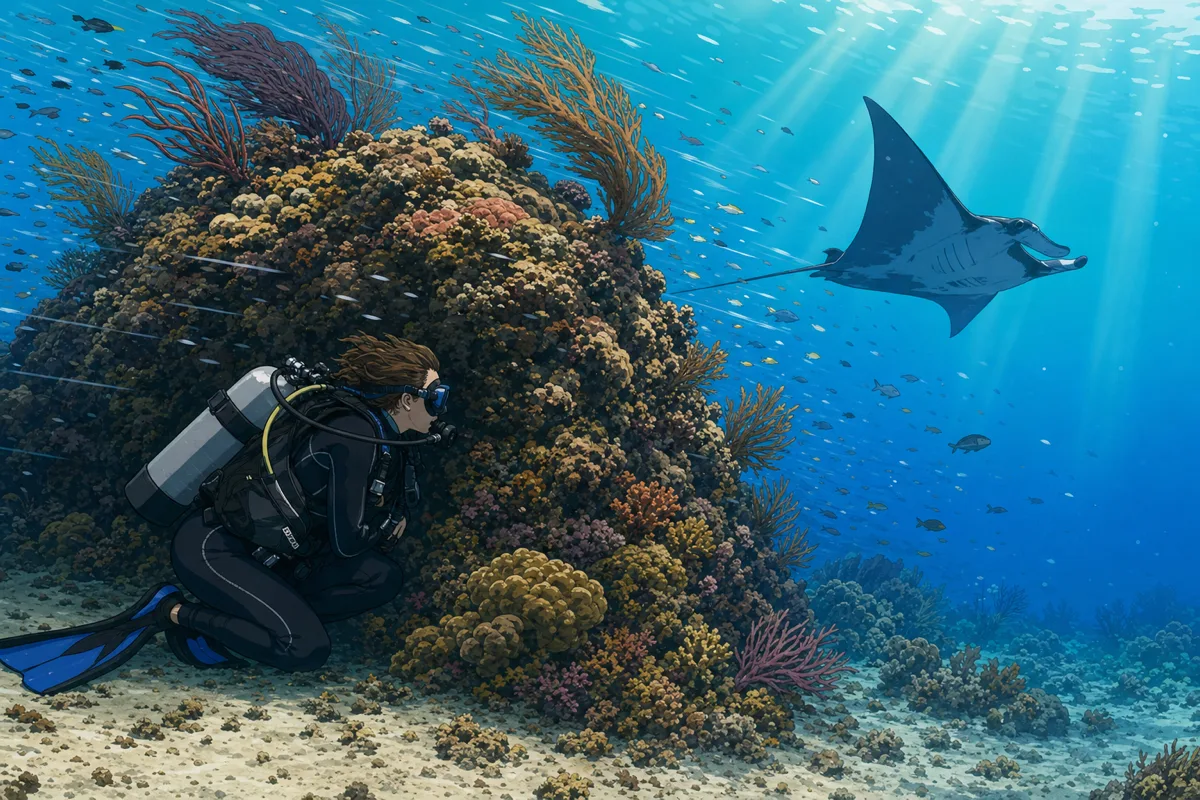
Penida's famous southern and western sites are current-affected rather than true drifts, and the distinction matters. At Manta Point, the skill is arriving at the cleaning station and then staying put, low, tucked, and out of the flow, while the mantas carousel overhead. At Crystal Bay, the bay itself is calm, but the channel beside it moves serious water, and respecting the guide's boundaries is what keeps the dive easy. Both sites teach the second great drift skill: not riding the current, but hiding from it.
Blue Corner: The Expert's Drift
On the right tide, Blue Corner off Nusa Lembongan is the most exciting dive in the Bali area, a steep drop-off where the current sweeps around a corner and the pelagics stack up in the blue: eagle rays, mobulas, big schools of jacks, and in season the mola. It is also the site where Bali stops being polite. The currents are strong, they can change mid-dive, and down-currents are possible near the point. This is a dive for experienced divers with solid buoyancy, good air consumption, and complete trust in their guide, and it is worth every one of the dives it takes to get there.
Gili Mimpang and Gili Tepekong: Small Islands, Big Water
Off Candidasa, the little rock islets of Gili Mimpang and Gili Tepekong sit in the middle of the Padang Bai channel and get everything the tide can throw at them. The reward is white-tip and black-tip reef sharks on almost every dive, huge schools of surgeonfish, cool upwelled water, and, in season, one of Bali's best mola records. The cost is real current, surge near the rocks, and the occasional washing-machine moment. Like Blue Corner, these are advanced sites, and we schedule them on tides that keep the excitement inside the fun zone.
Padang Bai: The Gentle Introduction
The reefs around Padang Bai itself, Blue Lagoon, Jepun, the Jetty, are mostly calm, but the sites just outside the bay offer soft, forgiving drifts over rich coral and sand slopes full of macro life. This is where nervous divers discover that a little current is a friend: it does the swimming while you do the looking. Our Padang Bai diving guide covers the full site list.
Menjangan: Drift Diving in Slow Motion
The walls of Menjangan Island in West Bali National Park usually carry the lightest of pushes, a knot or less, which makes them the perfect place to practise drift skills with training wheels on. You hang weightless beside a vertical garden of gorgonians and simply glide. If you want to learn trim and positioning before testing them at Penida, Menjangan is the classroom.
How a Bali Drift Dive Actually Works, Start to Finish
If you have never dived from a live boat, the choreography is worth understanding in advance, because a smooth drift dive is mostly won before anyone gets wet.
The briefing. Your guide explains the site, the expected current direction and strength, the planned depth, the entry style, the signal for regrouping, and the lost-diver procedure. Listen to the specifics. On drift dives the briefing is not a formality, it is the dive plan you will actually use.
The timed drop. The boat positions up-current of the site, often checking the water first, guides here read the surface the way farmers read clouds. On the count, the whole group enters together. In stronger current this is a negative entry: you roll in with an empty BCD and descend immediately, no bobbing on the surface while the current scatters the group. It sounds advanced; in practice it is one breath of commitment and then you are under and it is calm.
The descent and regroup. You drop as a group, level off at the briefed depth, and form up, guide in front, divers in a loose line or pairs behind, everyone in sight of everyone. From here the dive is simply the reef going by.
The ride. You hold trim, hold your buddy line, and steer with small fin movements the way a skydiver steers with their hands. Want to slow down for a turtle? Drop a metre closer to the reef, where friction slows the flow. Want to speed up? Rise a metre or two into the free stream. Depth is your throttle, this is the trick that turns passengers into pilots.
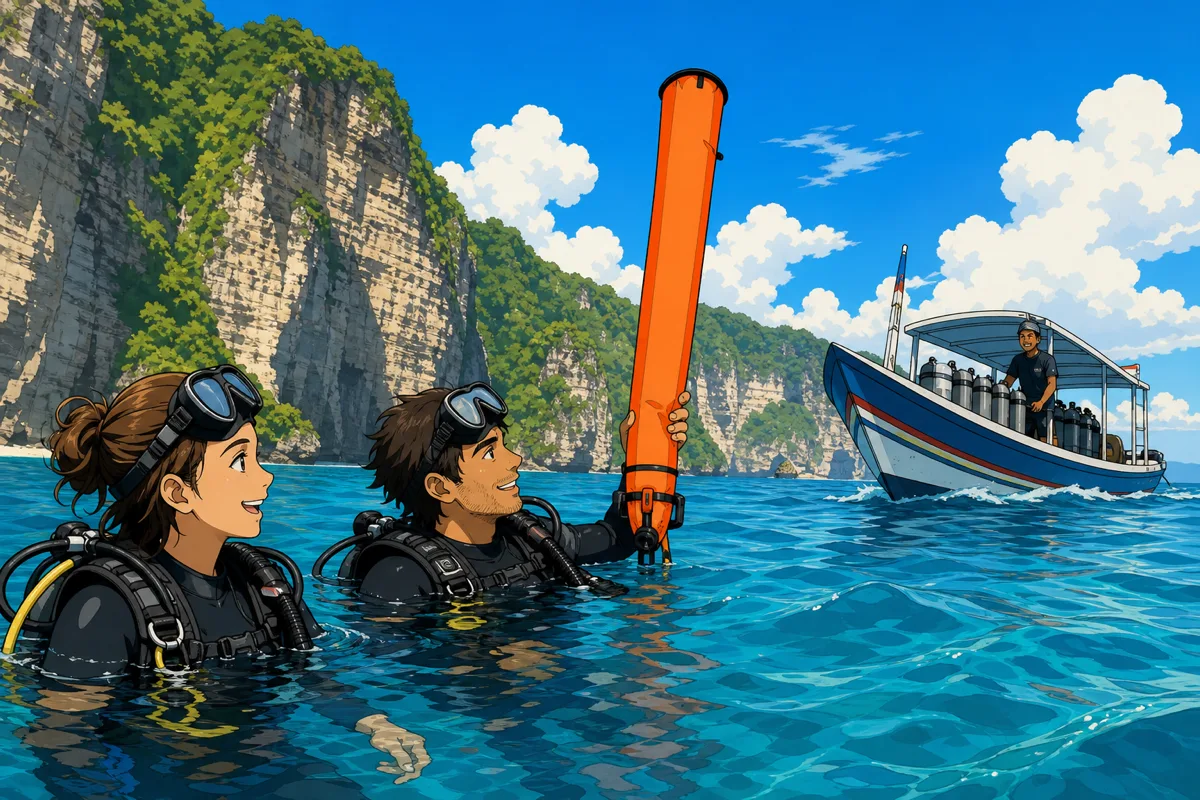
The ascent and pickup. Near the end of the dive, the guide deploys a DSMB, a bright surface tube on a line, and the group ascends together beneath it, drifting through the safety stop while the boat tracks the marker. You surface, inflate, and the boat comes to you. Done properly, you climb the ladder having never once swum against anything.
The Seven Skills of a Good Drift Diver
1. Buoyancy before everything. Current punishes sloppy buoyancy instantly: too heavy and you are dragged along the coral, too light and you are separated vertically from your group. If your control is rusty, one Peak Performance Buoyancy session, or a couple of easy days at Tulamben, pays for itself on the first Penida tide. Divers who have not been in the water for a while should consider a refresher before their first drift.
2. Trim and streamlining. Horizontal body, gauges and octopus clipped away, arms folded. In moving water you are a sail: the smaller and flatter you make yourself, the more control you keep. This alone cuts most divers' air consumption dramatically.
3. Use depth as your throttle. Current is slowest right against the reef and fastest in open water. One metre of depth change is often the difference between whipping past a pygmy seahorse and parking beside it.
4. Get low, get behind things. Every reef is full of current shadows, bommies, ridges, ledges. Tuck behind one and the flow parts around you while you watch the show, which is precisely how manta and mola dives work. Never grab or kneel on coral to do it: find rock, find sand, or hover.
5. Stay with the group, horizontally and vertically. In current, separation happens fast and reunion is hard. Keep the guide in front of you, your buddy beside you, and resist the temptation to chase things down-current alone. Refresh your hand signals, in a drift, communication is constant and mostly silent.
6. Watch your air honestly. Relaxed drifting sips air, but a few minutes of anxious finning gulps it. Check your gauge more often than usual and report honestly, the plan depends on it.
7. Trust the plan. If the guide turns the dive, aborts a site, or holds the group low, it is because they are reading water you cannot see yet. The divers who have the most fun in Bali's currents are, without exception, the ones who follow their guides most closely.
The DSMB: The Most Important Piece of Drift Gear Ever Invented
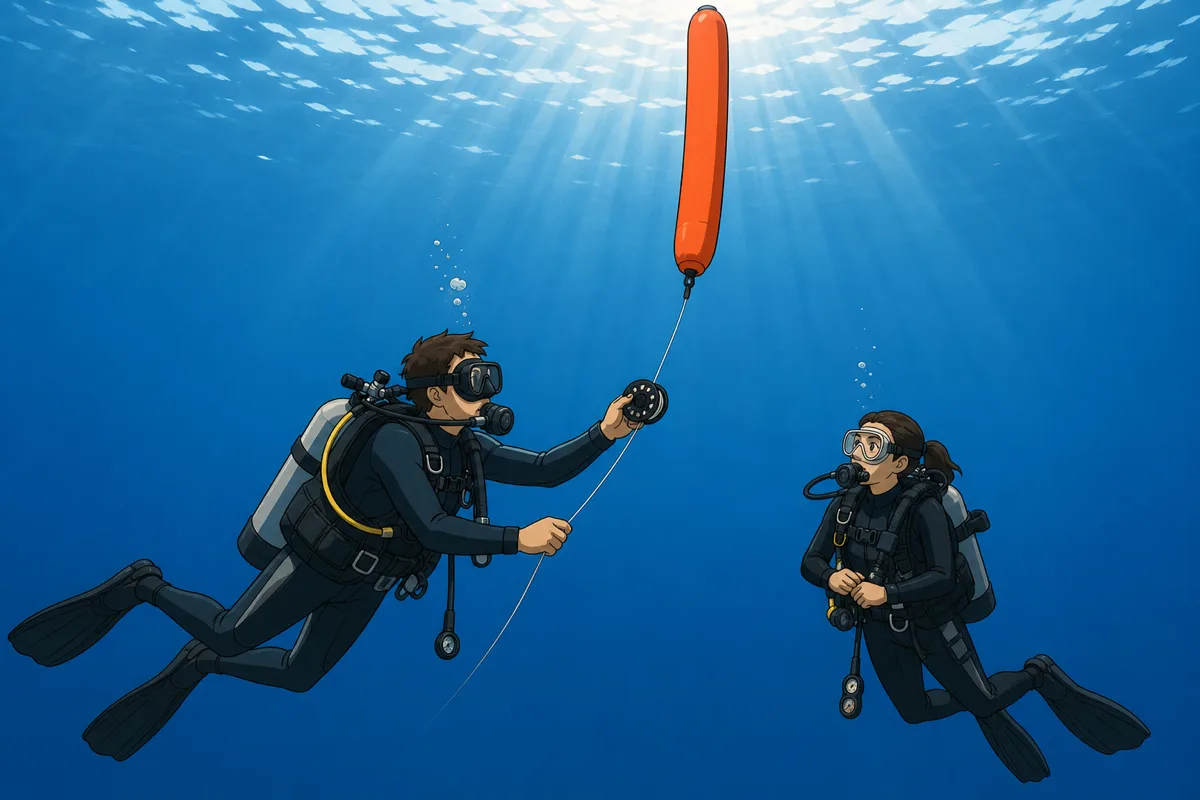
A delayed surface marker buoy is a bright tube you inflate underwater and send to the surface on a line near the end of the dive. On a drift, it does three jobs at once: it tells the boat where you are, it warns other boats that divers are below, and it gives the group a visual reference line for a drifting safety stop. In Bali's busy channels, it is not optional equipment. Your guide always carries one, and every certified diver in moving water should ideally carry their own plus a spool or reel.
If you have never deployed one, learn, it is a fifteen-minute skill that transforms your independence as a diver, and it is taught properly in the drift specialty course below. A few notes from thousands of deployments off our boats:
- Deploy from depth before you are low on air, not after. The stop is more relaxed when the marker is already flying.
- Keep the line in front of you and never wrap it around a hand or wrist. If the buoy is snatched by chop, you want to be attached to it by fingertips, not anatomy.
- Angle slightly down-current from your bubbles so the tube inflates clear of the group.
Beyond the DSMB, drift gear is ordinary gear, streamlined: a well-fitting wetsuit (3 mm for most of Bali, 5 mm for cold-season Penida, our packing list has the details), a dive computer, reef-safe habits, and nothing dangling. Reef hooks, standard practice in Komodo and Palau, are generally unnecessary in Bali: our current-heavy sites are dived as drifts or from natural shelter, not from hooked positions on the reef edge.
Safety: Respecting the Water Without Fearing It
Drift diving in Bali has an excellent safety record precisely because the local rules are strict and simple. A few things every visiting diver should understand:
Currents change mid-dive. Tidal flow is not a constant. It builds, eases, and occasionally switches, and around headlands it can split into eddies. This is normal and it is why we dive these sites with local professional guides on every single dive, and why groups here are small, our standard is a maximum of three or four certified divers per guide.
Down-currents exist and have exits. At a handful of advanced sites, Blue Corner, Tepekong's canyon, occasionally Crystal Bay's channel, water can flow downward off a reef edge. The response is trained and mechanical: fin at an angle toward and across the reef out of the moving column, get into the slope's shelter, add a little gas if needed, and never chase the surface vertically through the flow. Your guide briefs this wherever it is relevant. It sounds alarming; in practice it is a known feature of known corners of known sites, and dive planning exists to keep beginners nowhere near them.
Separation has a procedure. Look for one minute, then ascend slowly, deploy your marker, surface, and wait with the boat watching. Divers who follow the procedure get picked up quickly, in a drift the boat is always following the group, which is a comfort still-water diving does not offer.
Honesty is a safety skill. About your experience, your comfort, your air. A guide who knows you had a rough first descent will pick a friendlier second site. The sea rewards honest divers and audits the other kind, more on this in our piece on whether scuba diving is dangerous.
Can Beginners Drift Dive in Bali?
Yes, and they do, every day, on the right sites at the right tides. A calm-tide north Penida drift is well within the reach of a newly certified Open Water diver who listens to briefings, and gentle Padang Bai and Menjangan drifts are friendlier still. Even complete beginners on a try dive experience light current at protected sites, with an instructor literally within arm's reach.
What changes with experience is the menu. Manta Point on a pushy day, Crystal Bay in mola season, Mimpang, Tepekong, and Blue Corner, these ask for comfort in moving water, quick equalisation, composed buoyancy, and ideally an Advanced Open Water certification with a drift or deep background. If your logbook is thin, tell us, we sequence Bali perfectly for progression: Tulamben and Amed to warm up, north Penida to learn the ride, and the advanced corners when you are ready. That progression is, frankly, the ideal Bali dive holiday anyway, our one-week itinerary is built around it.
The PADI Drift Diver Specialty: Learning the Ride Properly
If drift diving grabs you, and it will, the PADI Drift Diver specialty course is the fastest way to turn white-knuckle into fluency. Over two training dives with an instructor, you learn to read current from the surface and underwater, plan drift entries and exits, control position with depth and trim, deploy a DSMB cleanly from mid-water, and manage buddy contact and navigation in flow. Bali might be the single best place on Earth to take it: the currents are reliable enough to guarantee real practice, and the classroom is a manta highway. The certification counts toward the PADI Master Scuba Diver rating, and the skills transfer directly to Komodo, the Gilis, and every other current destination on your list, including our own Komodo trips.
When to Drift Dive in Bali
Bali drifts twelve months a year, but two calendars are worth knowing. The dry season (roughly May to October) brings the best visibility and, from July to October, the cold upwellings that deliver mola mola to Crystal Bay and Tepekong, prime time for advanced drift sites, in a 5 mm wetsuit. The wet season (November to April) keeps the north Penida drifts and east-coast sites in excellent shape between showers, with warmer water and quieter boats, see our guides to rainy-season diving and the best time to visit Bali for the full picture.
Within any week, the tide matters more than the month. Around full and new moon, tidal ranges and therefore currents are at their biggest; around the quarter moons they are gentlest. We check the tables so you don't have to, but if you want the strongest manta action or the mellowest first drift, tell us when you book and we will slot your days accordingly.
How We Run Drift Dives at Neptune Scuba Diving
Our dive centre in Sanur sits directly across the channel from Nusa Penida, which makes us drift-diving specialists by geography as much as by choice. Every current-site trip runs with small groups (maximum three or four certified divers per PADI professional), tide-planned schedules, live-boat pickups, guides who dive these reefs hundreds of times a year, and full equipment including computers and DSMBs. Trips to Nusa Penida start from IDR 3,150,000 including hotel transfers, lunch, and insurance, and the Drift Diver specialty can be woven into any two-day plan. Browse all Bali dive sites, check our price guide, or just message us with your certification level and your dates, we will build the drift progression around you.
The current is not something that happens to your Bali dive holiday. It is the engine of it, the thing that feeds the mantas, summons the mola, polishes the visibility, and turns an ordinary reef tour into flight. Learn to ride it, and the best diving on this island, arguably some of the best diving anywhere, opens up like a door.
Frequently Asked Questions
Drift diving is a technique where you let a current carry you along the reef instead of swimming a fixed route. The boat does not anchor: it drops divers at the up-current end of the site, follows the group's surface marker, and picks everyone up wherever they surface. It is relaxed, fuel-efficient diving, and it is the signature style at Bali's best sites, especially around Nusa Penida.
Yes, on the right sites at the right tides. Gentle drifts at Nusa Penida's north coast, Padang Bai, and Menjangan are dived daily by newly certified Open Water divers, always in small guided groups. Advanced sites like Blue Corner, Gili Tepekong, and Manta Point on strong tides are reserved for experienced divers. Tell your dive centre your certification level and comfort honestly and they will sequence sites to match.
Nusa Penida's north coast (SD Point, Ped, Sental) is the classic Bali drift: healthy hard coral, 20-30 m visibility, and a reliable tidal current running parallel to the reef. For advanced divers, Blue Corner off Nusa Lembongan and Gili Mimpang/Tepekong near Candidasa offer stronger currents with sharks, pelagics, and seasonal mola mola. Menjangan Island offers the gentlest wall drifts, ideal for practising skills.
They range from barely perceptible to several knots depending on site, tide, and moon phase. East-coast sites like Tulamben and Amed are usually calm; Nusa Penida's channels move serious tidal water, strongest around full and new moon and gentlest near the quarter moons. Local guides plan every dive around tide tables, which is why diving current sites with an experienced local operator matters.
A DSMB (delayed surface marker buoy) is a bright inflatable tube deployed on a line near the end of a dive so the boat can track and collect drifting divers. On Bali drift dives your guide always flies one, and ideally every certified diver carries their own with a spool. It marks your position, warns boat traffic, and gives the group a reference for a drifting safety stop.
A negative entry means rolling into the water with an empty BCD and descending immediately, without waiting on the surface. It is used on stronger-current sites so the group reaches the reef together before the surface flow can scatter anyone. It requires equalising early and committing to the descent, and it is briefed and practised, it feels routine after the first attempt.
Stay calm, fin at an angle toward and across the reef to exit the moving column of water, and use the reef slope's shelter. Add a little air to your BCD if needed, and never try to fight straight up through the flow. Down-currents in Bali exist only at a few known corners of advanced sites like Blue Corner and Tepekong, guides brief the procedure wherever it is relevant and keep less experienced divers away from those spots entirely.
Yes, Bali is arguably one of the best places in the world to take it. The two-dive course teaches current assessment, drift entries, buoyancy and trim in flow, DSMB deployment, and buddy procedures, and Bali's currents are reliable enough to guarantee genuine practice. The certification counts toward Master Scuba Diver and transfers directly to Komodo, the Gilis, and other current destinations.
Bali drift dives year-round. The dry season (May-October) brings the best visibility, and July to October adds the cold upwellings that attract mola mola to advanced sites. The wet season (November-April) offers warmer water and quieter boats with the north Penida drifts still in excellent condition. Within any month, currents are strongest around full and new moon and gentlest near the quarter moons.
With Neptune Scuba Diving, a two-dive Nusa Penida trip starts from IDR 3,150,000 per person, including hotel transfers in southern Bali, a professional PADI guide (maximum 3-4 divers per group), full equipment with dive computer, boat, lunch, and scuba insurance. The Drift Diver specialty course can be added to any two-day plan.