

Getting the answer to how much weight do you need for scuba diving wrong is the most common reason new divers burn through air, struggle to hover and kick up sand on the reef. Weighting is also the single skill the Peak Performance Buoyancy specialty spends most of its time on, because almost every other buoyancy problem traces back to it. A diver who carries the right amount of lead uses less air, stays longer underwater and touches nothing.
Students first meet the question in the pool on a PADI Open Water course, and then have to answer it again in the sea, where salt water changes the numbers. Calm sites such as Padang Bai dive trips are where most divers in Bali fine-tune their weighting. This guide gives the starting formula, a weight chart by body weight and wetsuit, the weight check that confirms it, and a worked example.
The numbers below are rule-of-thumb starting points used by instructors across the main training agencies. They are a first guess to be tested in the water, never a final answer, because body composition and equipment vary too much for any chart to be exact.
How much weight do you need for scuba diving?
Correct weighting is the lead that lets a diver float at eye level with an empty BCD and a nearly empty tank, usually 5 to 10 percent of body weight.
- Swimwear only: about 2%
- 3 mm full wetsuit: about 5%
- 5 mm full wetsuit: about 8%
- 7 mm wetsuit: about 10%
The formula is body weight multiplied by the wetsuit percentage, then about 2 kg less for fresh water or a steel tank.
Divers usually confirm it with:
- A weight check led by a try dive instructor or course instructor
- Rental lead from a Bali dive shop
- A final check at the safety stop
In short: start at 5 percent of body weight in a 3 mm suit, then let the weight check decide.
What changes how much weight a diver needs?
Five things decide the final number: the wetsuit, the tank, the water, the diver's body and the rest of the equipment. The wetsuit and the water make the biggest difference for most divers.
| Factor | Effect on weight needed | Typical size of the change |
|---|---|---|
| Wetsuit thickness | Thicker neoprene floats more | About 1 to 1.5 kg per extra 2 mm for an average adult |
| Salt vs fresh water | Seawater is denser, so it lifts more | About 2 to 3 kg more in the sea |
| Tank material | Aluminium turns buoyant as it empties; steel stays negative | About 2 kg less lead with steel |
| Tank size and gas | Air has weight, and it is breathed off during the dive | About 2 kg of air in a full 12 L tank at 200 bar |
| Body composition | Fat floats, muscle and bone sink | Varies by several kilograms between divers of the same weight |
| BCD and accessories | Padding, a hood or a new wetsuit add buoyancy | About 0.5 to 2 kg |
Wetsuit
Neoprene is full of tiny gas bubbles, so it floats. A new suit floats more than an old one, because the cells compress permanently with use. Most Bali sites, from the east coast to Menjangan Island, sit at 26 to 29°C and are comfortable in 3 mm, but divers heading to the colder water at Crystal Bay and the south of Nusa Penida often switch to 5 mm and need extra lead. How cold those thermoclines get is covered in Bali diving conditions and the Mola mola season guide.
Salt water
Seawater has a density of about 1.025 kg per litre against 1.000 for fresh water. A diver and their equipment displace roughly 80 to 110 litres, so the sea pushes up about 2 to 3 kg harder than a pool does. This is why weighting from a freshwater pool session almost never works on the first sea dive.
Tank
Air weighs about 1.2 grams per litre at the surface. A 12 L tank filled to 200 bar holds about 2,400 litres, or close to 3 kg of gas, and a typical dive uses around 2 kg of it. Aluminium tanks are slightly negative when full and buoyant when nearly empty, so the diver must carry enough lead to stay down at the end of the dive, not the start.
Body and equipment
Two divers who both weigh 75 kg can need weights 3 kg apart, depending on body fat and lung volume. Nervous divers also tend to breathe with fuller lungs, which adds buoyancy. That often settles after 10 to 20 dives, and many divers find they can drop a kilogram or two as they relax.
Scuba weight chart: where should a diver start?
Find the body weight row and the wetsuit column for a starting weight. The chart assumes seawater, an aluminium 12 L tank and a standard jacket BCD.
| Body weight | Swimwear (2%) | 3 mm full (5%) | 5 mm full (8%) | 7 mm (10%) |
|---|---|---|---|---|
| 50 kg | 1 kg | 2.5 kg | 4 kg | 5 kg |
| 60 kg | 1 kg | 3 kg | 5 kg | 6 kg |
| 70 kg | 1.5 kg | 3.5 kg | 5.5 kg | 7 kg |
| 80 kg | 1.5 kg | 4 kg | 6.5 kg | 8 kg |
| 90 kg | 2 kg | 4.5 kg | 7 kg | 9 kg |
| 100 kg | 2 kg | 5 kg | 8 kg | 10 kg |
Adjust the chart for these cases:
- Fresh water, such as a training pool or a lake: subtract about 2 kg.
- Steel tank instead of aluminium: subtract about 2 kg.
- Hood, vest or a brand new wetsuit: add 0.5 to 1 kg.
- Very lean or very muscular build: expect to need less than the chart; higher body fat usually needs more.
Rental lead usually comes in 1 kg and 2 kg blocks, with some shops offering 0.5 kg pieces or soft pouches. Round to the nearest kilogram and fine-tune from there. Divers who travel often write their final weight in their logbook next to the suit, tank and water type, as recommended in the Bali scuba diving packing list.
How do you do a weight check?
A weight check is done at the surface with an empty BCD and a normal breath: correctly weighted divers float with the water at eye level and sink slowly when they exhale. It takes two minutes and should be repeated whenever the suit, tank or water changes.

1. Estimate the starting weight
Use the chart above for the wetsuit and body weight, then apply the adjustments for water and tank. Write the number down before kitting up, so the next dive starts from a known figure.
2. Get in with full equipment
The check only works with every piece of equipment worn for the dive, including the hood, camera and any spare torch. The diver gets into water too deep to stand in, next to the boat or a buddy.
3. Empty the BCD and hold a normal breath
The diver deflates the BCD completely, breathes from the regulator and holds a normal breath, not a deep one. Fins should hang still, because kicking hides the real result.
4. Read the waterline
If the water sits at eye level, the weighting is right. If the head rides high with the shoulders out, add 1 kg and repeat. If the diver sinks while holding the breath, remove 1 kg.
5. Exhale and confirm
On a full exhale, a correctly weighted diver sinks slowly. If they stay floating even with empty lungs, more lead is needed for a controlled descent.
6. Adjust for a full tank
The ideal check uses a tank at about 50 bar, but most checks happen with a full tank before the dive. In that case, add the weight of the air the diver will breathe off, about 2 kg for a 12 L tank, after passing the check. The final test is the safety stop at the end of the dive.
Worked example: a 75 kg diver at Padang Bai
The example follows a 75 kg diver in a 3 mm full wetsuit with an aluminium 12 L tank through a first day of sea diving after a pool session. The numbers are illustrative, but each step uses the method above.
| Step | Situation | Result | Weight carried |
|---|---|---|---|
| Chart estimate | 75 kg × 5%, seawater, aluminium tank | Starting point 3.75 kg, rounded up | 4 kg |
| Pool session | Fresh water, same suit and tank | About 2 kg less needed | 2 kg |
| Surface check, full tank | Padang Bai, BCD empty, normal breath | Eye level with 2 kg | 2 kg |
| Add air allowance | About 2 kg of air will be breathed off | Add 2 kg after the check | 4 kg |
| Safety stop at 5 m | 50 bar left, BCD empty | Hovers without kicking | 4 kg confirmed |
| Next day at Crystal Bay | Switch to a 5 mm suit | About 1.5 to 2 kg more | 6 kg |
The chart estimate and the final number match here, which is common for average builds in a 3 mm suit. A leaner diver might confirm at 3 kg and a diver with more body fat at 5 kg. The safety stop step is the one that matters most, because it is the only point where the tank is near empty and the diver is close to the surface, exactly when being underweighted causes an uncontrolled ascent.
When the chart and the check disagree
The weight check always wins over the chart. A difference of 1 or 2 kg is normal and simply reflects body composition or a newer wetsuit. A difference of 3 kg or more usually means something else is going on: air trapped in the wetsuit or BCD, a deep breath held during the check, or a tank of a different size or material than expected.
Before accepting a number far from the chart, repeat the check after letting air out of the suit at the neck and wrists and fully venting the BCD from the lowest dump valve. If the result is the same twice, it is the right number for that diver and that equipment. Record it, along with the suit thickness, tank and water type, so the next trip starts from a tested figure instead of a guess.
How can you tell if you are overweighted or underweighted?
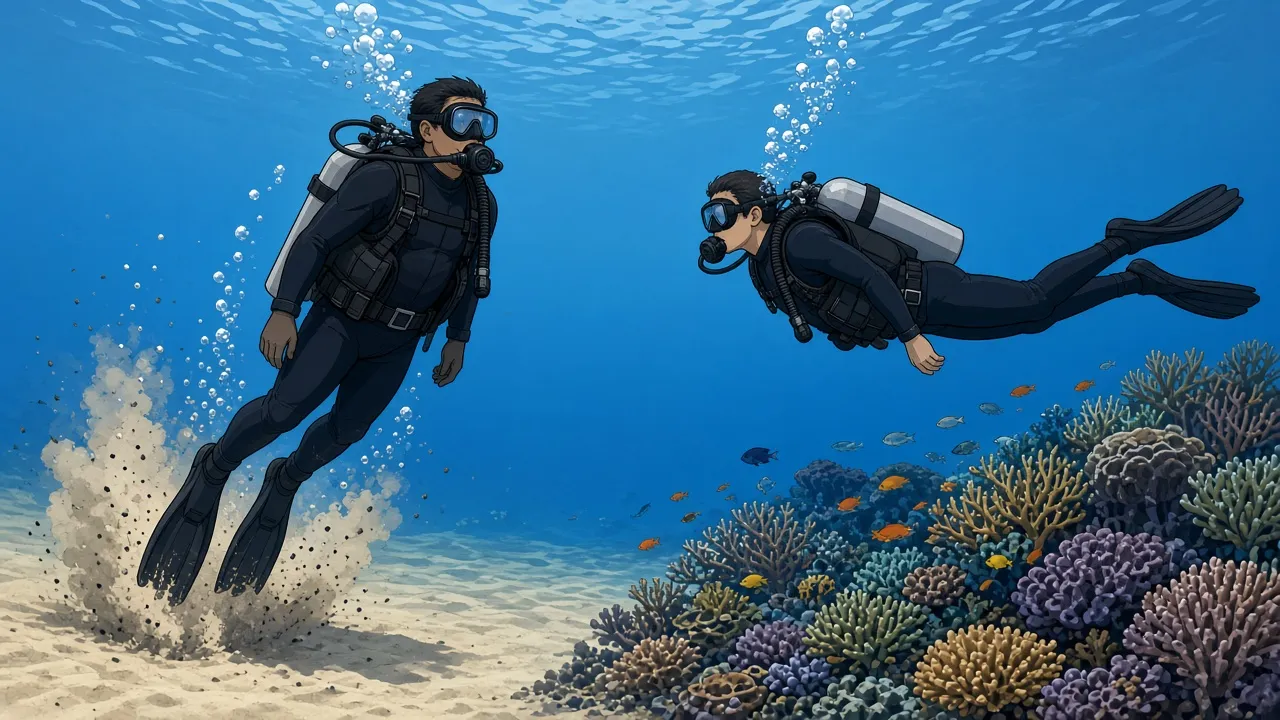
Overweighted divers swim head-up with a lot of air in the BCD and use air quickly; underweighted divers struggle to descend and float up during the safety stop. Most new divers err on the heavy side.
| Sign | Overweighted | Underweighted |
|---|---|---|
| Descent | Drops fast, needs to add air early | Cannot get down without kicking or a line |
| Body position | Head-up, feet-down, legs sink | Feet float up, hard to stay level |
| BCD | Needs a lot of air to stay neutral | Almost empty for the whole dive |
| Air use | High, from constant finning | Normal, until fighting to stay down |
| Safety stop | Easy to hold, but bottom contact earlier | Floats up towards the surface |
| Reef impact | Kicks sand and touches coral | Grabs rock to stay down |
Being overweighted feels safe, which is why it is so common. The extra lead means more air in the BCD, and that air expands and shrinks with every depth change, so the diver is constantly adjusting. The fixes that follow weighting, such as trim and finning, are covered in how to improve buoyancy.
Being underweighted is less common but more dangerous near the surface. On a multilevel wreck such as the USAT Liberty in Tulamben, an underweighted diver may cope at 20 metres and then lose control at the 5-metre stern as the tank empties. Divers returning after a long break often notice both problems, which is one reason the PADI ReActivate refresher includes a weight check.
Weight belt vs integrated weights vs trim weights: which is best?
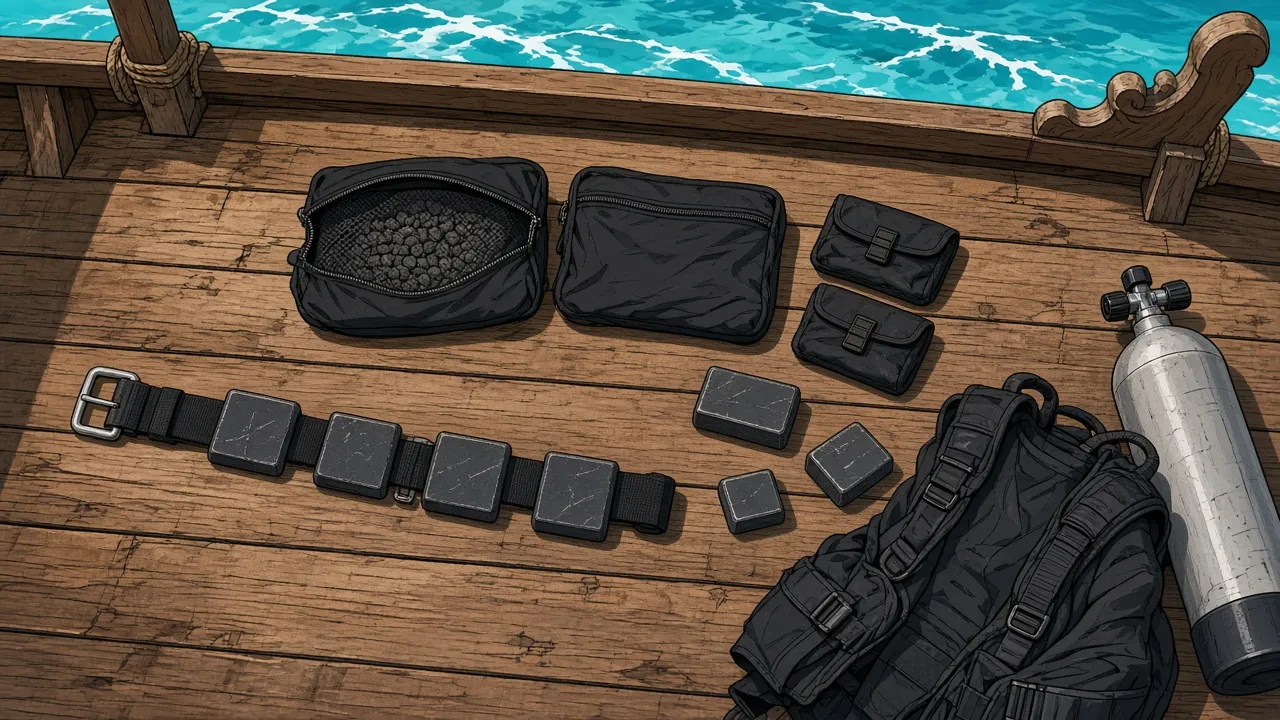
A weight belt is the simplest and most common system, integrated weights are more comfortable, and trim weights fix body position rather than total buoyancy. Many divers use a combination.
| System | How it works | Advantages | Drawbacks | Best for |
|---|---|---|---|---|
| Weight belt | Lead blocks on a nylon belt with a quick-release buckle | Cheap, available everywhere, easy to adjust | Can slip or twist; pressure on the lower back | Courses, rental and most fun diving |
| Integrated weights | Pockets in the BCD that pull out to release | Comfortable, no belt to forget | Heavy BCD to carry; check the release before each dive | Divers with back issues and owners of their own BCD |
| Trim weights | Small pouches on the tank strap or upper BCD | Fixes legs-down or head-down position | Not ditchable in most designs | Fine-tuning horizontal trim |
| Ankle weights | Small weights strapped above the ankles | Stops fins floating up | More effort when finning | Divers with buoyant fins or legs |
Whatever the system, the buddy check before each dive should cover where the weights are and how to release them. Some lead should always be ditchable, because dropping weight is the fastest way to become buoyant at the surface in an emergency, a skill practised on the PADI Rescue Diver course.
On a boat dive, belts are usually put on last and taken off first, sitting on the side of the boat. Integrated pockets are often removed and handed up to the crew before the diver climbs the ladder.
Where to put the lead
The total amount of lead decides whether a diver floats or sinks; where it sits decides the body angle. Weight carried low on the hips pulls the legs down, which is why many belt divers swim slightly feet-down. Moving a block from the front of the belt towards the back, or moving 1 kg into trim pockets near the shoulders, often levels a diver out without changing the total.
Lead should be split evenly between left and right, otherwise the diver rolls to one side and works constantly to correct it. Blocks on a belt sit best just in front of the hips rather than on the spine, where they can press on the tank band and slip. With integrated pockets, it is worth checking that each side holds roughly the same amount after every rental change.
How should weighting change by diver level and type of dive?
Beginners usually start heavier and lose 1 to 2 kg over their first 20 dives, while experienced divers adjust for each dive type rather than for nerves. The table shows typical patterns.
| Diver or dive type | Typical weighting approach | Why |
|---|---|---|
| Try divers | Set by the instructor, often slightly heavy | Keeps a first-timer stable at shallow depth |
| Open Water students | Chart plus weight check on the first sea dive | Weight check is a required skill |
| New certified divers | Recheck every few dives, drop lead gradually | Breathing relaxes with experience |
| Drift and negative entries | Correct weighting, quick descent technique | Currents punish extra air in the BCD |
| Night and wreck diving | Precise weighting and good trim | Silt and confined spaces need control |
| Liveaboard trips | Log the final weight on day one | Same suit and tank for many dives |
Try divers and students
Beginners are often slightly heavy on purpose, because a stable diver learns faster than one who floats away. A first sea dive after the pool is the right moment to reduce, as explained in first-time diving in Bali.
Advanced and drift divers
After the PADI Advanced Open Water course, divers begin drift, deep and night dives where accuracy matters more. On the Drift Diver specialty, a quick negative entry and a fast descent are taught with correct weighting, not extra lead.
Returning divers
Divers coming back after a year or more out of the water usually need to recheck from the chart rather than trust an old log entry. Body weight, wetsuit and breathing habits all change, and nervous breathing on the first dive back often adds buoyancy. A short pool session or shallow first dive with a full weight check removes the guesswork.
Wreck, night and liveaboard diving
The Wreck Diver specialty and the Night Diver specialty both reward precise weighting, because silt and darkness leave little room for correction. On a multi-day trip such as the King Neptune liveaboard, the first check-out dive is used to set weighting for the rest of the week.
Example: weighting on a course with Neptune Scuba Diving in Bali
Neptune Scuba Diving runs courses and dive trips from its dive center in Sanur. The example below shows how weighting is handled in one operator's format; it is not the only way to learn.
- Day one of the three-day Open Water course is equipment and pool training, where students first try different amounts of lead.
- The open water dives at Padang Bai and Tulamben include a surface weight check, as PADI standards require.
- A 3 mm wetsuit and a 12 L tank are standard on Bali dive trips, with 15 L tanks available as extra equipment.
- The one-day PPB course starts from IDR 5,400,000 per person at the time of writing and focuses on finding the exact weight a diver needs.
This format is not for everyone. It is not for divers who need drysuit training, which is not relevant in Bali's warm water, or for divers who want technical sidemount or twinset configurations. Divers who already hover comfortably with an empty BCD at the safety stop will gain little from a dedicated buoyancy course.
What does the evidence say about weighting and diving safety?
Weighting problems rarely cause accidents on their own, but they feed the buoyancy and ascent problems that do. In a DAN study of 947 recreational scuba deaths from 1992 to 2003, emergency ascent was the disabling agent in 55 percent of cases and buoyancy trouble in 13 percent (Denoble and colleagues, 2008).
The physics behind this is Archimedes' principle: a diver is pushed up with a force equal to the weight of water they displace. Gas in the BCD and wetsuit compresses with depth and expands on the way up, so a diver carrying too much lead needs more air in the BCD, and that air expands fastest in the last 10 metres. An underweighted diver with an empty tank has no way to stop rising.
The same study found that insufficient gas was the most common trigger, in 41 percent of deaths. Correct weighting lowers air consumption, so it reduces that risk indirectly. The broader risk picture is covered in whether scuba diving is dangerous, and the role of the ascent rate alarm in what a dive computer is.
Divers planning deeper profiles can practise controlled ascents with correct weighting on the PADI Deep Diver specialty, where buoyancy changes with depth are most noticeable.
Key takeaways
- Correct weighting lets a diver float at eye level with an empty BCD and near-empty tank, usually 5 to 10 percent of body weight.
- Start at about 5 percent of body weight in a 3 mm suit and 8 percent in a 5 mm suit.
- Subtract about 2 kg for fresh water or a steel tank, and add the weight of the air if checking with a full tank.
- Confirm the number with a surface weight check, then again at the safety stop with about 50 bar left.
- Overweighted divers swim head-up and use more air; underweighted divers float up at the end of the dive.
- Keep some weight ditchable and log the final weight with the suit, tank and water type.
Sources: Denoble et al., Common causes of open-circuit recreational diving fatalities, Undersea and Hyperbaric Medicine, 2008, Diving weighting system, Buoyancy compensator, Archimedes' principle, Divers Alert Network and PADI.