
Every week we watch the same thing happen on the beach at Sanur. Two divers go in together on identical tanks, same site, same guide. One surfaces after fifty minutes with 80 bar left and a camera full of nudibranchs. The other is out of air at thirty five minutes, has a scraped knee, and spent the whole dive somewhere between the reef and the surface without ever settling. Fitness is rarely the difference. Experience is not always the difference either. What separates them is buoyancy, and the good news for anyone trying to improve their buoyancy scuba diving is that it is a mechanical problem with mechanical fixes, which is precisely why the PADI Peak Performance Buoyancy course exists as a formal specialty rather than a vague piece of advice.
This guide is what our instructors actually say in the briefing, written out properly. It covers what neutral buoyancy is, why almost everyone is carrying too much lead, how to run a weight check that tells you something useful, what trim is and why it matters as much as weighting, and how to diagnose the five specific problems divers bring to us. It is written for certified divers, whether you finished an Open Water course last week or have two hundred logged dives and a nagging sense that you are working harder underwater than the people around you.
One thing worth saying at the start. Buoyancy is the single skill that improves every other part of diving at once. Your air lasts longer, your photographs get sharper, your ears behave because you can control your descent rate, you stop breaking coral, and difficult sites stop being difficult. Nothing else you can learn in a day gives that kind of return.
What neutral buoyancy actually means
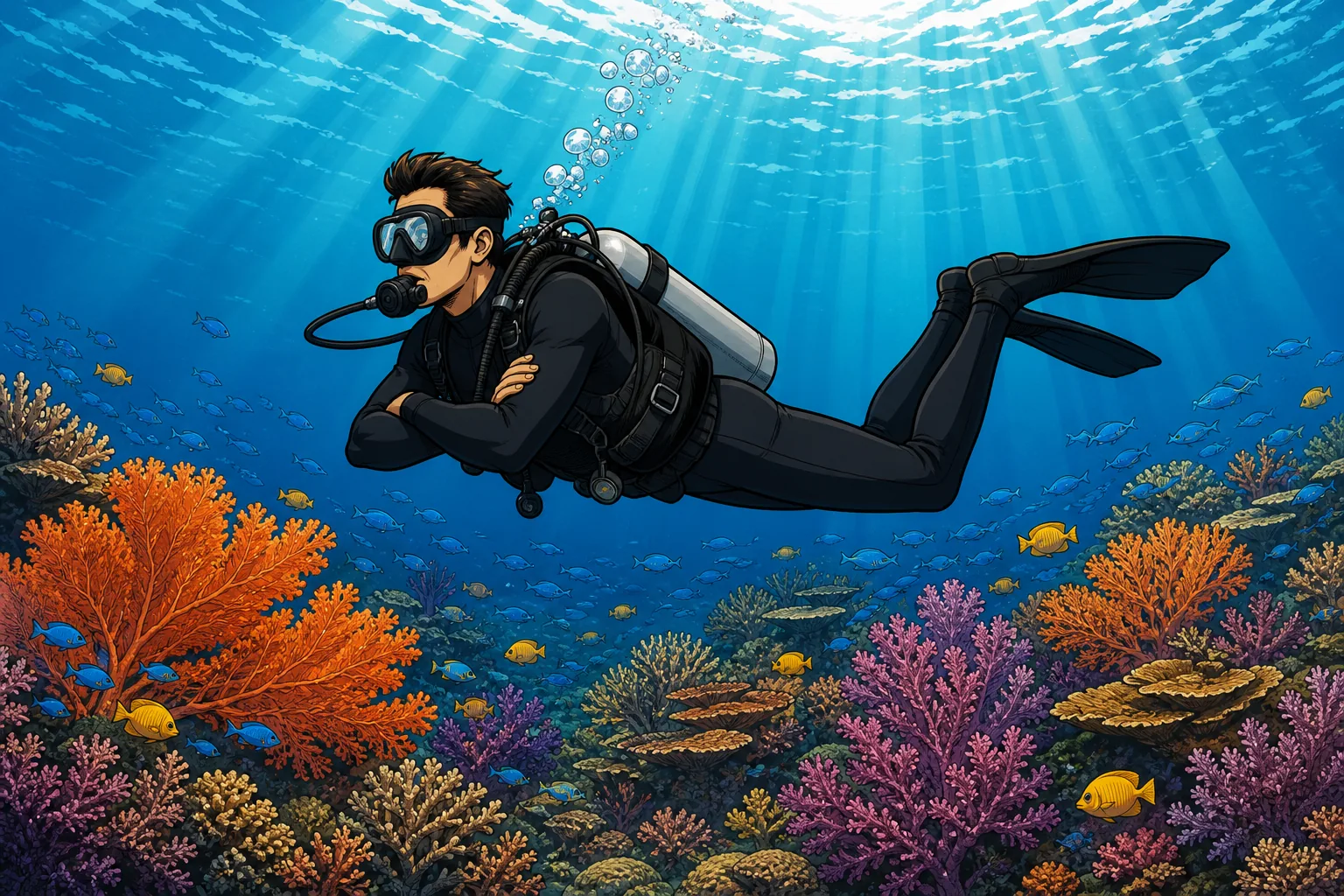
Neutral buoyancy means you neither rise nor sink. Put a diver in mid water, have them stop moving entirely, and if they stay at that depth they are neutral. That is the whole definition, and it sounds simple until you notice the catch: it is only true for one depth, one lung volume and one tank pressure at a time. The moment any of those change, and they change constantly through a dive, you are no longer neutral and you have to do something about it.
This is why buoyancy is a skill and not a setting. You do not achieve it once at the start of the dive and coast. You make small corrections continuously, most of them with your lungs, a few of them with your inflator, and after enough dives you stop noticing you are doing it. Divers who look effortless are not doing less work. They are doing much smaller amounts of work, much earlier, before the problem becomes visible.
The opposite of neutral is not just floating or sinking. It is the exhausting middle state where you are slightly heavy and fin gently upward the entire dive to compensate. That diver never notices they have a buoyancy problem because they never crash and never cork. They just come up with 40 bar while everyone else has 90, and conclude they have small lungs. They do not have small lungs. They have four kilos of lead they do not need.
You are almost certainly over-weighted
If we could fix one thing for every visiting diver it would be this. In our experience running refresher dives out of Sanur, something close to seven in ten divers who arrive with a stated weight requirement are carrying at least two kilograms more than they need, and a fair number are carrying four or five. They are not being careless. They were handed that number years ago in a colder sea, in a thicker suit, possibly in fresh water, and it has followed them around ever since like a bad nickname.
Over-weighting is uniquely destructive because it does not fail loudly. It fails quietly and in several directions at once. Being heavy means you have to add air to your BCD to get neutral, which puts a large compressible bubble on your back. That bubble expands and contracts dramatically with every metre of depth change, so your buoyancy becomes twitchy and you spend the dive chasing it with the inflator and the dump valve. The extra lead also pulls your hips down, which tips you feet-first, which means your fins now point at the reef instead of behind you. And a diver in that position who wants to stay off the bottom has to fin. Constantly. That is where the air goes.
The counter-argument we hear is that a bit of extra weight makes descending easier. It does, for about ninety seconds. Then you pay for it for the remaining fifty minutes. If you struggle to get down, the fix is a proper exhale and a vertical, patient descent, not more lead. We cover the descent itself in our guide to equalising your ears, because a controlled descent and a comfortable set of ears are the same problem viewed from two different angles.
How to run a weight check that tells you something

The standard check takes two minutes and most divers have either never done it or did it once during their course and never since. Do it in the water you are actually going to dive in, wearing everything you are actually going to wear, including the camera.
Get in, stay vertical, and empty your BCD completely. Hold a normal breath, not a huge one, and stop finning. You are correctly weighted if you float with the water line at eye level, roughly across the middle of your mask. Then breathe out fully. You should begin to sink, slowly and unmistakably. If you sink while holding a normal breath you are heavy. If you stay bobbing at chin level after a full exhale you are light.
There is an honest complication with this check that instructors sometimes skip. You will normally run it with a full cylinder, and a standard aluminium eighty gains roughly two kilograms of buoyancy as you breathe it down. So a diver who is perfect at the start of the dive will be two kilos light at the safety stop, which is exactly when being light is most annoying. There are two clean solutions. Either add about two kilograms to your full-tank result, or, better, repeat the check at the end of a dive when you are down to 50 bar and trust that number instead. The end-of-dive check is the one we use when we are genuinely trying to dial someone in.
As a rough starting point for Bali, where the water sits around 28 to 29 degrees at the surface and most people dive a 3 mm suit, here is where we usually begin with an adult of average build on an aluminium tank. Treat these as an opening bid, not a prescription. Body composition moves these numbers more than anything else, and a naturally buoyant diver in a 3 mm can legitimately need what a lean diver needs in a 5 mm.
| Exposure protection | Typical starting weight | Notes |
|---|---|---|
| Rash guard or swimsuit only | 1 to 2 kg | Common on warm shallow check dives |
| 3 mm shorty | 2 to 3 kg | Popular with guests who feel the cold little |
| 3 mm full suit | 3 to 5 kg | The Bali default for most of the year |
| 5 mm full suit | 5 to 7 kg | Worth it for cold upwellings and long macro dives |
| Steel tank instead of aluminium | Subtract 2 to 3 kg | Steel stays negative, so you carry less lead |
Write your final number in your logbook alongside the suit, the tank material and whether it was salt or fresh water. Those four things together are the only weight record that is worth anything. A number on its own is how people end up over-weighted for a decade.
Trim is the half of buoyancy nobody mentions
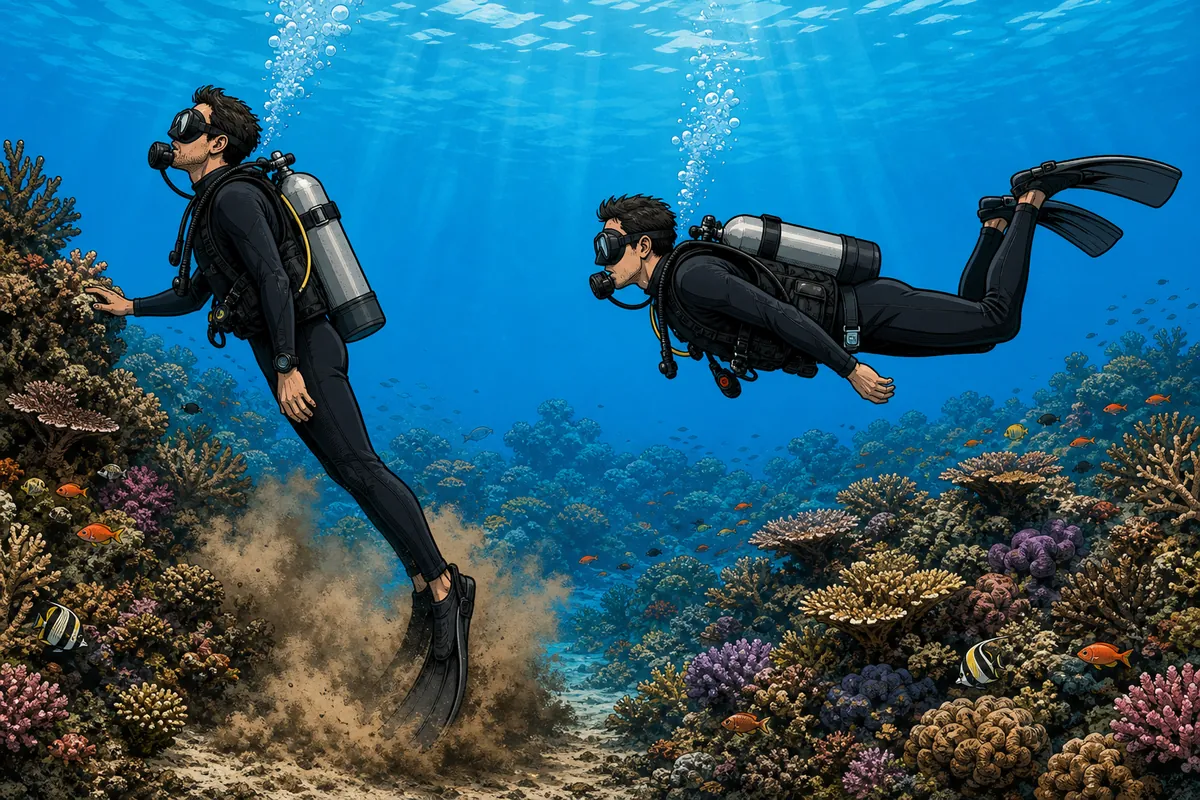
You can be perfectly weighted and still be a menace. Weighting decides whether you float or sink. Trim decides which way you are pointing while it happens, and pointing the wrong way undoes most of the benefit of being correctly weighted.
Good trim is roughly horizontal, flat from shoulders to fin tips, with your knees bent and your fins slightly raised behind you rather than hanging below. From that position your fins push water backwards, which moves you forwards, which is the point. From a feet-down position your fins push water downwards, which drives silt and broken coral into the water column and pushes you upward at the same time, so you dump air to compensate, and now you are heavy again the moment you stop kicking.
Most trim problems are weight distribution problems. If your legs sink, your weight is too far down and too far forward on the belt. Moving two kilos from your hip belt up into trim pockets on the tank band, or simply sliding the cylinder a few centimetres higher in the band, fixes more feet-down divers than any amount of coaching. If your legs float, which is less common and usually happens with thick neoprene boots or a drysuit, the weight goes the other way.
Fin choice and kick style matter here too. A frog kick keeps the downwash behind you instead of underneath you, and on the sandy macro sites where we spend a lot of time it is the difference between finding a critter and burying it. Our guide to macro and muck diving in Bali goes further into this, because on a black sand slope your fin technique is not an aesthetic question.
Your lungs are the fine control, the BCD is the coarse one
This is the idea that turns competent divers into good ones, and it is genuinely simple. Your BCD is for large, deliberate adjustments, mainly at the start of the descent and as you change depth significantly. Your lungs handle everything else.
A litre of air displaces about a kilogram of water. An adult can move four or five litres between a full inhale and a full exhale, which is four or five kilograms of buoyancy swing available to you without touching a single button. Normal relaxed breathing moves a smaller amount, perhaps half a litre either side of centre, and that is your steering. To rise over a coral head, inhale a little earlier than you feel you need to and let the breath carry you up and over. To settle down beside a cleaning station, exhale slowly and sink onto the spot. The delay is the thing people miss: your body responds a second or two after the breath, so you have to act early. Divers who react late end up oscillating, over-correcting up and then over-correcting down, all dive long.
One warning that matters. Using your lungs for control does not mean holding your breath or skip-breathing to save air. Skip-breathing builds up carbon dioxide, which gives you headaches and a creeping anxiety that most divers misread as being cold or tired, and holding your breath while your depth is changing is the one genuinely dangerous thing in recreational diving. Breathe continuously. Just breathe slowly, deeply and with intent. If you want the wider safety context, we set it out in our piece on whether scuba diving is dangerous.
Why your buoyancy changes during the dive
Three things shift under you during a normal dive, and knowing which one is acting on you at any moment removes most of the mystery.
Your wetsuit compresses
Neoprene floats because it is full of gas bubbles, and those bubbles shrink under pressure. Most of the loss happens in the first ten to fifteen metres, which is why the top of the water column feels twitchy and the deeper part of the dive feels stable. A 5 mm suit that gives you five kilos of lift at the surface may be giving you barely half of that at thirty metres. This is the main reason a diver who is comfortable at eighteen metres suddenly feels heavy on a deeper profile, and it is one of the things the Deep Diver specialty deals with directly.
Your tank gets lighter
You breathe roughly two kilograms of gas out of a full aluminium eighty over a dive, and that mass leaves your back. This is a slow, one-way drift toward being more buoyant, and it is why the safety stop is where weighting errors show up. If you can hold five metres comfortably at the end of a dive with 50 bar, your weighting is genuinely right.
Salt water holds you up more than fresh
Salt water is denser, so you need roughly two to three kilograms more lead than you would in a lake or pool, depending on your total mass. Anyone who learned in a quarry and then arrives in Bali is going to be light on their first dive, and anyone who trained here and goes home to a freshwater lake will be heavy. It is the single most common reason a familiar weight number stops working.
Five buoyancy problems and what actually causes them
These are the complaints we hear at the dive centre, more or less word for word, along with what is usually behind them.
I drop like a stone at the start of the dive
Over-weighting, nearly always. A correctly weighted diver has to work slightly to begin a descent: a full exhale, a still body, and a few seconds of patience before gravity takes over. If you sink the instant you dump your BCD, you are heavy. The secondary cause is descending head-down, which puts your BCD's dump valves above the air inside it and makes the bubble impossible to manage. Go down feet-first and upright until you are on the reef.
I cannot stay down at the safety stop
Usually the opposite reading of the same instrument: you were weighted for a full tank and you are now two kilos lighter. It can also be residual air trapped in a wing or in the shoulder of a BCD that has not been fully vented. Roll slightly to one side and lift the shoulder dump. If it happens on every single dive regardless, add a kilo and check again at the end of the next one.
I use far more air than my buddy
Air consumption is the honest scoreboard for buoyancy. Poor buoyancy means constant finning, and finning is by far the most expensive thing you can do with a tank of gas. Before you conclude you are simply a heavy breather, take four kilos off, sort your trim out and dive the same site again. We have watched people gain fifteen minutes of bottom time in a single afternoon this way. There are real physiological reasons some divers use more gas, size and sex among them, but they are much smaller than the buoyancy effect and you should rule out the big one first. Worth clearing up a related confusion too: diving on nitrox extends your no-decompression limits, it does not make a tank last longer, so it solves a different problem entirely.
I keep bumping into the reef
Trim, distance and speed, in that order. Feet-down divers contact the reef with their fins without ever knowing it. Then there is proximity: most divers work far closer to the coral than they need to, because being close feels like better viewing. It is not. Hold a metre off and you can see more, you have room to correct a mistake, and you stop being the reason a coral head snaps. In current this becomes a safety matter rather than an etiquette one, which is why we set expectations before drift dives in Bali rather than during them, and why the Drift Diver specialty spends as much time on position as it does on navigation.
I am finning the whole dive just to stay level
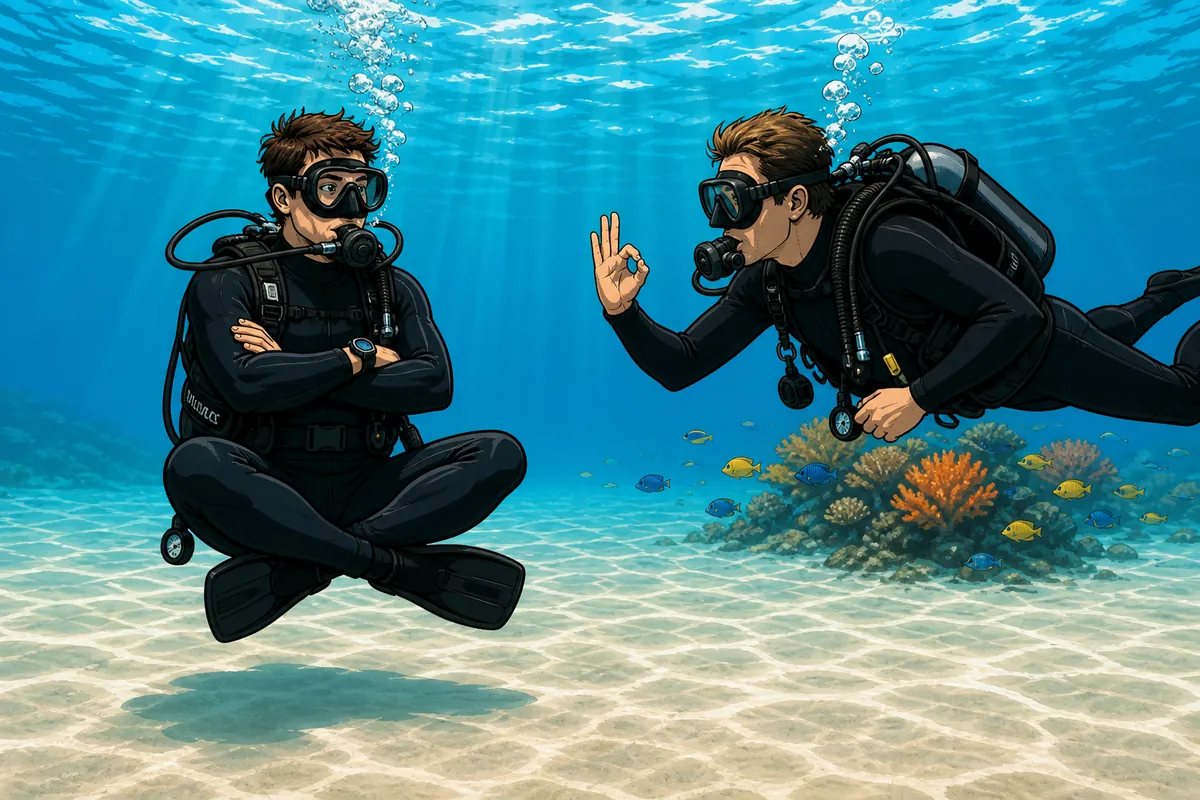
You are slightly heavy and compensating with your fins, which is the quiet failure mode described earlier. Try this: stop kicking completely, fold your arms, and count to ten. Whatever happens in those ten seconds is your real buoyancy. Most people are startled by how fast they sink. This is also the single best self-test you can run on any dive, and it costs nothing.
Where to practise buoyancy in Bali
Bali is unusually good for this because the range of conditions is so wide, and you can pick a site that matches exactly what you are trying to fix.
For the basics, the shallow sand off our own stretch of Sanur is hard to beat. Shore entry, flat bottom at five to eight metres, nothing fragile to damage and no boat schedule pressing on you. This is where we do weight checks and hovering drills, and it is deliberately boring, which is the point.
Tulamben is the next step, and the Liberty wreck is a genuinely excellent buoyancy classroom. The structure gives you three dimensional reference points, there is usually little or no current, and the temptation to swim through gaps gives you an immediate and honest read on your control. Amed nearby has gentle coral gardens in shallow water that reward slow, careful diving.
Wall diving is the real examination. At Menjangan the reef drops away beneath you and there is no bottom to give your eyes a reference, so depth creep goes unnoticed unless your control is genuinely internal. Divers who think their buoyancy is fine often discover otherwise on a wall, and it is worth choosing your dive site to match the skill you are working on rather than the photograph you want.
Then there is Nusa Penida, which does not teach buoyancy so much as audit it. Moving water finds every weakness in your position and weighting within about ninety seconds. We are honest with guests about this: if your control is rusty we will suggest a warm-up day before a Penida trip, not because we want to sell an extra dive but because the alternative is a stressful hour and a photograph of nothing. Padang Bai sits usefully in between, with sheltered shallow bays for practice and more demanding sites offshore when you are ready.
Is the Peak Performance Buoyancy course worth a day?
We will give you the unglamorous answer. The PADI Peak Performance Buoyancy specialty is one day and two dives with an instructor whose only job is to watch your body. There is no secret technique revealed on it. What you get is a proper weight check done by someone who does them daily, your lead redistributed until you sit flat, and two dives of immediate correction while the habit is forming. For most divers the weight check alone changes the number they have been using for years.
It is worth a day if you are planning current diving, if you have taken up underwater photography, if you are heading toward Rescue Diver or professional training, or if you have simply always suspected you are working too hard down there. It is worth less if you are newly certified and about to do twenty dives this trip anyway, because twenty attentive dives will get you a long way on their own. In that case put the day into the Advanced Open Water course instead, which includes a buoyancy dive within a broader syllabus. Our Advanced course guide sets out what those five dives involve.
If you have been out of the water for a couple of years, buoyancy is the skill that decays first and fastest, ahead of mask clearing and regulator recovery which come back in minutes. A refresher with a deliberate buoyancy focus is usually the better use of the day than the specialty, and we will tell you that at the counter rather than sell you the more expensive option.
What good buoyancy actually buys you
More bottom time, first of all, and not marginally. Trimmed, correctly weighted divers routinely get ten to twenty minutes more out of the same cylinder than they did before, which on a two dive day is most of a third dive's worth of underwater time for free.
Then there is what you get to see. Almost everything interesting in Bali requires you to stop moving and wait. A mantis shrimp will come back out of its burrow if the large clumsy thing above it holds still for two minutes. Cleaning stations only work if you are not hovering over them like weather. This is the entire foundation of underwater photography, and it is why we tell people that their buoyancy is a bigger upgrade than their next lens.
There is a conservation argument too, and in Bali it is not abstract. Reefs here carry heavy visitor traffic and the damage is cumulative: a fin tip here, a steadying hand there, a dangling gauge dragged across a plate coral. Divers who can hold position do not do those things. Buoyancy is the most practical form of reef protection an individual diver has, and it happens to be the same skill that makes the dive better for you.
The last thing is the one that is hardest to describe and the one experienced divers recognise instantly. When you are not thinking about your depth, your position or your air, you have attention left over for the actual dive. Every diver we know who describes diving as meditative is describing what it feels like once buoyancy has stopped being a task. You are welcome to come and work on it with us at the dive centre in Sanur, or to work on it yourself with the checks above, which cost nothing and will still get you most of the way. If you are planning a longer trip, our diving packages give you enough consecutive days for it to stick.