

This question lands in our inbox most weeks, usually from someone who has just booked flights and is now reading a travel forum at midnight. Do I need malaria tablets for Bali? The short answer is no, and you can stop worrying about that specific thing right now. The longer answer is worth five minutes of your time, because there are two or three genuine health considerations for Bali that almost nobody asks us about, and at least one of them can affect whether you are allowed in the water at all. We run daily dive trips out of Sanur, so we see the practical version of this play out constantly.
A necessary disclaimer up front, and we mean it rather than just saying it. We are a dive centre, not a medical practice. Nothing below is a prescription, and every decision about tablets and vaccines belongs to you and a travel clinic who can see your medical history. What we can offer is the operator's view from our shop in Sanur: what the official sources currently say, what we actually see happen to guests, and the specific overlap between travel medicine and diving that general health websites never cover. Everything here reflects guidance as of July 2026, and this stuff does change, so check the dated sources we link before you fly.
Is There Malaria in Bali? The Short Answer
No. The CDC's Indonesia destination page states plainly that there is no malaria transmission in the resort areas of Bali, none in Ubud, and none in the Gili Islands. Bali is not a malaria destination, and no reputable travel clinic will put you on prophylaxis for a standard Bali holiday. The mosquitoes here are a nuisance and they do carry other things, which we will get to, but the Anopheles cycle that sustains malaria is not running on this island.
Where the confusion comes from is that Indonesia as a whole is a malaria country, and country-level advice is blunt. Search for Indonesia and you will find plenty of pages telling you to take tablets, because parts of Indonesia genuinely warrant them. Bali is not one of those parts. The distinction matters because antimalarial drugs have side effects, cost money, and in one specific case can interact badly with diving, so taking them unnecessarily is not a harmless bit of extra caution.
The one Bali-adjacent trip worth asking about
Divers often tack on a side trip to Lombok. Worth knowing that the CDC treats the Gili Islands as no-transmission but flags rural areas of West Nusa Tenggara, which includes Lombok, differently. If your plan is Gili Trawangan and a beach, that is not the same as a week trekking inland. This is exactly the kind of itinerary detail a travel clinic wants to hear, and it takes them ten seconds to answer once they know the specifics. If you are still designing the trip, our one-week Bali dive itinerary and the guide to where to stay in Bali for diving will help you pin the route down first.
Antimalarials and Diving: The Bit Nobody Tells You
Say you are combining Bali with somewhere that does need prophylaxis, or your doctor has recommended tablets for reasons of their own. Now the choice of drug stops being purely medical and starts being a diving question too, and this is the part general travel-health sites skip entirely.
The headline issue is mefloquine, sold as Lariam. Divers Alert Network warns that its side effects, dizziness, disorientation and other neurological symptoms, can mimic the symptoms of decompression illness. Think about what that means on a boat. Somebody surfaces from a dive at Tulamben feeling dizzy and confused, and now nobody, including the guide, can tell whether they are looking at a drug reaction or a bend. DAN notes that some countries prohibit diving while taking it. We would rather not be running that guessing game on our boat, and we will ask you about it if you mention you are on antimalarials.
A published review of antimalarial safety for divers reached a practical conclusion: atovaquone-proguanil, sold as Malarone, is the preferred regimen for people who are diving, mainly because its side effect profile is mild and unlikely to be confused with anything hyperbaric. Doxycycline came second, with one significant caveat for the tropics. Chloroquine did not fare well in that review. Mefloquine ranked last for divers, which matches DAN's caution.
Doxycycline and the Bali sun
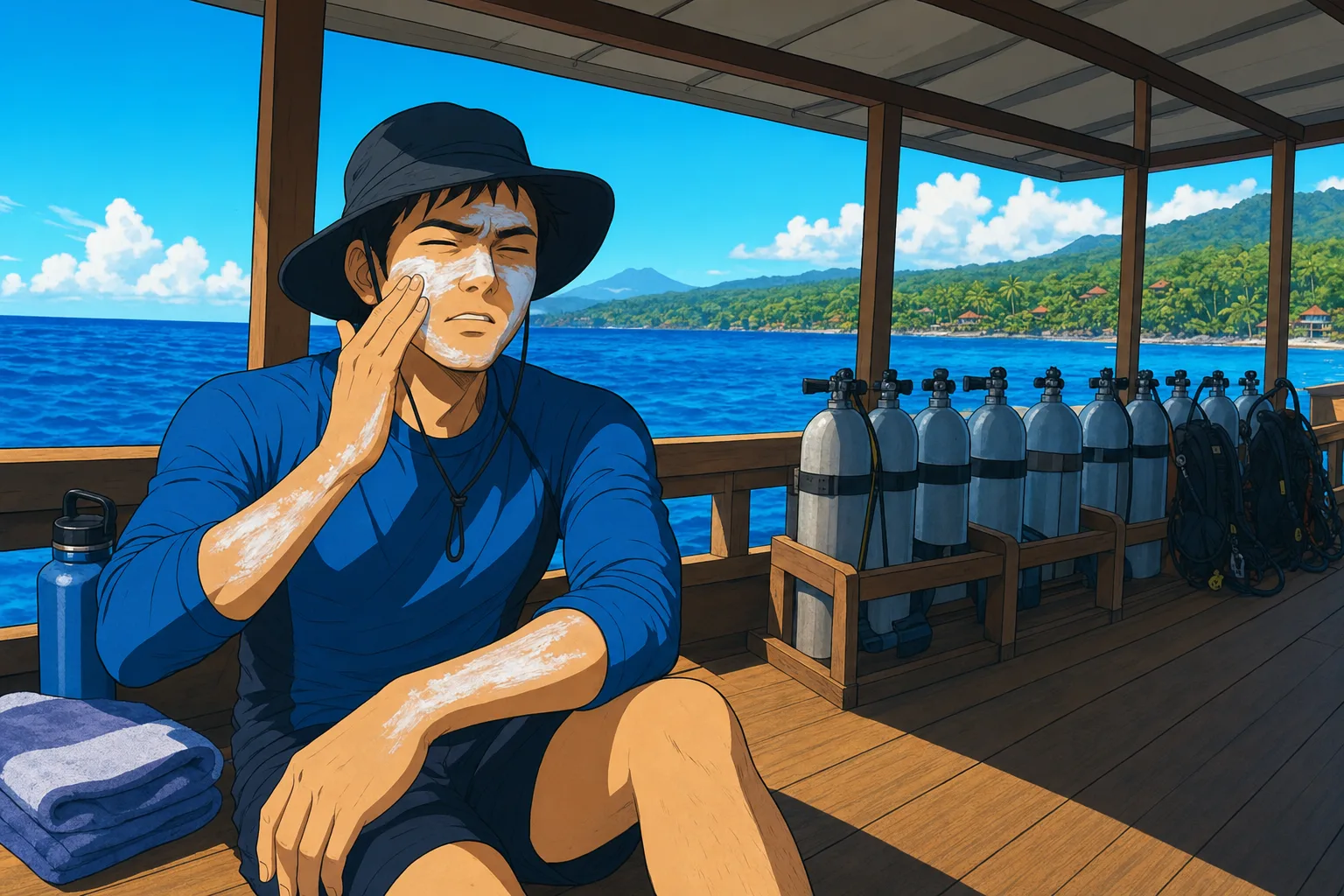
The doxycycline caveat is photosensitivity. The drug makes skin markedly more reactive to UVA, and a Bali dive boat is about the least forgiving environment for that. You are on open water at eight degrees south, the deck reflects, the sea reflects, and you are out there for six hours. We have watched divers on doxycycline burn through sunscreen they thought was plenty. If you end up on it, treat sun protection as equipment rather than an afterthought: a long-sleeved rash guard, a hat for the surface intervals, high-SPF broad-spectrum sunscreen reapplied after every dive, and the shaded end of the boat. Our Bali scuba diving packing list has the full kit rundown.
None of this is a reason to refuse medication your doctor thinks you need. It is a reason to tell your doctor that you will be scuba diving, in the tropics, most days of the trip. That single sentence often changes which prescription you walk out with, and it costs you nothing to say it.
Vaccinations for Bali: What Travel Clinics Usually Recommend
Nothing is legally required for entry from most countries. The exception is the yellow fever certificate, which Indonesia asks for only if you are arriving from a country with yellow fever transmission, which for most of our guests means not applicable. That is an entry rule rather than health advice, and it sits alongside the visa paperwork we cover in the Bali e-visa guide for divers.
Recommended is a different list from required. Travel clinics typically start with your routine vaccinations being up to date, and measles deserves a specific mention because cases have been climbing in many countries and Indonesia has seen its share. Beyond routine, hepatitis A and typhoid are the two most commonly advised for Indonesia, both being food and water transmitted, which is a sensible precaution anywhere you plan to eat at warungs, and you absolutely should eat at warungs. Hepatitis B, rabies and Japanese encephalitis come up depending on how long you are staying and what you are doing.
The situational ones
Japanese encephalitis is a rural, rice-paddy, rainy-season risk rather than a beach-and-boat risk, so it tends to be raised for long stays or serious inland travel. Rabies gets its own section below because Bali is a genuine exception to the usual travel-vaccine calculus. The general shape of the advice is that a two-week diving holiday based in Sanur sits at the low end of the risk spectrum, while three months of scootering around the north coast does not. Timing matters too: some of these need multiple doses over several weeks, so a travel clinic appointment six to eight weeks before you fly is far more useful than one made the week of departure.
Rabies in Bali: The Risk Actually Worth Preparing For

Here is the swap we would like every visitor to make: worry less about malaria, which is not here, and learn the rabies protocol, which takes two minutes and could genuinely save your life. Rabies has been endemic in Bali since the outbreak that began in 2008, and despite large-scale dog vaccination campaigns it has not been eliminated. Bali consistently records some of the highest case numbers in Indonesia. Provincial figures reported in June 2026 counted more than 29,300 animal bite cases in the first five months of the year, which averages roughly 200 a day, and Bali's dog population was put at over 565,000 in 2025.
Read those numbers correctly, though. The overwhelming majority of those bites involve animals that are not rabid, and your personal chance of being bitten by an infected animal during a two-week holiday is very low. The reason it still matters is the asymmetry. Rabies is essentially always fatal once symptoms appear, and it is essentially always preventable if you get post-exposure treatment promptly. Low probability, catastrophic consequence, cheap insurance. That is a risk profile worth respecting.
What to do if you are bitten or scratched
Dogs cause most cases, but monkeys, cats and bats are all documented carriers, and the monkeys at the temple sites are bold, habituated and entirely willing to go through your bag. If any animal bites or scratches you, wash the wound with soap under running water for a full 15 minutes, which is far longer than feels natural, then apply antiseptic. Then get to a hospital that stocks rabies treatment. In south Bali that means BIMC or SOS Medika, and you go the same day rather than waiting to see whether anything develops, because waiting is precisely the mistake that kills people.
Pre-exposure vaccination does not make you immune. What it does is simplify the treatment enormously if something happens, shortening the follow-up series and removing the need for rabies immunoglobulin, which is expensive and can be hard to source at short notice. That trade-off is usually judged worthwhile for longer stays, rural travel, anyone scootering around remote areas, and children, who are both more likely to approach animals and less likely to report a small scratch. Families should read our family diving guide alongside this, and our broader piece on whether Bali is safe covers the non-medical side of the same question.
Dengue: The Mosquito Risk That Is Actually Here
If you are going to spend energy on mosquitoes in Bali, spend it here. Dengue is present year round and rises during and after the rainy season, roughly November through April, the period we cover in the rainy season diving guide. There is no prophylactic tablet, and the vaccines that exist are not part of standard travel advice for short-stay tourists. Prevention is repellent and clothing, full stop.
The critical detail most people get wrong is timing. Aedes mosquitoes, the dengue carriers, bite during the day, with peaks around dawn and late afternoon. Everyone applies repellent at sunset because that is the malaria habit, which is exactly backwards for Bali. Use a DEET-based repellent in the daytime, particularly in the late afternoon when you are back from diving, showered, and sitting outside with a drink. That is the moment we see guests get bitten. Air-conditioned rooms with the doors shut help, and our shop keeps repellent behind the counter because so many people forget to buy any.
Dengue symptoms are hard to miss: sudden high fever, a severe headache often felt behind the eyes, joint and muscle pain that has earned it the nickname breakbone fever, and sometimes a rash a few days in. If that describes you, see a doctor rather than self-medicating, and mention that you are in a dengue area, because the standard advice is to avoid aspirin and ibuprofen. And to state the obvious that people still ask us: no, you cannot dive with dengue, and you should not be planning to.
Bali Belly, Dehydration and Why It Affects Your Diving

The single most likely thing to interfere with your Bali diving is not exotic at all. Traveller's diarrhoea, universally called Bali belly, affects a decent share of visitors, and it is the reason guests miss dives at our shop more than everything else on this page combined. Sensible precautions are the familiar ones: bottled or filtered water, no ice from questionable sources although ice at established restaurants is generally produced commercially and fine, fruit you peel yourself, and busy warungs over empty ones because turnover means fresh food.
Pack oral rehydration salts. Not sports drinks, actual ORS sachets, which cost almost nothing and are sold in every Indomaret on the island. This matters more for divers than for other tourists, because dehydration is a recognised contributing factor for decompression sickness, and a day of fluid loss followed by three dives in warm water is a genuinely poor combination. Loperamide has its place for a long travel day, but it manages the symptom rather than the problem.
Our rule on the boat
We will not take you diving with active vomiting or diarrhoea. This is not us being precious. Being sick underwater is dangerous, dehydration raises your decompression risk, and a moving boat makes everything worse. It happens a handful of times each season that a guest arrives at 7:30 AM insisting they are fine, and our guides have become quite good at spotting the grey face behind the sunglasses. You get the dive rescheduled where we can, not lost, and we would rather have that conversation than the other one. Guests who are new to all this often find our article for first-time divers in Bali a useful primer on how a dive day actually runs.
There is more to say about this than fits here, so we wrote it all down separately: our full guide to Bali belly covers what actually causes it, which precautions are worth bothering with, what to buy at the apotek, what a doctor costs here, and how long to wait before you get back in the water.
Fit to Dive: Colds, Fevers and the Medical Form
Every diver signs a medical questionnaire before getting in the water, whether you are doing a try dive, starting the Open Water course or just joining a fun dive as a certified diver. Answer it honestly. A yes to certain questions means a doctor's sign-off, which sounds like a hassle but is a five-minute conversation at a Sanur clinic in most cases, and infinitely preferable to discovering a problem at 20 metres. If you have a condition you are unsure about, message us before you travel rather than on the morning of the dive, because a doctor's letter obtained at home is much easier than one arranged in a hurry here.
The everyday version of this is congestion. A head cold, blocked sinuses or the tail end of a chest infection means you cannot equalise properly, and forcing it risks ear and sinus barotrauma, which is painful, occasionally lasting, and will ruin the rest of your trip far more thoroughly than missing one dive. Decongestants are a grey area we prefer to avoid, because if one wears off at depth the reverse block on ascent is a genuinely nasty experience. A fever is a flat no, regardless of cause.
The conditions guests ask us about most
Four come up repeatedly, and our answer is the same shape each time: the medical form will flag it, a doctor decides, and getting that sorted before you fly saves your holiday. Asthma is the most common. Well-controlled asthma does not automatically rule out diving in most modern guidance, but it does need a physician's assessment, and the answer depends on your triggers and how recently you have needed a reliever. Diabetes has a similar picture, with established protocols for divers whose control is stable. Heart conditions and blood pressure medication need individual review, and some medications matter more for the side effects than the condition itself.
Pregnancy is the one clear-cut answer on the list: standard guidance across every training agency is not to dive while pregnant, because the effects of hyperbaric exposure on a foetus are not established and nobody is willing to run that experiment. Guests sometimes hope we will give a different answer, and we will not. Snorkelling and the boat ride are still on the table, which is why a decent number of our Penida trips carry someone who is diving and someone who is very happily not.
None of this is unique to Bali, but the holiday context makes people push through in a way they never would at home, because the trip is short and the boat is leaving. Our overview of whether scuba diving is dangerous makes the same point in a wider context, and the honest summary is that most incidents involve someone who knew, at some level, that they should have sat it out. Worth adding that alcohol belongs in this conversation too, as we discuss in the piece on diving and alcohol.
Insurance, Clinics and the Recompression Chamber
Get travel insurance that explicitly covers recreational scuba diving to the depth you will actually dive, because plenty of standard policies either exclude it or cap it at depths shallower than the sites at Nusa Penida. Many divers add specific dive cover through DAN or a similar provider. Check that medical evacuation is included, since that is the expensive part in a genuine emergency and the reason insurance exists at all.
For everyday medical care, south Bali is well served. BIMC and SOS Medika are the international-standard options that most travellers use, both with English-speaking staff, and there are competent local clinics everywhere for minor things. For diving emergencies specifically, the recompression chamber divers here rely on is at the main hospital in Denpasar, roughly twenty minutes from our shop, which is one quiet advantage of diving from Sanur rather than somewhere more remote. Our staff know the route and the phone numbers, and every one of our guides holds Emergency First Response training, with the senior team certified to Rescue Diver level and above.
If reading all this has made you want the skills rather than just the phone numbers, the Rescue Diver course is the one that teaches emergency oxygen, incident management and how to recognise a problem early. It is the most useful three days most divers ever spend, and it makes the medical side of diving considerably less abstract. The Advanced Open Water course is the more common next step if you are earlier in your training.
What We Actually Tell Guests Before They Fly
Compressed into the version we give at the counter. Skip the malaria tablets for Bali, they are not needed here. Book a travel clinic appointment six to eight weeks out and let them decide on hepatitis A, typhoid and anything situational, mentioning that you will be diving daily. Learn the rabies protocol and keep your distance from the monkeys, however photogenic. Use daytime repellent for dengue rather than evening repellent out of habit. Pack ORS sachets and treat sun protection seriously, especially if you are on doxycycline. Do not dive with a fever, congestion or an unhappy stomach, and tell your guide the truth when they ask.
That is genuinely the whole list. Bali is a straightforward destination healthwise, and the boring precautions carry almost all of the benefit. The dives themselves, whether that is the wreck at Tulamben, the walls at Menjangan, the reefs at Padang Bai and Amed or a manta morning at Penida, will occupy your attention far more than any of this. If you have a specific medical question about your own trip, message us and we will tell you what we know, refer you to the right people for the rest, and never pretend to be doctors. Trip details and current rates are on the price list, and snorkelling options are there for anyone in the group sitting out the diving.