
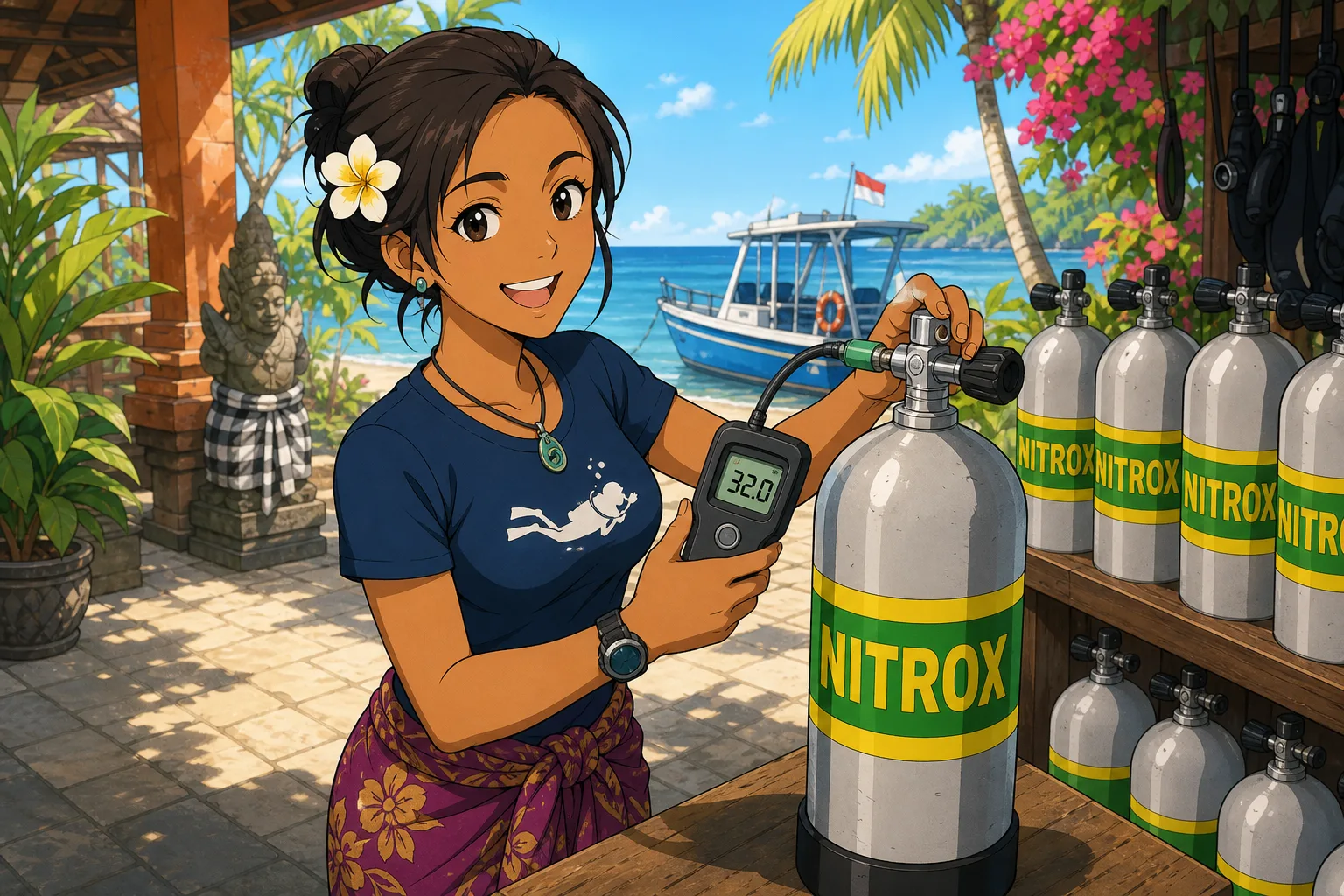
Somebody asks us about nitrox almost every day at our Sanur shop. Usually it goes like this: they saw the green-and-yellow tanks on our fill station, they heard another diver mention it at breakfast, and now they want to know if nitrox diving in Bali is worth the extra money. Our answer is annoyingly honest: sometimes yes, absolutely, and sometimes we will tell you to keep your rupiah. It depends entirely on where you are diving and how many dives you are doing. This guide covers both sides, with the actual numbers from our trips, plus what the one-day PADI Enriched Air Diver course looks like if you decide to get certified while you are here.
Quick context for anyone new to the term. Nitrox, also called enriched air or EANx, is simply breathing gas with more oxygen and less nitrogen than normal air. Normal air is about 21 percent oxygen. The nitrox we blend most often is 32 percent, written EAN32. Less nitrogen going into your body means more time before your no-decompression limit runs out, and on the deeper sites around Nusa Penida that difference is not small. On some profiles it is the difference between a 25-minute dive and a 40-minute dive. That is the entire sales pitch. Everything else in this article is detail, caveats, and the occasions when the pitch does not apply to you.
What Nitrox Actually Does (and What It Doesn't)
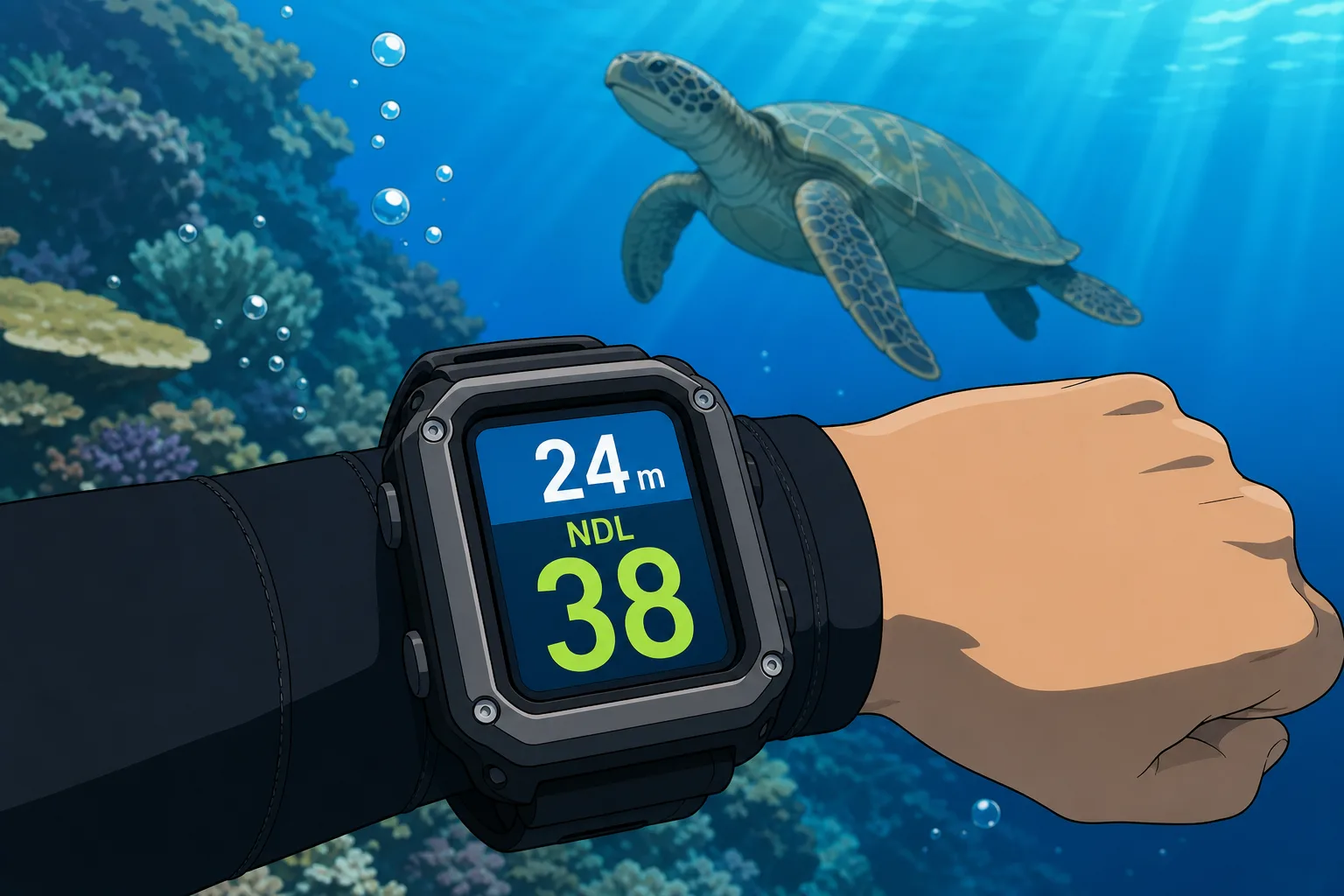
Your body absorbs nitrogen under pressure. The deeper you go and the longer you stay, the more nitrogen dissolves into your tissues, and your dive computer tracks this as your no-decompression limit, the NDL. When the NDL hits zero you can no longer ascend directly to the surface without mandatory stops. Recreational diving lives inside that limit. Nitrox attacks the problem at the source: with 32 percent oxygen in the tank there is simply less nitrogen in every breath, so the clock runs slower.
Here is what that looks like in practice. At 18 metres on air, a typical computer gives you somewhere around 50 to 60 minutes of no-deco time. On EAN32 at the same depth you get around 90 minutes or more, which usually means your tank empties before your NDL does. At 24 metres the gap tightens but matters more: roughly 30 minutes on air against roughly 45 on EAN32. At 30 metres you are looking at about 20 minutes on air versus about 30 on nitrox. Those are table-style approximations, your computer will calculate live numbers, but the pattern holds everywhere: the deeper the dive, the more minutes nitrox buys you back, right up until depth itself becomes the limit.
Just as important is what nitrox does not do. It does not reduce your gas consumption. A 12-litre tank holds the same number of breaths whether it is filled with air or EAN32, so if you empty a tank in 40 minutes, nitrox will not stretch that. It also does not make you immune to decompression sickness, and it is not a magic energy drink, although plenty of divers swear they feel fresher after a nitrox day. The research on that is genuinely mixed. We tell guests it is a maybe, not a promise.
The one myth we correct every week
Nitrox does not let you go deeper. It is the opposite. Because oxygen becomes toxic under enough pressure, every nitrox mix has a maximum operating depth that is shallower than what air allows. For EAN32 that ceiling is about 33 metres. If your dream is depth, that path runs through the PADI Deep Diver specialty and proper training, not through a richer mix. We wrote a whole piece on how deep you can actually scuba dive if you want the full picture. Nitrox is about time, not depth. Once that clicks, everything else about it makes sense.
Nitrox Diving in Bali: Real Numbers From Our Trips
Theory is nice. Here is where nitrox diving in Bali actually pays off, site by site, based on the profiles our guides swim week in and week out. Bali is unusual in that our most famous sites sit at very different depths, so the value of nitrox swings hard depending on which dive trip you book.
Nusa Penida: where nitrox earns its keep
The dive sites around Nusa Penida are the strongest case for nitrox on this island. The reef slopes at SD, Ped and Toyapakeh are healthiest between 18 and 30 metres, the water is cool, the current does the flying for you, and on air your computer is very often the thing that ends the dive, not your tank. A typical second dive of the day on air at 24 metres can leave you with single-digit no-deco minutes frustratingly early. On EAN32 the same profile keeps you comfortably in the zone while the reef scrolls past. If you have read our guide to drift diving in Bali you already know these dives reward relaxed, unhurried divers. Nitrox buys exactly that.
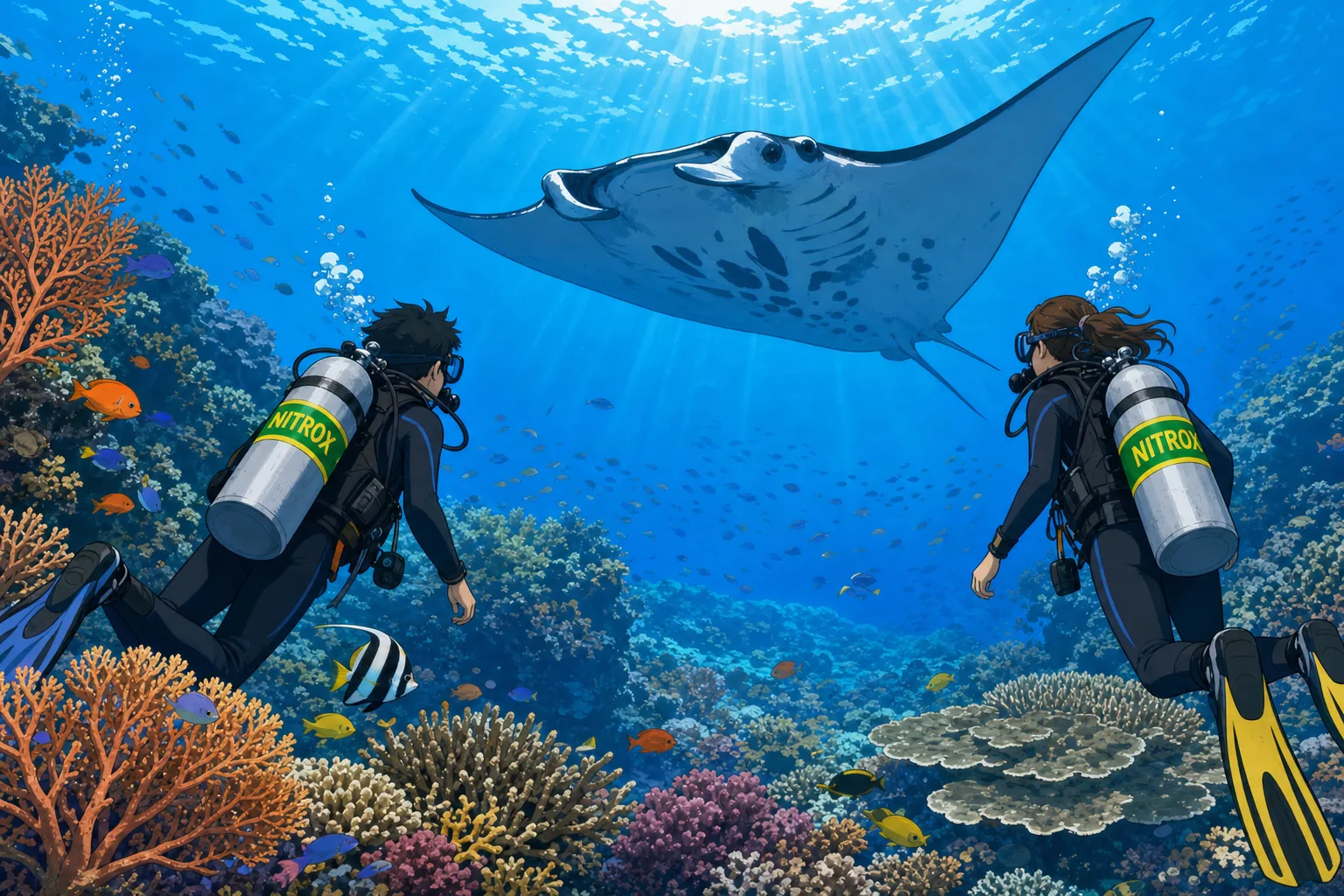
One honest exception on the Penida menu: Manta Point sits at 10 to 16 metres, and at those depths air already gives you an hour or more of no-deco time. Nitrox adds nothing you can use there. Since almost every Penida day combines Manta Point with one or two deeper reef dives, we usually suggest nitrox for the whole day anyway, because the deeper dives are where the day is won or lost. Manta encounters happen on roughly 9 out of 10 trips in season, and if you want the background, our article on diving with manta rays at Nusa Penida covers it properly.
Tulamben and the Liberty wreck
The USAT Liberty wreck at Tulamben lies between 5 and 28 metres, which makes it a genuinely interesting nitrox case. You can dive the shallow stern on air all day. But the most atmospheric parts of the wreck, the cargo holds and the deeper bow section, sit in the 20 to 28 metre band, and divers on air routinely have to leave that zone just as it gets good. On EAN32 you can linger. Wreck fans doing two or three dives on the Liberty in one day, which is a very normal Tulamben itinerary, feel the difference by dive two. Our full guide to the USAT Liberty wreck has the history and the layout, and if wrecks are your thing, the PADI Wreck Diver specialty pairs beautifully with a nitrox certification.
Padang Bai, Amed and Menjangan
Padang Bai is a mixed bag. The bay sites like Blue Lagoon are shallow and relaxed, no nitrox needed. But Gili Tepekong and Gili Mimpang, the offshore rocks we dive on the Tepekong and Mimpang trips, drop quickly past 20 metres and the best action, including sharks and the occasional mola, happens deep. Nitrox is a strong yes there. Amed sits in the middle: the Japanese wreck is shallow, the drop-off rewards depth. And the walls at Menjangan Island in the northwest are classic multilevel profiles where enriched air quietly adds ten relaxed minutes at the pretty part of the wall. Our guides on those trips dive nitrox by default. That should tell you something.
When Nitrox Is Worth the Money
Four situations, in descending order of certainty. First: three-dive days at deeper sites. If you booked a Penida day or a Tepekong day with a third dive added, nitrox is close to a no-brainer. By the third dive on air your residual nitrogen has stacked up and your computer gets stingy. Nitrox keeps dive three from becoming a 25-minute apology. Second: consecutive diving days. Diving four or five days straight is completely normal on a Bali holiday, and enriched air lowers the nitrogen load you carry from day to day. Plenty of guests tell us they feel less wrecked at dinner. As we said, the science shrugs, but the logic of less nitrogen is sound.
Third: liveaboards. On a boat like the King Neptune you might log 18 to 24 dives in a week, and on that schedule nitrox stops being a luxury and becomes the sensible default. Most experienced liveaboard guests would not board without the certification. Fourth: photographers and slow movers. If your dive style is hovering over one coral head waiting for a shrimp to pose, your bottom time at depth is your most precious resource, and nitrox is the cheapest way to buy more of it.
There is also the safety-margin argument, and we think it is legitimate. Dive nitrox while keeping your computer on air settings, or simply stay well inside your nitrox NDL, and you have built yourself a real buffer against decompression stress. Divers over 50, divers who are tired or dehydrated, and anyone who has had a close call before tends to appreciate that cushion. It is also worth remembering the numbers stack with everything else in your dive planning, including the no-fly window after diving, which nitrox does not shorten, so plan your last dive day accordingly.
A real example from last month, because abstract percentages only go so far. A couple from Munich did three days with us: two days at Penida, one at Tulamben, three dives a day, all on EAN32. On their second Penida day, dive two at Ped, their computers still showed over 20 minutes of no-deco time when the group on air turned shallow with 6. Nine dives across three days and not once did a computer end their dive early. They paid the nitrox surcharge nine times and got, by their own count, over an hour of extra bottom time for it. That is the trade in its plainest form: money for minutes, at the depths where Bali keeps its best material.
When We'll Tell You to Save Your Money
Now the other half, because this is the part most dive shops skip. If your whole plan is shallow reef dives above 16 metres, nitrox gives you almost nothing. Air already offers more no-deco time than your tank can deliver at those depths. A relaxed morning of easy bay diving at Padang Bai? Keep the money, buy a good lunch. Same story if you are doing a single dive. One dive leaves no residual nitrogen problem for nitrox to solve, so unless that one dive is deep, the benefit is thin.
The big one: if you empty your tank fast, fix that first. A diver who burns through 200 bar in 35 minutes at 20 metres is limited by gas, not nitrogen, and nitrox does not add a single breath to the tank. In that case the money is far better spent on a PADI Advanced Open Water course or a peak performance buoyancy session, because better trim and breathing habits will add more minutes to your dives than any gas mix ever will. We refuse to sell nitrox as a badge. It is a tool, and roughly a third of the divers who ask us about it are better served by something else. Our breakdown of what scuba diving in Bali costs can help you decide where your budget works hardest.
And no, you cannot use nitrox on a try dive or during your entry-level course. Enriched air requires its own certification, which brings us to the fun part.
The PADI Enriched Air Course in Sanur: One Honest Day
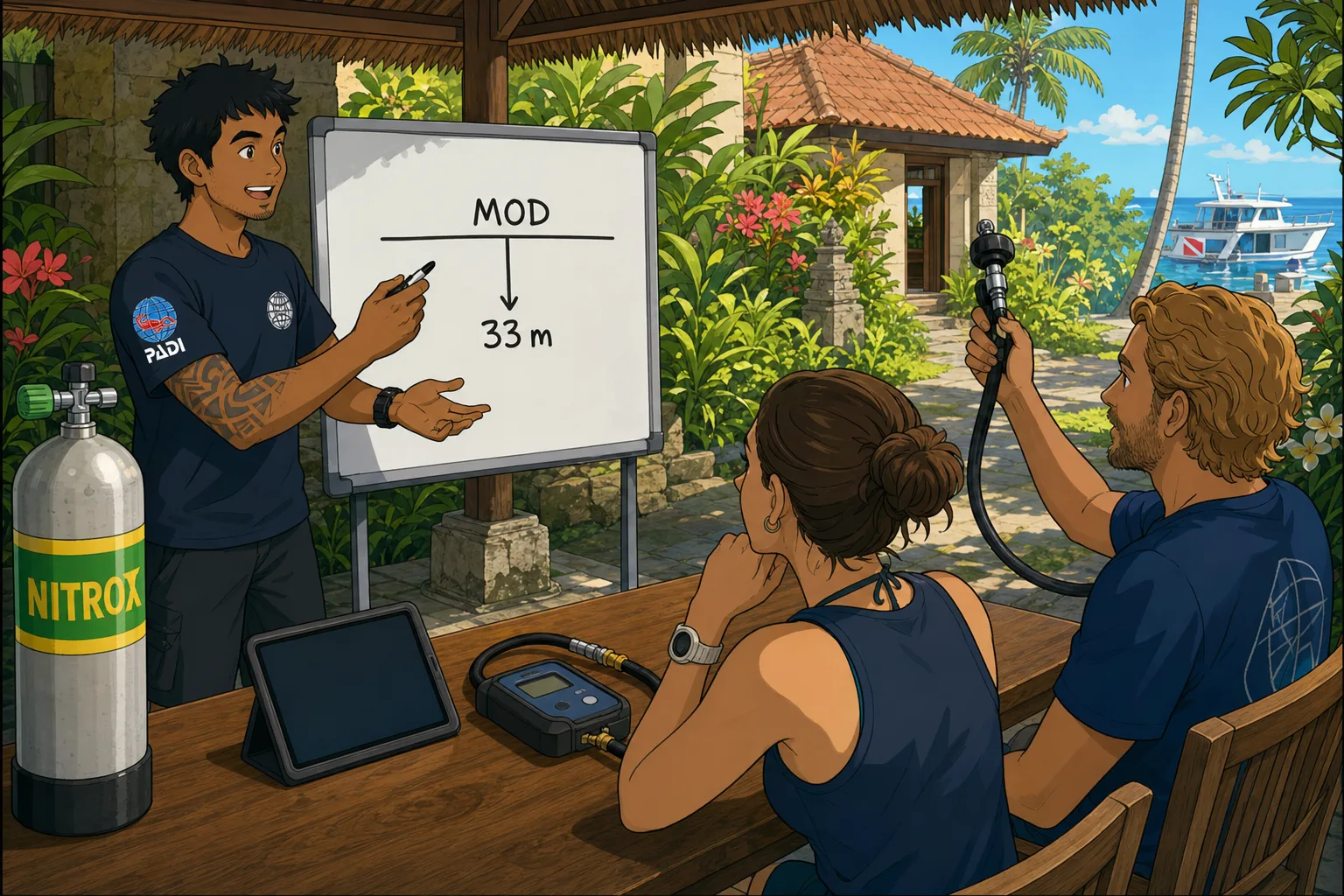
The PADI Enriched Air Diver course is the most popular specialty in the entire PADI system, and the reason is simple: it is one day, there is no swimming requirement, no exam anxiety worth the name, and the card never expires. At our shop the course runs from 9:00 AM to about 3:00 PM and costs IDR 3,060,000 per person, with the PADI e-learning, your instructor and the certification fee all included. You can even do the theory from a beach chair before you arrive, because the e-learning is sent to you at booking.
What the day actually covers
Three things, honestly. First, the why: how higher oxygen and lower nitrogen change your no-deco times, and what oxygen exposure means for your body. Second, the numbers: finding the maximum operating depth for any mix, planning with the nitrox tables or, more realistically, setting your dive computer to the right percentage and letting it work. Third, the hands-on part, which is the bit that matters most: you will personally analyse tanks with an oxygen analyser, verify the mix, calculate its MOD, and fill in the fill log the way every nitrox diver does at every dive centre on the planet for the rest of their diving life. It is a habit, and we drill it until it is boring, because boring is exactly what safety should feel like.
Adding dives, and stacking it with other courses
Actual dives are optional for this certification, which surprises people. You can finish the course dry in an afternoon. That said, most of our students bolt the course onto a regular dive trip the next day and simply do their first two enriched air dives at Penida or Tulamben with their guide, which is both more fun and better learning. The course also stacks nicely: divers fresh off the Open Water course often add nitrox in the same week, and it counts toward the five specialties you need for Master Scuba Diver. If you are mapping out a bigger certification ladder, our overview of PADI certification in Bali shows how the pieces fit together.
Nitrox Safety: MOD, Oxygen and the Analyser Habit
Nitrox is not dangerous when you follow two rules, and genuinely dangerous when you ignore them, so let us be precise. The risk is oxygen toxicity. Breathe oxygen at a high enough partial pressure for long enough and it can trigger a convulsion without warning, which underwater is life-threatening. The fix is a hard depth ceiling. Recreational diving uses a working limit of 1.4 bar of oxygen partial pressure, and from that number every mix gets its maximum operating depth.
Maximum operating depth in plain numbers
For EAN32 the MOD is 33 metres. For EAN36 it is 28 metres. Compare that with the profiles above and you see why EAN32 is the workhorse mix in Bali: it clears every recreational profile we run except the deepest mola hunts. Your computer, once set to the correct percentage, will warn you as you approach the ceiling. But the ceiling only protects you if the number in the computer matches the gas in the tank, which brings us to the habit that the entire course is really about.
Do you need special equipment for nitrox?
Short answer for recreational mixes: no. Standard regulators, BCDs and computers from the major manufacturers are rated for enriched air up to 40 percent oxygen, so the gear you already own or rent from us works exactly as it is. The tank is the exception. Cylinders used for nitrox carry the green-and-yellow band, get oxygen-compatible service, and are the shop's responsibility, not yours. The one piece of equipment that genuinely matters is a nitrox-capable dive computer, and every computer made in the last fifteen years qualifies. You set the oxygen percentage after analysing the tank, the computer recalculates your no-deco limits and tracks your oxygen exposure, and that is the entire equipment story. If a shop anywhere tries to sell you special nitrox gear for recreational mixes, be politely suspicious.
The analyser routine at our shop
Every nitrox tank that leaves our fill station gets analysed twice: once by us when it is filled and logged, and once by you before it goes anywhere near the boat. You clip the analyser to the valve, crack it gently, watch the number settle, write the percentage and MOD on the tank tape, and sign the log. Ninety seconds, every tank, every time, no exceptions, including for our own staff. It is the same culture of unglamorous verification that the Rescue Diver course builds for emergencies: the discipline is the skill. If a dive operation anywhere hands you a nitrox tank without offering you the analyser, that is your cue to ask questions.
Nitrox and Mola Mola Season at Crystal Bay
One Bali-specific wrinkle deserves its own section. From July to October, divers come from everywhere hoping to see the oceanic sunfish, and the classic encounter site is Crystal Bay, where the fish rise from deep water to be cleaned, often hanging at 25 to 40 metres. Notice the problem: the bottom of that range is below the 33-metre MOD of EAN32. This is the one situation in Bali where nitrox needs actual thought rather than a reflexive yes.
Our approach is straightforward. On mola dives we plan around the MOD, position ourselves at 24 to 30 metres where the cleaning stations sit, and let the fish come up to us, which is also simply better mola etiquette than chasing one into the deep. EAN32 at 28 metres still gives you a meaningfully longer window at the cleaning station than air does, and that extra patience is often the difference between seeing a mola and hearing about one at the surface. But if a guide plans to take the group past 33 metres, the group is on air, full stop. Read our mola mola season guide for timing, water temperatures and the honest odds, which we will not inflate here: even in peak season, sightings are a privilege, not a schedule.
Booking Nitrox Diving in Bali: The Practical Bits
The logistics, quickly. We blend nitrox at the shop in Sanur, so tell us you want enriched air when you book your trip, ideally a day ahead, and the tanks will be analysed, taped and on the boat with your name on them. Our boats to Penida load at the shop around 7:30 AM and are on the water by 8:00, and the analyser comes out before the boat briefing so nobody is squinting at a gauge on a moving deck. Bring your certification card or have it in the PADI app; we are required to sight it, even if you look trustworthy. There is a modest per-tank surcharge for enriched air fills; the current rate is on our price list along with all trip pricing.
If you rent a dive computer from us, we will set it to your analysed mix together, and if you bring your own, your guide will happily double-check the settings. Guests planning a bigger diving itinerary, several days across Penida, Tulamben and Menjangan for example, can borrow ideas from our one-week Bali dive itinerary. And if you are still not sure whether nitrox makes sense for your particular plan, just send us a message with your dive schedule. We will tell you honestly, dive by dive, where it helps and where it does not. That conversation costs nothing and it is the same one we have at the shop counter every single morning.
Nitrox will not transform you into a better diver. It will quietly hand you ten or fifteen extra minutes exactly where Bali is at its best, between 18 and 30 metres, where the mantas bank and the wreck opens up and the current carries you along a reef that refuses to end. For one day of easy training, most divers who fall in love with this island decide that trade is worth it. We think they are right.