
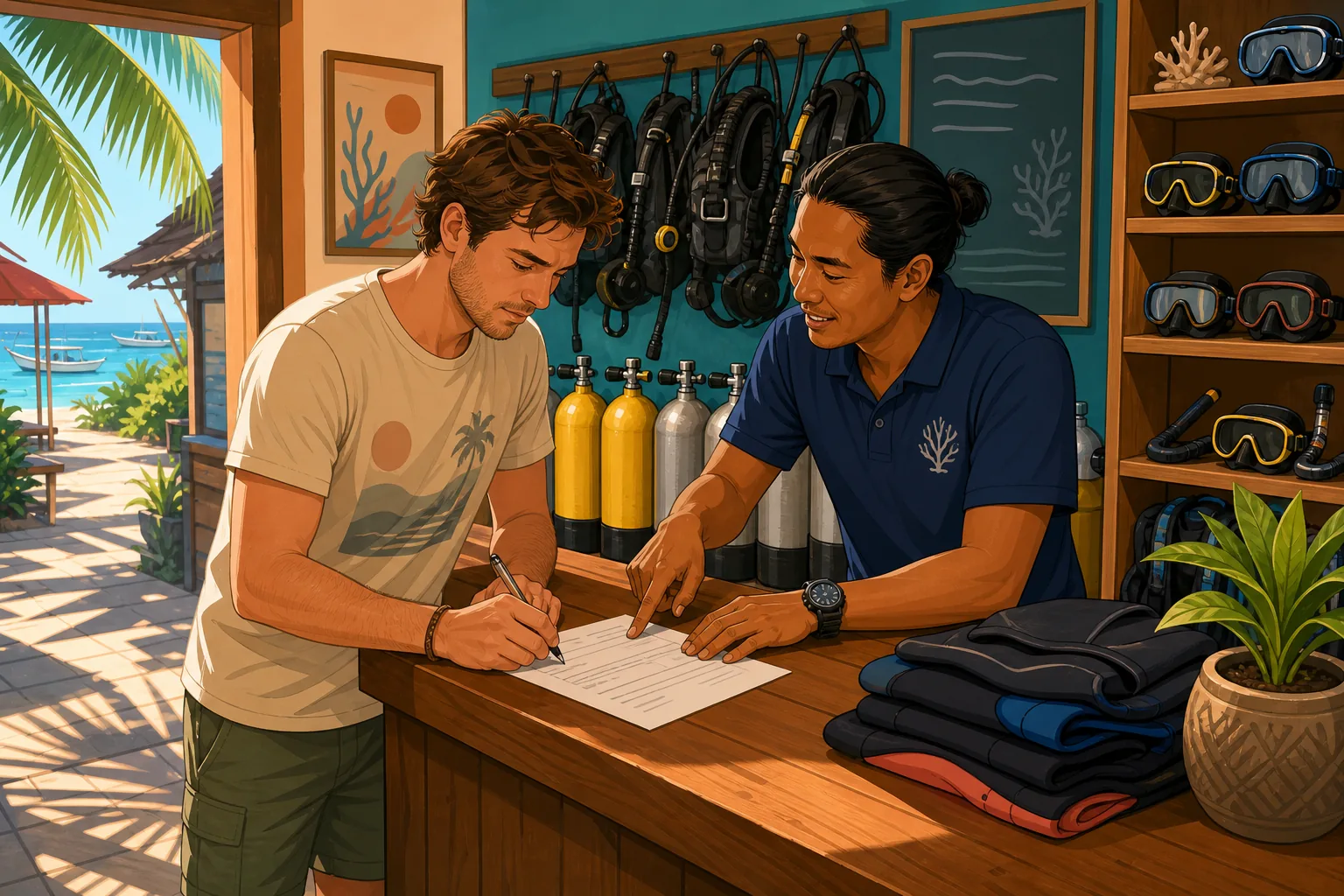
Every week someone sits at our desk in Sanur with a pen, gets a few questions into the medical form, and stops. It is nearly always the same box. Asthma. They have not had an attack since they were fourteen, they run half marathons, and now a single sheet of paper is standing between them and the PADI Open Water course they booked three months ago. So here is the honest answer, the one we give at the counter: asthma does not automatically stop you diving. What it does is change your paperwork. Sort the paperwork out before you fly and it costs you nothing. Leave it until you are standing in Bali with a boat leaving in twelve hours and it can cost you the whole trip.
This guide covers the medical side of diving in Bali properly, not just asthma. What the form actually is and who wrote it, which answers send you to a doctor, the one formatting mistake that gets a correctly signed medical rejected at our desk, where to get examined on the island if you have left it late, and what the emergency infrastructure here really looks like. It applies whether you are booking a single Discover Scuba Diving session or a three-week professional pathway, because the same questionnaire sits at the front of both.
One thing before we start. We are a dive centre, not a clinic. Nothing below is medical advice about you specifically, and no instructor anywhere is qualified to clear you to dive. What we can do is tell you exactly how the system works, because we walk people through it several times a week and we know where it goes wrong.
The short answer on diving with asthma
Well controlled asthma is not a blanket disqualification, and it has not been treated as one by mainstream diving medicine for a long time. Plenty of certified divers have asthma on their history. Some of them are instructors. What matters is not the word on your file, it is the behaviour of your airways now, and that is a judgement only a doctor can make.
The concern is mechanical and it is worth understanding rather than just accepting. Air in your lungs expands as you ascend. On a normal ascent you breathe it out without thinking. If a part of your airway is narrowed or plugged with mucus, air can be trapped behind that narrowing, expand on the way up, and injure lung tissue. That is pulmonary barotrauma, and in the worst case it forces gas into the bloodstream. It is rare. It is also the single most serious thing that can happen quickly to a diver, which is why the screening is stricter around lungs than around almost anything else.
There is a second, duller issue. Breathing compressed gas through a regulator at depth is more work than breathing air at the surface, because the gas is denser. If your baseline lung function already leaves you short of margin, depth removes more of it, and a hard fin against a current at Nusa Penida is exactly where you would notice.
In practice, the pattern we see cleared most often is childhood asthma that has been silent for years, no medication, normal exercise tolerance, normal lung function tests. The pattern that tends not to get cleared is asthma that is currently triggered by exercise, cold air or stress, because those three things describe a dive. Between those two poles sits a large grey zone, and the grey zone is precisely why the form exists. Your doctor decides. Not you, and definitely not us.
The form everyone fills in, and where it comes from
The document is the Diver Medical Participant Questionnaire. It was not written by PADI. It was produced by the Diver Medical Screening Committee, working with the Undersea and Hyperbaric Medical Society, DAN in the United States and DAN Europe, which is why you meet the same form whether you train with PADI, SSI, RAID or SDI. Changing agency does not change the questions. Changing dive shop does not either. Any operator that waves it away is telling you something about how they run everything else, and you can read our view on that in our guide to whether scuba diving is actually dangerous.
The structure is simple. The first page is a short list of yes or no statements about your health. If every answer is no, you sign it, we file it, and you go diving. If any answer is yes, that question points you to a follow-up box with more specific questions about that area. Answer no to everything in the follow-up box and you are often still fine. Answer yes inside the box and you need a physician to complete the evaluation page at the back before you get in the water.
You can download the current version from the PADI forms page at any time, for free, before you book anything. We would rather you read it at home in March than discover it at our counter in August. Fill it in honestly. The form is not a test you pass by guessing what we want to hear, and the people it protects most are the ones who are tempted to tick no.

What actually trips people up at the desk
Asthma gets the attention, but it is not the only thing that stops a booking. Here is what we see in practice across a season in Sanur, roughly in order of how often it comes up.
Airways and allergies
The lung section is deliberately broad. It reaches past diagnosed asthma into wheezing, significant allergies and hay fever that congests you, because a blocked airway behaves the same way regardless of the label on it. Divers who take antihistamines every day of their lives in Europe often arrive in Bali and discover the tropical pollen and the air conditioning are a different problem entirely.
Being over 45 with anything cardiac
Age on its own is not a barrier, and we regularly certify people in their sixties and seventies. The form pairs age with cardiovascular history, family history, smoking and cholesterol, because cardiac events, not decompression sickness, account for a large share of diving fatalities in older divers. A cardiologist who knows you is worth far more here than a general clinic that does not.
Ears, sinuses and past ear surgery
This is the one that catches people who have never thought of themselves as unwell. Grommets, tympanoplasty, a perforation that healed, chronic sinus trouble. All of it matters, because equalising is the one thing you have to do on every single descent. If you have a history here, read our guide on how to equalise your ears properly and then talk to an ENT specialist, not a general practitioner.
Neurological history
Seizures, epilepsy, loss of consciousness, significant head injury, migraine with neurological symptoms. The concern is straightforward. Anything that could cause you to lose awareness underwater is treated very seriously, because the surface is not somewhere you can simply lie down and recover.
Diabetes
Diabetes used to be an automatic no and no longer is. Divers on stable, well managed regimes are certified routinely now, with protocols around blood glucose testing before and after the dive. It needs a doctor who understands both the condition and diving, and it needs planning, but it is a normal conversation.
Medication and mental health
Prescription medication is asked about directly. Most everyday medication is not a problem. What matters is what it does at depth, whether it causes drowsiness, and how you cope if you miss a dose. Anti-anxiety and antidepressant medication is common among divers and is frequently cleared. Anything sedating deserves a real conversation. If you are taking antimalarials, our guide to malaria risk and vaccinations for divers in Bali covers which ones matter and which are irrelevant for Bali specifically.
Pregnancy
This one has no grey zone. Nobody dives while pregnant. There is no safe depth, no shallow exception and no signature that changes it, because the effect of a nitrogen load on a foetus has never been established and nobody is willing to find out. Snorkelling and freediving are different questions with different answers, and our snorkelling trips are open to you.
| What you ticked | Why the form asks | What usually happens next |
|---|---|---|
| Childhood asthma, none for 10 years | Risk of trapped air on ascent | Usually cleared after lung function testing |
| Current exercise-induced asthma | A dive is exertion in cold, dry gas | Often not cleared, specialist decides |
| Over 45, no other issues | Cardiac risk rises with age | Usually a straightforward sign-off |
| Grommets or ear surgery | You equalise on every descent | ENT opinion, often with a waiting period |
| Well managed diabetes | Hypoglycaemia underwater | Cleared with a glucose protocol |
| Pregnancy | Unknown effect on the foetus | No diving, no exceptions |
The conditional approval trap
This is the part almost nobody knows, and it is the reason we have had to turn away divers who did everything right. When a physician completes the evaluation page, they have two options. Approved, or not approved. That is the whole menu.
What a helpful doctor sometimes does instead is write something reasonable-sounding in the margin. Approved for dives to 12 metres. Approved provided there is no current. Approved if accompanied by an instructor. Every one of those is a kindness, and every one of those is unusable. The committee that designed the form was explicit about it: if a physician adds limits or conditions to the approval, dive professionals are required to treat the form as not approved. We do not get to weigh up whether the condition seems sensible. We are not allowed to.
So the practical instruction, and please pass this to your doctor rather than assuming they know: hand them the physician evaluation page itself, and tell them the form takes a clean Approved or a clean Not Approved with no annotations. If they genuinely believe you should only dive to a limited depth, the place for that is a conversation with you and a note in your own records, not the box on that page.
The other version of this problem is a medical certificate on clinic letterhead instead of the actual form. A letter saying you are in good general health is not the same document and does not carry the same questions. Bring the form. Bring the real one.
Where to get a dive medical in Bali
The best place to get examined is at home, weeks before you fly, from a doctor who has your history in front of them. We say this to everyone and about a third of people do it. For the rest, Bali is better equipped than most tropical dive destinations.
The Hyperbaric and Diving Medicine Centre at Kasih Ibu Hospital in Saba, Gianyar, is the specialist option. It opened in July 2019, it runs a multiplace chamber, and it is a DAN preferred provider with a doctor holding a master's in hyperbaric and diving medicine. Diver medical check-ups are one of their core services rather than an afterthought, which is exactly what you want if your case is not simple. Non-emergency services run Monday to Saturday, roughly nine to five, closed on national holidays. It sits on the east side of the island, closer to Padang Bai than to Seminyak, so plan the drive.
RSUP Prof. dr. I.G.N.G. Ngoerah in Denpasar, which most long-term residents still call Sanglah, is the large government referral hospital and it also has a hyperbaric facility. Its hyperbaric clinic keeps weekday morning hours, so it is not a walk-in-on-Sunday option for a routine medical, but it is the closest chamber to Sanur and the one most emergency plans on this side of the island point at.
Two pieces of practical advice. Call ahead, because hours and pricing change and a wasted trip across Bali traffic is a lost dive day either way. And build a buffer: if you arrive on a Friday needing a medical for a Saturday course, the maths does not work. We would rather move your course than watch you rush a medical appointment, and we will move it without a rebooking fee if the reason is a medical clearance.

What we actually do when a form comes back with a yes
Nothing dramatic. We read it, we work out whether the yes leads anywhere, and we tell you straight away rather than at the boat.
A surprising number of yes answers resolve on the same page. Someone ticks the surgery question because they had a wisdom tooth out, or the medication question because of the contraceptive pill, which the form specifically excludes. Those take a minute. Others do not resolve, and then the conversation is about sequencing your trip rather than cancelling it: doing the theory while you wait for a clearance email, moving your open water dives to the back half of the holiday, or switching a course booking to a fun dive package later in the week.
Here is what we will not do. We will not hand you a fresh blank form and suggest you think harder about your answers. It happens in this industry and it is the worst thing a dive centre can do, because the person who gets hurt is you, forty minutes into a dive, twenty metres down, a long way from the shop in Sanur. We also will not accept a photograph of a form signed by someone whose name and registration we cannot read. If that costs us a booking, it costs us a booking.
What we will do is be flexible with everything that is within our control. Dates, sites, the order of your training days. Just tell us early. A message through our contact page three weeks out gives us room to solve it. The same message at 7pm the night before does not.
The temporary things that stop a dive on the day
The medical form deals with your permanent history. Most of our actual cancellations are about something that started on Tuesday.
Congestion is far and away the biggest one. A head cold that is merely annoying on land becomes a reverse block at six metres, and a reverse block on the way up is genuinely painful. The dangerous version is the diver who takes a decongestant, descends comfortably, and then has the drug wear off at depth so the sinuses reseal while they still have to come up. If you are blocked, we will offer you a different day, and in the worst case we will offer you a snorkelling trip instead. Roughly one diver a week takes that trade in the wet season.
Alcohol and dehydration deserve their own mention on an island where the holiday starts before the diving does. Dehydration is an accepted risk factor for decompression sickness, and Bali dehydrates you before you even get in the water. We cover this properly in our article on scuba diving and alcohol.
Then there is the local classic. Stomach trouble from a bad meal is not a punchline when you are planning to breathe from a regulator over a two-hour boat ride to Nusa Penida. Fluid loss, cramping and a mask are a bad combination. Take the day, drink water, and dive on Thursday instead.
Finally, jet lag and the first-day rush. If you land at midnight and want to dive at eight, you can, and people do it constantly. You will enjoy it more with a night's sleep, and our regulars from Europe almost always book their first day at the easy sites around Sanur or Padang Bai rather than starting with a current dive.
If something does go wrong: chambers, DAN and insurance
The screening exists so this section stays theoretical. It is still the section you should read.
Bali has recompression capability, which is not true of every dive destination in Indonesia. The chamber at Kasih Ibu Saba runs emergency treatment around the clock, and Prof. Ngoerah in Denpasar has a hyperbaric facility attached to a full referral hospital with a 24-hour emergency department. For a diver in Sanur, Denpasar is close. For a diver in Amed or Tulamben, the drive is long, which is one honest argument for conservative profiles on the Tulamben and Amed coast.
DAN runs a 24-hour emergency hotline with a dedicated Indonesian number, +62 21 5085 8719, and an international line on +1 919 684 9111. Those are for emergencies only. Put them in your phone before your first dive, not after. DAN's emergency assistance page explains what happens when you call and what information to have ready.
On insurance, the trap is assuming you already have it. A large number of standard travel policies exclude scuba diving entirely, and many of the ones that include it cap you at 18 or 30 metres, exclude anything with the word course in it, or refuse cover for solo and technical activity. Chamber treatment and evacuation are expensive in a way that ordinary travel medical cover is not built for. Read the depth limit, read the activity list, and if you are joining a liveaboard trip check evacuation cover specifically, because a boat in the Banda Sea is a long way from a chamber. Our article on flying after diving covers the other end of the trip, which is the surface interval you need before your flight home.

Diving long term with a condition on your file
Getting cleared once is not a lifetime pass, and that is a feature rather than a nuisance. The form asks about the last twelve months for a reason. If your asthma returns after four quiet years, the honest thing is a fresh conversation with your doctor, not a shrug because you already have a certification card.
The requirements also tighten as you go up the ladder. Recreational courses such as Advanced Open Water and Rescue Diver use the same questionnaire, but professional training is a different matter. Anyone heading towards Divemaster should expect a proper diving medical from a physician, repeated periodically, because you are no longer responsible only for yourself. Rescue in particular is worth doing regardless of your career plans, since it is the course where you learn to spot the diver who is quietly not coping, and it pairs naturally with Emergency First Response.
Two practical notes for divers managing something ongoing. First, enriched air is not a treatment for anything and we would never sell it as one, but the longer no-decompression limits do let you build a more relaxed, less rushed profile, which some divers find helpful. Second, if it has been years since your last dive and your health has changed in the meantime, book a refresher rather than assuming your body picks up where it left off. Skills fade. So does fitness.
How to plan so the medical never costs you a dive day
The whole problem is solvable weeks before you land, and it takes about an hour of your time.
Download the questionnaire from the official forms page today, before anything is booked, and fill it in honestly at your kitchen table. If every answer is no, print it, put it with your passport, and forget about it. If anything is yes, book your doctor now, take the physician evaluation page with you, and tell them about the no-annotations rule before they pick up a pen. Bring the signed original on paper and keep a photograph of it on your phone as a backup, because paper and Bali humidity are not friends.
Then tell us. Not the details of your medical history, which are none of our business, just that a clearance is in play. It changes nothing about how we treat you and it changes everything about how we schedule you. Divers who mention it at booking almost never lose a day. Divers who mention it at the counter sometimes lose two.
If you are still deciding whether diving is for you at all, our guide to diving in Bali for the first time walks through what an actual first day looks like, and parents planning a family trip should read the family diving guide, because the youth version of the medical statement asks a slightly different set of questions. When the paperwork is done, the rest is the easy part: pick a site, get on the boat, and let us worry about the logistics. You can browse the sites we run or start from the course list whenever you are ready.