
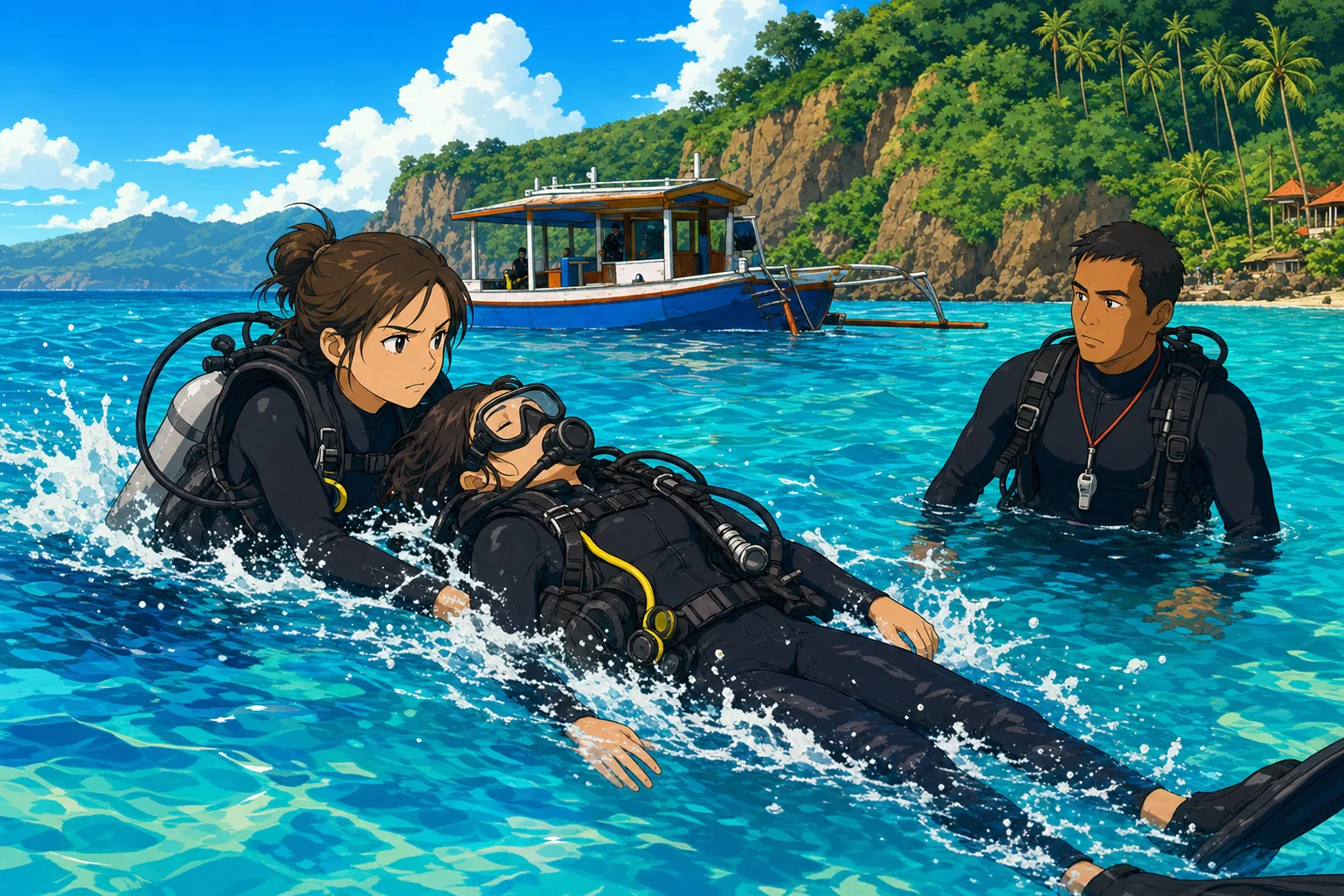
Divers ask us for the fun courses. Deep, wreck, nitrox, the ones with a good story attached. Then somebody who has already done the PADI Rescue Diver course in Bali overhears the conversation at our Sanur shop and says the thing they always say: it was the hardest course I ever did and the only one that actually changed how I dive. They are right, and this article is our attempt to explain why without the marketing gloss. What the three days really contain, which parts are genuinely tiring, what it costs, and who we think should wait a season before booking.
Set your expectations properly first. This is not a course about scenery. You will spend most of it looking at another diver instead of the reef, you will swallow some seawater, and by mid-afternoon on the last day your shoulders will complain. It also has a prerequisite that catches almost everyone off guard, the Emergency First Response first aid course, which is why what people book as a two-day course usually becomes three. In exchange you stop being a passenger on a dive. If you have read our piece on whether scuba diving is dangerous, this is the course that turns that theory into muscle memory.
What the PADI Rescue Diver Course Actually Teaches
Every course before this one is about you. Open Water teaches you to look after yourself, Advanced teaches you to do that in more demanding conditions, and the specialties add tools to your own kit. Rescue is the first course where the subject of the lesson is somebody else. You learn to spot a problem in another diver before they know they have one, and that skill is far less romantic and far more useful than it sounds.
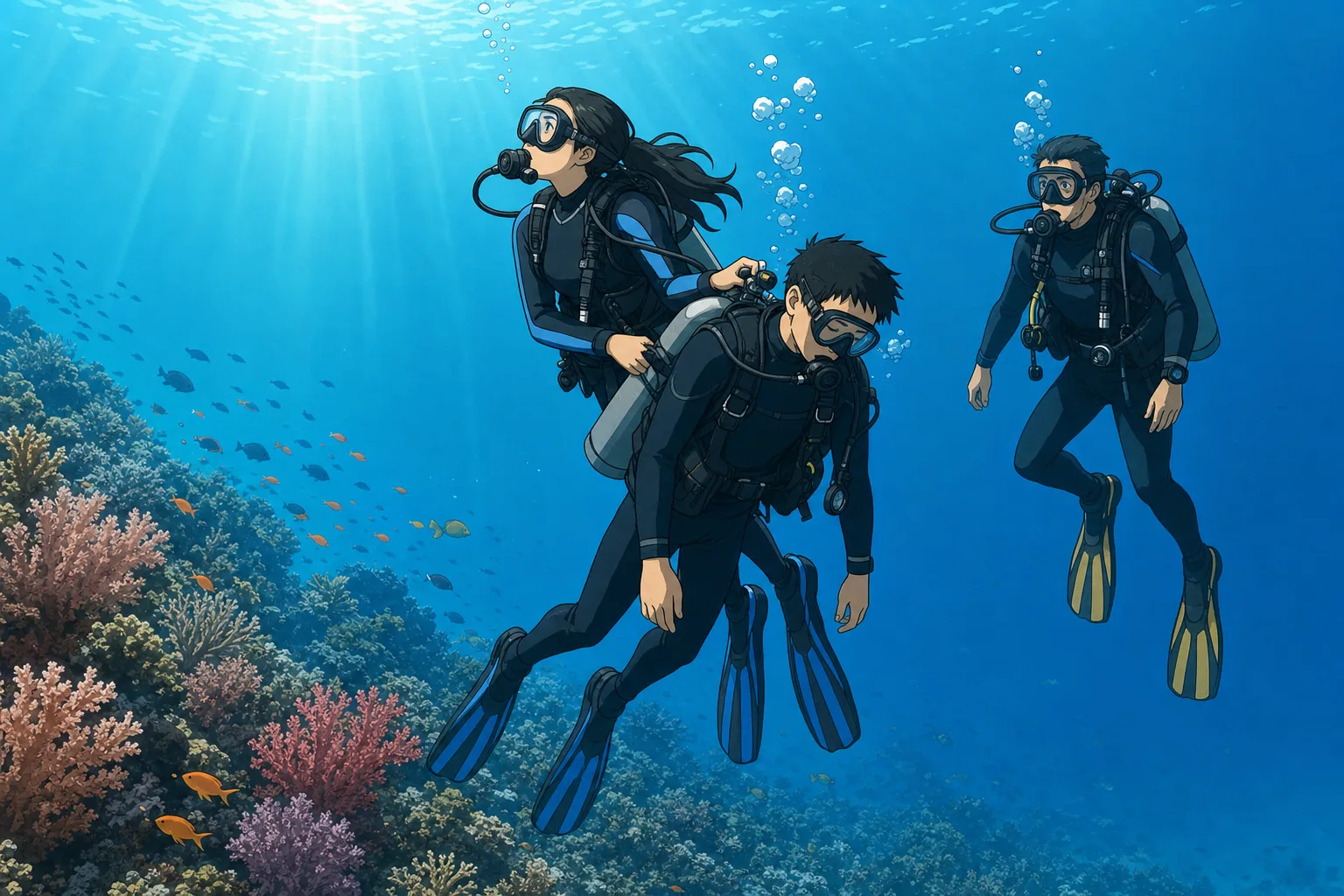
The bulk of the learning is not dramatic hauling of bodies from the deep. It is observation. A diver whose breathing rate climbs on the descent line. Someone fiddling with a mask strap for the fourth time. The buddy pair drifting apart at the back of the group. Our instructors call this reading the water, and by the end of day three you cannot switch it off. You will catch yourself doing it on a holiday dive months later, counting heads without meaning to, noticing that the guy on your left has his hand on his inflator hose a bit too often.
The mindset shift nobody warns you about
Here is the part we like most. Rescue Diver quietly makes you a better ordinary diver, because you cannot help anybody else if your own diving is a mess. Your buoyancy has to be good enough to hold position while you sort out a stranger's gear. Your air consumption has to be steady enough that you are not the one running low. Your hand signals have to be clear enough to be understood by a person who is halfway to panicking. Plenty of students finish the course and immediately book a Peak Performance Buoyancy session because the rescue scenarios showed them exactly where their own trim falls apart. That is the course doing its job.
The other half of the mindset is accepting that you might do nothing. A surprisingly large slice of the training is about prevention and self-preservation, including the honest lesson that a rescuer who becomes a second casualty has made the situation twice as bad. We teach people to throw something that floats before they swim, to call for help early rather than heroically late, and to say out loud that a dive is off. In eleven years of running trips, the times our staff have prevented a real incident almost never looked like a rescue. They looked like somebody saying, you seem tired, sit this one out.
The PADI Rescue Diver Course in Bali: Three Days, Hour by Hour
Different shops sequence this differently, so here is exactly how we run it out of Sanur. Before you arrive, PADI e-learning lands in your inbox. Budget five to ten hours for it, and please do not leave it for the flight over, because the knowledge reviews feed directly into the first morning's discussion. Guests who arrive with the theory done get a much better course than guests who are still watching videos at breakfast.
Day one: Emergency First Response
A full day of first aid, usually at the shop. CPR on a manikin, rescue breathing, bleeding control, shock management, the recovery position, and secondary care assessments. There is an AED trainer and, in the second half, oxygen kit familiarisation, which for divers is the most relevant part of the day. It is not a diving day at all, and some students find it the least glamorous eight hours of their holiday. It is also the day whose skills you are most likely to use in real life, on a road in Ubud or at a family dinner, far away from any reef.
Day two: classroom and confined water
Morning is the classroom session, which is short if your e-learning is done, plus the equipment and dive planning talk. Then the pool, and the pool is where the real work starts. We run the self-rescue skills, cramp removal, tired diver tows, and the first attempts at handling a panicked diver, which is where most students discover that a person in genuine distress at the surface is astonishingly strong. Your instructor and a divemaster will play the victim, and they play it well. Our divemasters have a small competition going over who can be the most convincing panicked tourist. You will not enjoy being on the receiving end of the winner.
Day three: open water at Padang Bai
Hotel pickup is around 7:00 AM, the drive east to Padang Bai takes roughly an hour and a half depending on Denpasar traffic, and you are usually in the water by mid-morning. We use Padang Bai for the two open water training dives because the bay gives us protected, reasonably shallow water with easy boat access and a sand bottom to work over, which matters when three students are churning up a scenario. Water sits around 27 or 28 degrees most of the year, though a thermocline can push it down toward 25. Our full guide to diving Padang Bai covers the sites themselves if you want to come back later for fun dives, which many students do.
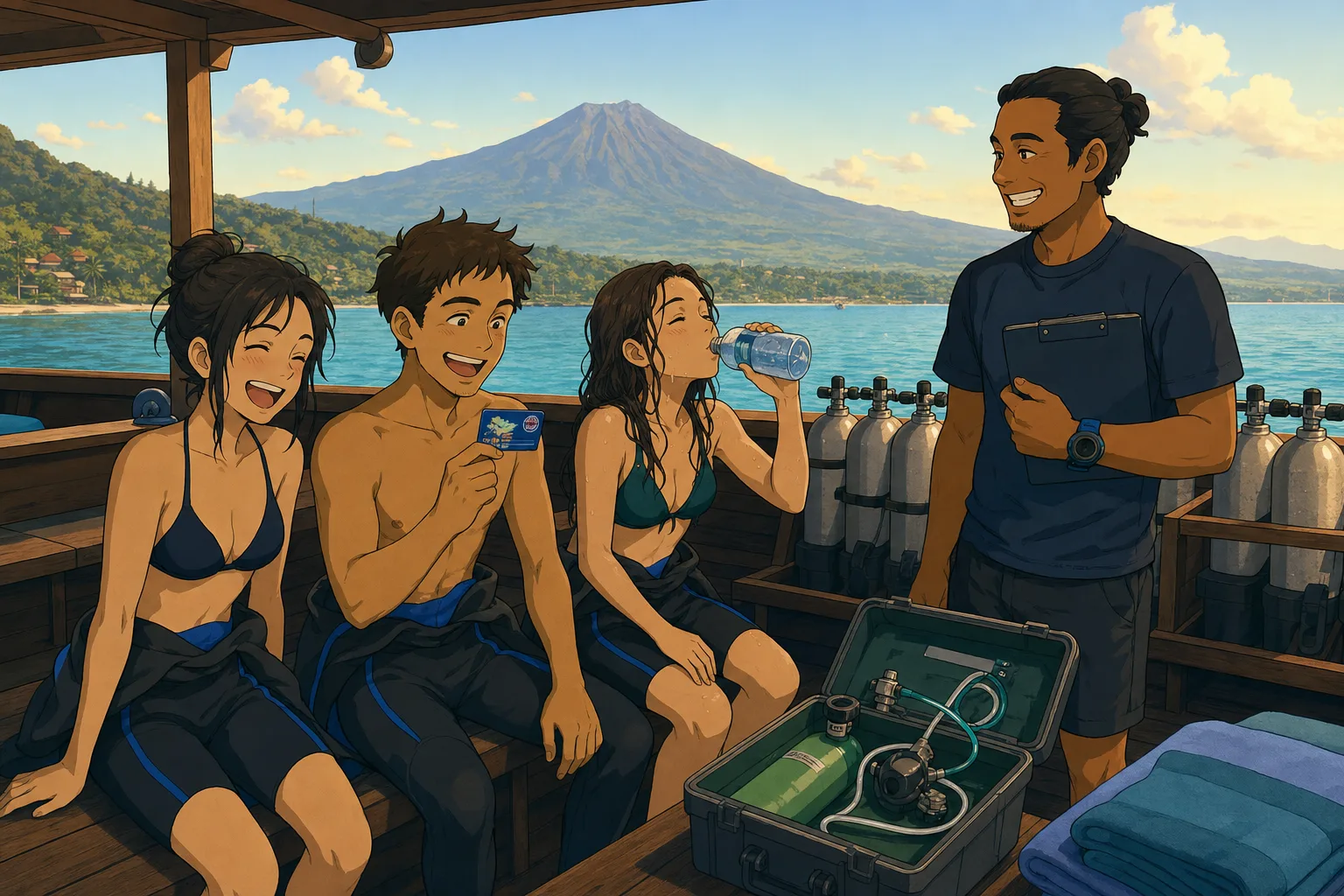
The two dives run the underwater exercises, then the surface scenarios, then the two final assessment scenarios that pull everything together without warning. We are normally back at the shop between 3:00 and 4:00 PM. Certification is processed the same evening, and the card lands in your PADI app before you have finished dinner.
The Ten Rescue Exercises in Plain Language
PADI structures the course around ten exercises. The standards language is a bit dry, so here is what each one feels like in the water at Padang Bai.
One, self-rescue. Cramp removal, air-sharing, mask problems, tired diver self-care. Easy, and a good warm-up. Two, tired diver. A conscious diver at the surface who is out of energy. You establish buoyancy, calm them down, and tow. Deceptively knackering over 50 metres. Three, panicked diver. The one everyone remembers. A person who has stopped listening, wants to climb on top of you, and needs to be approached from behind or, better, not approached at all until they tire. This is where the course earns its reputation.
Four, response from shore or boat to a responsive diver. Reaching, throwing, wading, rowing, and only then swimming. Reach first, swim last, in that order, always. Five, distressed diver underwater. Out of air, entangled, or panicking below the surface, and you learn to give them what they need without letting them take your regulator. Six, missing diver. Search patterns, the U-pattern and the expanding square, plus the sober arithmetic of how long you have.
Seven, surfacing the unresponsive diver. A controlled ascent while managing two buoyancy systems, one of them attached to somebody who cannot help you. Most students get this wrong the first time by ascending too fast, which is exactly why it is practised. Eight, unresponsive diver at the surface. The long one. In-water rescue breaths every five seconds while stripping gear and towing to the boat, all at once, which is genuinely hard and is where the tiredness bites. Nine, exiting the water. Getting an unconscious adult onto a boat or up a beach, which is far more awkward than it sounds. Ten, first aid for pressure-related injuries and oxygen administration. Recognising decompression sickness, delivering emergency oxygen, and knowing what to tell the emergency services.
Two scenarios close the course. Your instructor stages a realistic incident, you run it start to finish, and nobody tells you which exercise is coming. Somebody surfaces face down 30 metres from the boat, or a buddy pair returns as a single diver looking worried. The point is not perfect technique. It is whether you can think while wet, tired and mildly stressed, and whether you delegate properly, because the first sensible instruction in almost every real incident is to point at a specific person and tell them to call for help. Vague shouting at a boat full of tourists accomplishes nothing.
Emergency First Response: The Prerequisite Nobody Plans For
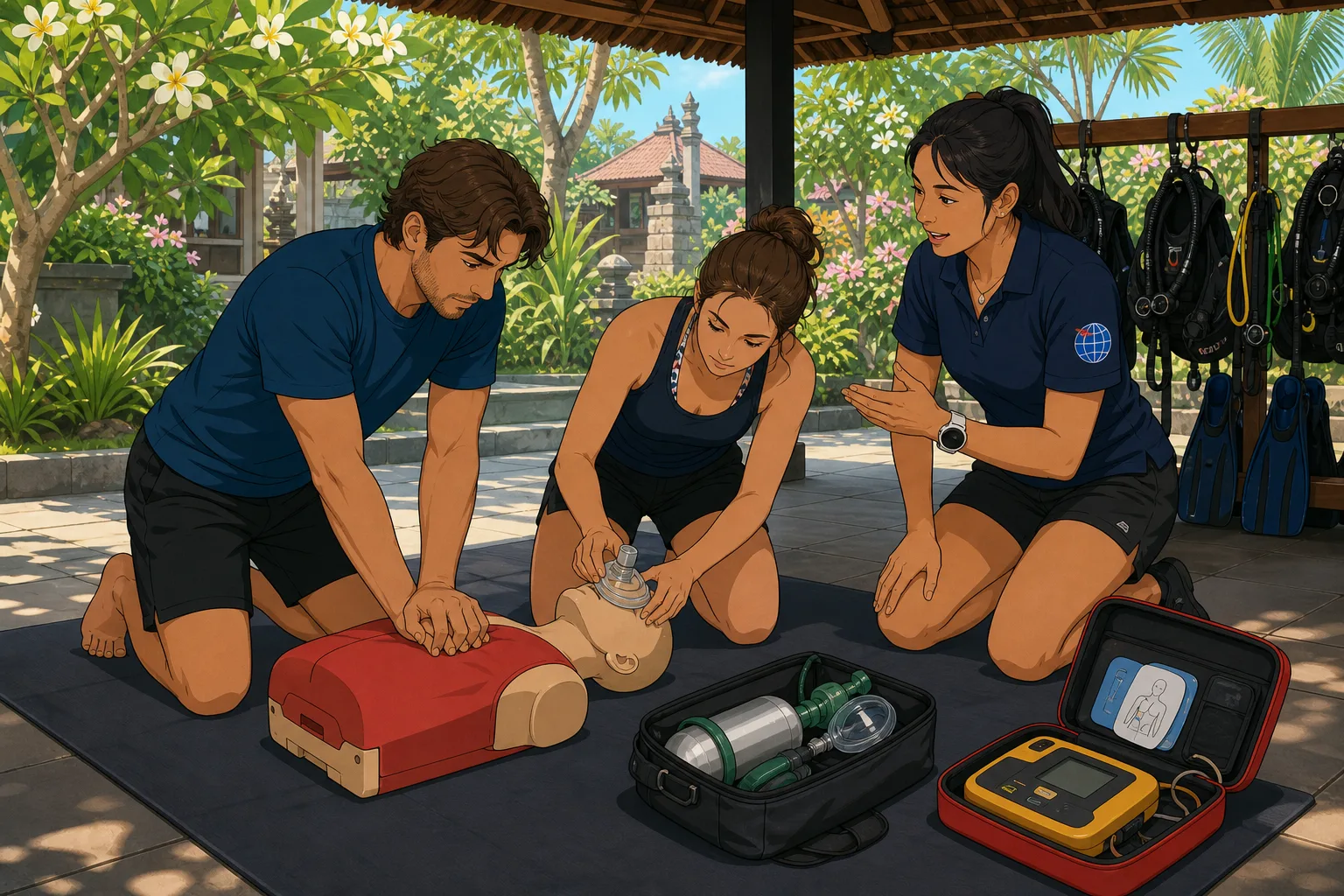
Every week somebody messages us wanting to book Rescue for the following morning, and every week we explain the EFR requirement. To enrol in Rescue Diver you need current first aid and CPR training, completed within the previous 24 months. If you did a workplace first aid course last year, bring the certificate and we will check whether it qualifies. Plenty do. If not, you take EFR with us for IDR 3,150,000, it takes one day, and it is worth doing even if you never dive again.
The other prerequisites are simpler. You need to be a certified Adventure Diver or Advanced Open Water Diver with the underwater navigation dive logged, or the equivalent from another agency, and you need to be at least 12 years old, with under-15s certifying as Junior Rescue Divers. Cards from SSI, RAID, CMAS and the rest are all fine. If you are not sure where your certification sits in the ladder, our overview of scuba diving certification types sorts out the equivalences.
How many dives should you really have?
PADI sets no minimum dive count beyond the certification level, and we think that standard is too generous. Our honest recommendation is 25 logged dives before you start, and ideally some of them recent. The reason is simple: during the scenarios your own diving has to be automatic, because your attention is entirely on the victim. A student who is still thinking about their own buoyancy has nothing left over. We have never refused a qualified student, but we have suggested to several that they do two fun dives with us first, and none of them regretted it. If your last dive was years ago, start with a scuba refresher instead.
Is the Rescue Course Hard? Our Honest Answer
Physically, yes, more than any other recreational course. Not in a marathon sense, but in a sustained, low-grade, all-afternoon sense. Towing an adult in full kit across 50 metres of water is real work, and you will do variations on it repeatedly. Add Bali sun on an open boat deck and the dehydration that follows, and by the last scenario most students are running on fumes. Drink far more water than feels necessary. We put extra bottles on the boat for this course specifically.
Mentally it is demanding in a different way. There is no checklist to follow, because every scenario is slightly different, and the instructor will not tell you when you have started. That ambiguity is the point and it is what makes the course feel unlike the ones before it. Students who like clear instructions find day three uncomfortable for the first hour. Almost all of them find it exhilarating by the last.
What we will and will not do
We cap this course at three students per instructor, and we do not budge on it. Bigger ratios are legal, and other shops run them, but with five or six students the scenarios turn into queueing, and each person gets a fraction of the coaching that makes the course worth the money. We will also postpone a day if conditions at Padang Bai turn, which happens a handful of times each year, usually in the wetter months when swell wraps into the bay. When that happens we either move the day or run the training at Tulamben where the shore entry gives us a calmer option. We will not run rescue scenarios in conditions where the training itself becomes the hazard. Our overview of Bali diving conditions explains the seasonal pattern.
Who Should Book Now, and Who Should Wait
Book now if you have 25 or more dives, you are comfortable in the water without thinking about it, and you dive with other people regularly. Book now, emphatically, if you dive with a partner or with children, because the person most likely to need your help is the one you are holidaying with. Book now if you are heading toward Divemaster, since Rescue is a hard prerequisite and doing it in warm 27 degree water with a small group is a far better experience than grinding through it somewhere cold.
Wait if you have fewer than about 20 dives, or if your certification is fresh from last week. There is no prize for stacking courses back to back, and we would rather sell you two Penida trips now and a Rescue course next visit than watch you struggle. Wait if you are not a confident swimmer at the surface without gear, because a meaningful chunk of the course happens there. And wait, honestly, if you are in Bali for four days and want to see the island, because this course will eat three of them. The Enriched Air specialty gives you far more value per holiday hour if time is your constraint, as our nitrox guide lays out.
One more group worth naming: divers who had a scare. Every few months somebody books Rescue because something went wrong on a dive, theirs or a buddy's, and they never want to feel that helpless again. Those students are usually the best in the class, and we think their instinct is exactly right. If your diving is new enough that the scare was a basics problem, though, the fix might be the fundamentals rather than rescue skills, and our article for first-time divers in Bali covers that ground.
What the Rescue Diver Course Costs in Bali
Our price is IDR 8,100,000 per person for the Rescue Diver course, plus IDR 3,150,000 for EFR if you need it, so budget a shade over IDR 11 million for the full three-day package. At current rates that is roughly 700 US dollars for the pair. It is one of the more expensive things on our price list, and we would rather explain why than pretend it is cheap.
What the price covers: PADI certification and e-learning, a professional instructor at a maximum ratio of three to one, a divemaster acting as your victim for the scenarios, boat and car hire, hotel pickup and drop-off in Sanur, Kuta, Seminyak and Nusa Dua, a full set of rental equipment, scuba diving insurance, lunch, snacks, bottled water and towels. What it does not cover is extra dives, a private instructor if you want one to yourself, or anything you add afterwards. The single biggest hidden cost at cheaper operations is the ratio, so when you compare quotes, ask how many students share the instructor. Our breakdown of scuba diving prices in Bali puts the course fees in context against day trips, and the full list of PADI courses we run shows how Rescue sits between Advanced and the professional levels.
Compared globally, Bali remains good value for this particular course. You are paying European prices for the certification itself, but the water is 27 degrees, you dive in a 3 mm suit instead of a drysuit, and nobody is cutting the pool session short because everyone is shivering. Warm water genuinely makes rescue training better, since the scenarios are long and cold students learn less.
After Rescue: Where the Certification Takes You
The obvious next step is professional. Rescue is the last recreational rung before Divemaster, and a good number of our rescue students come back within a year or two to do exactly that, sometimes on the Zero to Hero programme if they are changing careers rather than adding a card. Rescue also counts toward Master Scuba Diver, the highest recreational rating, which needs Rescue plus five specialties.
The less obvious payoff is that the certification changes the trips available to you. Rescue Divers get taken seriously by operators everywhere, and on more demanding itineraries it is sometimes a de facto requirement. If your ambitions run toward remote diving, the certification makes a week on the King Neptune liveaboard a much more comfortable proposition, both for you and for the crew. Divers who spend a season with us often do Rescue in Bali and then use it at our Komodo dive centre, where the currents demand exactly the situational awareness the course builds.
Closer to home, the skills show up on ordinary days. Currents at Nusa Penida separate buddy pairs regularly, and a Rescue Diver is the one in the group who notices the gap opening and closes it before the guide has to. That is the whole return on investment, really. Not a dramatic save, just a hundred small corrections nobody else sees. If you are mapping out a longer training path, our summary of PADI certification in Bali and the article on the Advanced Open Water course show what comes before and after.
Booking Your Rescue Course and What to Bring
Book at least a week ahead if you can. The ratio cap means we cannot squeeze an extra student into a running course, and in July, August and the Christmas weeks the instructor calendar fills. Tell us your certification level and your most recent first aid training when you enquire, and we will confirm whether you need the EFR day. Our shop is on Jl. Suka Merta in Sanur Kauh, and free hotel transfers cover Sanur, Kuta, Seminyak and Nusa Dua, with other areas arranged case by case. Just message us with your dates.
Bring your certification card and logbook, a swimsuit you can move in properly, reef-safe sunscreen, and a hat for the boat. Rental gear is included but if you own a mask, bring it, because a leaking rental mask during a rescue scenario is a miserable and entirely avoidable distraction. Eat breakfast. Skip the big night out before day three. And build a rest day into your plans afterwards, because most students want one, and it pairs nicely with an easy fun dive trip later in the week to enjoy the reef again without watching anyone else's bubbles. That first relaxed dive after certification is when most people notice how much has changed. You will still be counting heads. You just will not mind.