
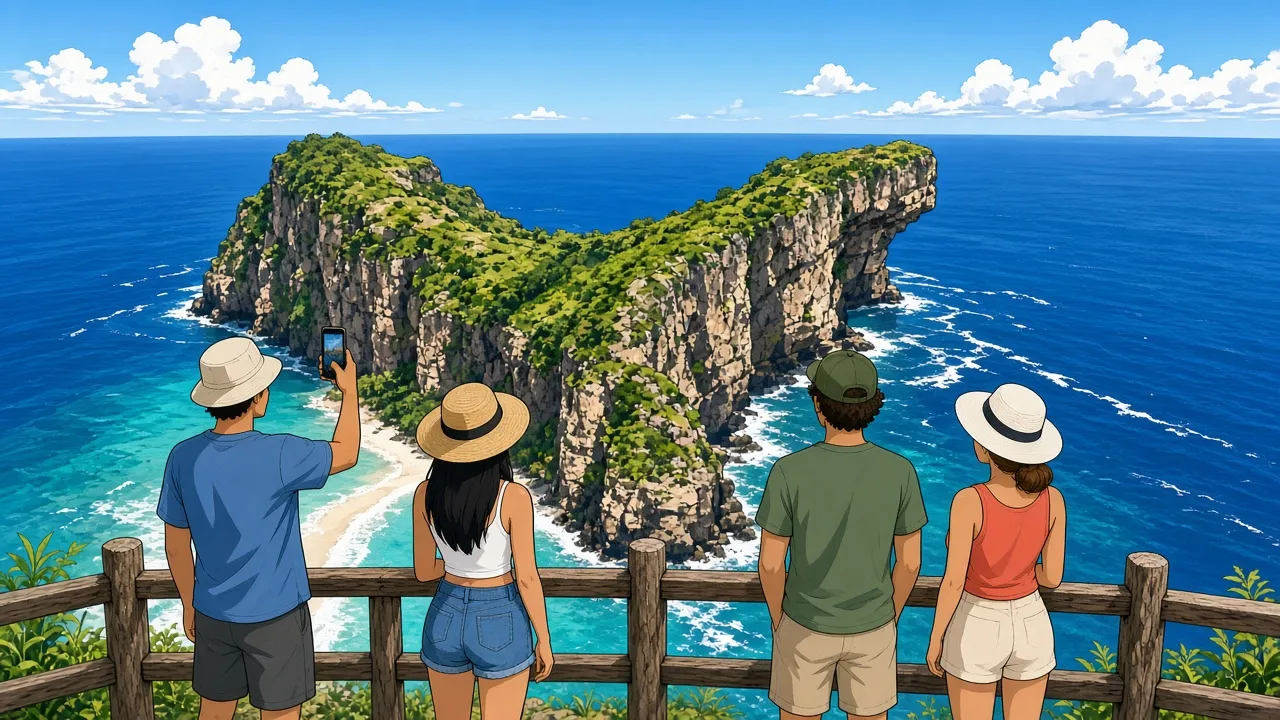
The best things to do in Nusa Penida are its clifftop viewpoints and hidden beaches, led by Kelingking Beach and its T-Rex shaped headland, plus snorkelling with manta rays, cave temples and a waterfall shrine reached by a cliff staircase. The island lies about 40 to 55 minutes by fast boat south-east of Bali, measures roughly 200 square kilometres, and most of its famous sights sit on two coasts that are slow to drive between.
Most visitors come on Nusa Penida day trips from Bali, which cover the west coast sights in one long day. Staying one to three nights opens up the quieter east coast, early mornings before the tour groups arrive, and a full day on the water. This guide lists the sights with the time each takes, the hazard to know about and what it costs, then sets out itineraries, transport and safety.
Prices are in Indonesian rupiah (IDR) as quoted by operators and published price pages in 2026, and drive times assume normal traffic on the island's narrow roads.
What are the best things to do in Nusa Penida?
Choosing what to do in Nusa Penida comes down to how much time there is and whether the day is spent on land, on the water, or both.
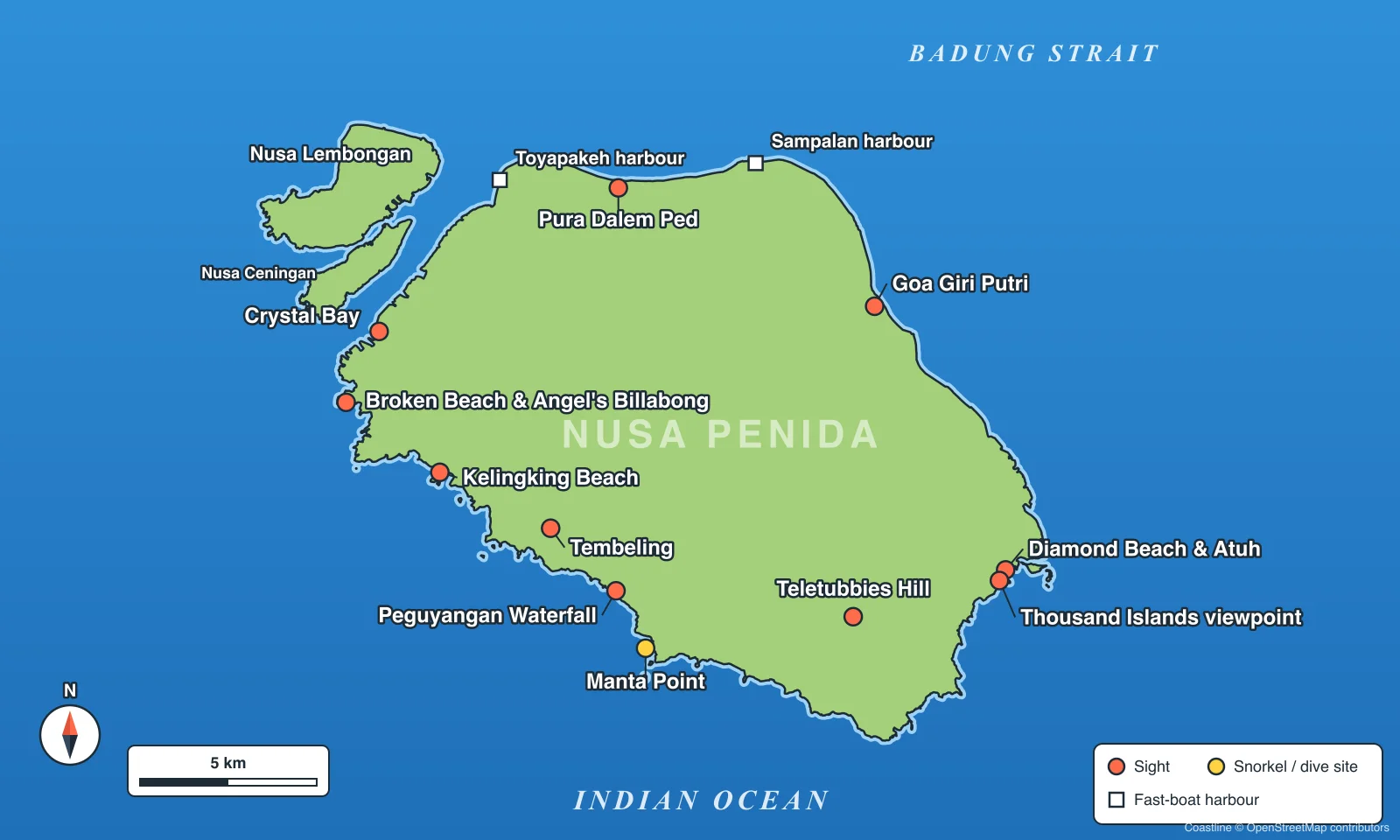
- One day: the west coast loop of Kelingking, Broken Beach, Angel's Billabong and Crystal Bay.
- Two days: add the east coast, with Diamond Beach, Atuh Beach and the Thousand Islands viewpoint.
- Three days: add a snorkelling or diving day with manta rays, plus Goa Giri Putri and Peguyangan Waterfall.
- Water lovers: put the boat day first, while the body is fresh and the sea calmest in the morning.
Travel time decides everything: the west and east coasts are each 45 to 90 minutes from the harbours, so trying both in one day means most of it is spent in a car.
Water days are usually booked as:
- Nusa Penida snorkelling trips to Manta Point and Crystal Bay
- Nusa Penida dive trips for certified divers
- Bali snorkelling tours that leave from Sanur
In short: one day for the west, a second for the east, and a third for the mantas.
West tour vs East tour: which should you choose?
The West tour suits first visits and day trips, because its four headline sights are close together. The East tour suits a second day or travellers who want fewer crowds, at the cost of longer drives.
West tour
The West tour links Kelingking Beach, Broken Beach, Angel's Billabong and Crystal Bay, usually with lunch near Crystal Bay. It is the route almost every Bali day trip follows, so the viewpoints are busiest between about 11:00 and 15:00.
East tour
The East tour links Diamond Beach, Atuh Beach, the Thousand Islands viewpoint and the treehouses, often with Goa Giri Putri or Teletubbies Hill on the way. The roads are longer and the crowds thinner, and the coast faces the sunrise.
Key distinction:
- The West tour is shorter to reach and fits a day trip from Bali.
- The East tour needs an overnight stay or a very early start to enjoy it properly.
| West tour | East tour | |
|---|---|---|
| Main sights | Kelingking, Broken Beach, Angel's Billabong, Crystal Bay | Diamond Beach, Atuh, Thousand Islands, treehouses |
| Drive from the north harbours | About 45 to 60 minutes to the first sight | About 60 to 90 minutes to the first sight |
| Crowds | Heavy from late morning | Moderate |
| Best light | Morning at Kelingking, sunset at Crystal Bay | Sunrise on the coast |
| Fits a day trip from Bali | Yes | Only with an early boat |
The best things to do in Nusa Penida in 2026
The sights below run roughly clockwise from the west coast. Each entry gives who it suits, the conditions, the cost where published, and one real limitation. The map shows where they are.
1. Kelingking Beach and the T-Rex viewpoint
Kelingking is the image most people know Nusa Penida by: a narrow green headland shaped like a dinosaur's head, seen from a clifftop railing above a white-sand beach. It suits everyone for the view, which takes 20 to 30 minutes including the walk from the car park. Only fit walkers should go further: the trail down the cliff is steep, narrow and partly unrailed, takes roughly 30 to 60 minutes each way, and should not be attempted in the midday heat, in rain or in flip-flops. The limitation is the crowd, which peaks from late morning, so the first hour after sunrise is the calmest time.
2. Broken Beach (Pasih Uug)
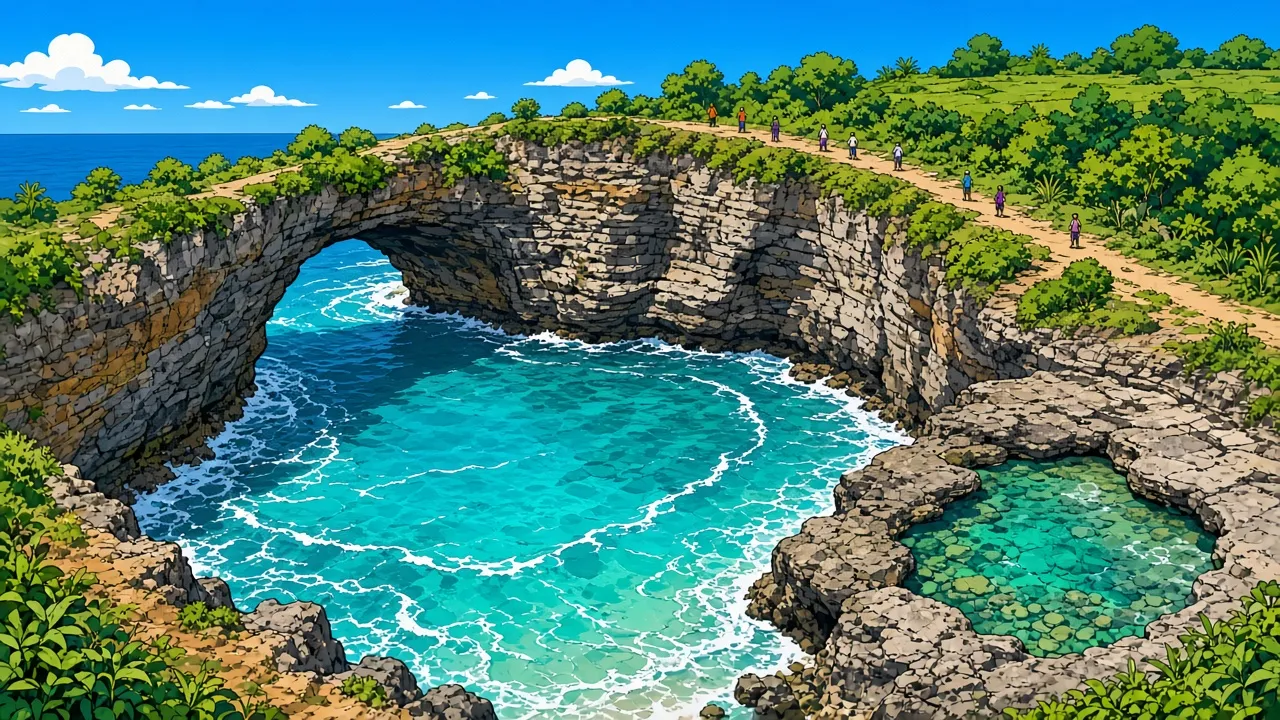
Broken Beach is a near-circular cove enclosed by cliffs, with the sea flowing in through a large natural arch. A footpath runs around the rim, and the full loop takes about 20 to 30 minutes on mostly flat ground, which makes it one of the easiest sights for families and older travellers. There is no access down to the water. The limitation is the access road, which is narrow and rough in places, so the last stretch can be slow.
3. Angel's Billabong
A few minutes' walk from Broken Beach, Angel's Billabong is a clear natural pool on a rock shelf at the sea's edge. On a calm day at low tide it looks like an infinity pool. It suits photographers and anyone already at Broken Beach. The limitation is serious: waves from the open ocean can wash across the shelf without warning, visitors have been swept off it, and local guides advise against entering the pool unless the sea is flat and the tide is low.
4. Crystal Bay
Crystal Bay is a sandy bay on the west coast with warungs, sunbeds for rent, a small temple on the rocks and some of the island's best sunsets. Snorkelling from the beach is possible close to shore, and boats moor offshore for snorkelling and diving. It suits families, a lunch stop and the end of a West tour. The limitation is the current outside the bay, which can be strong, so snorkellers should stay inside the bay unless they are with a boat and guide.
5. Snorkelling with manta rays
Reef manta rays feed and visit cleaning stations off the south coast all year, at sites called Manta Point and Manta Bay. Boat trips usually combine a manta stop with Crystal Bay and a sheltered reef, and operators report sightings on most trips in normal conditions. It suits confident swimmers. The limitation is the swell at Manta Point, which can be big enough for boats to switch to the calmer Manta Bay, and the water can be cold, as the Nusa Penida snorkelling guide explains, and prices and formats are compared in the guide to Nusa Penida snorkelling tours.
6. Diving at Crystal Bay and Manta Point
Nusa Penida is one of Indonesia's best-known dive destinations, inside a marine protected area of about 20,000 hectares around the three Nusa islands. Mantas are present all year, and ocean sunfish (mola mola) rise from the deep between about July and October. It suits certified divers, and newcomers can join a first dive at sheltered sites. The limitation is the current and cold thermoclines, described in the guide to diving with manta rays at Nusa Penida.
7. Diamond Beach
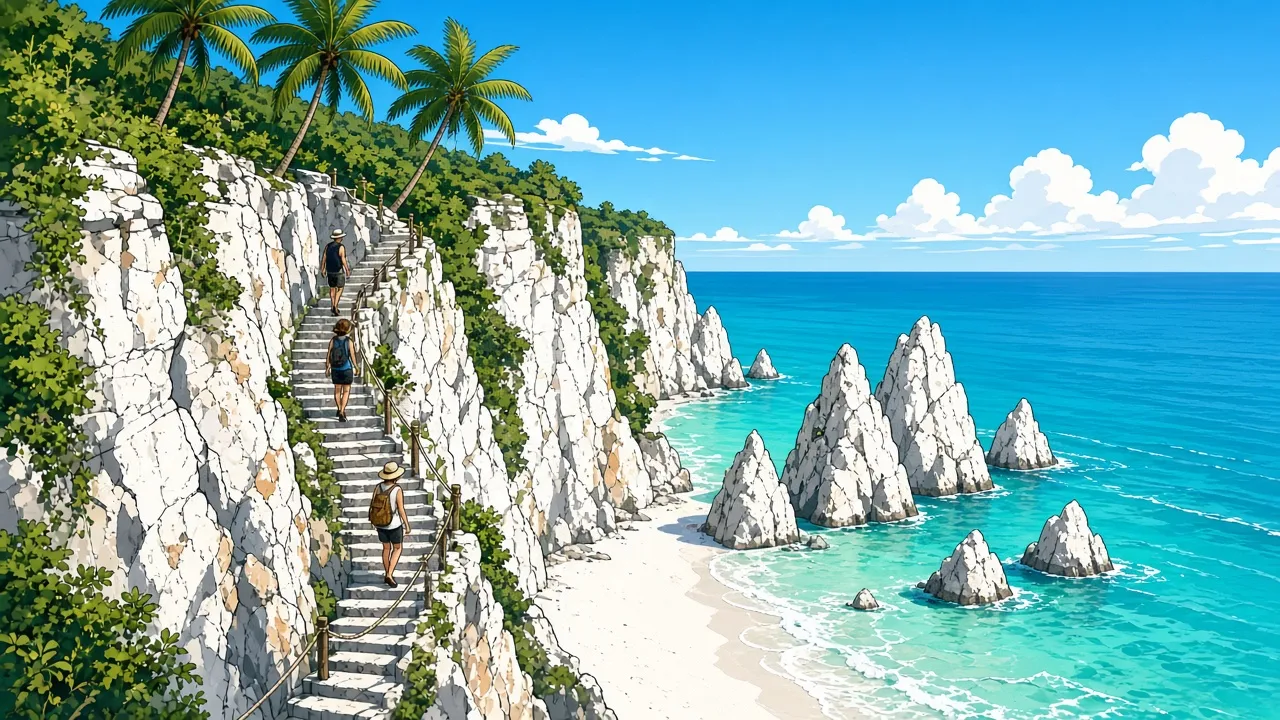
Diamond Beach, on the east coast, has white sand and pointed limestone pinnacles in turquoise water, reached by a staircase cut into the cliff with a rope handrail. The walk down takes about 10 to 15 minutes. It suits couples and photographers, and the early morning light is the best. The limitation is the sea: waves break hard on the sand, and swimming is only safe in calm conditions, close to shore.
8. Atuh Beach
Atuh is the sheltered bay next to Diamond Beach, with sunbeds, a few warungs and a sea arch at one end, reached by a steep path. It suits a long swim and lunch break on an East tour. The limitation is the climb back to the car park, which is tiring in the heat.
9. The Thousand Islands viewpoint and treehouses
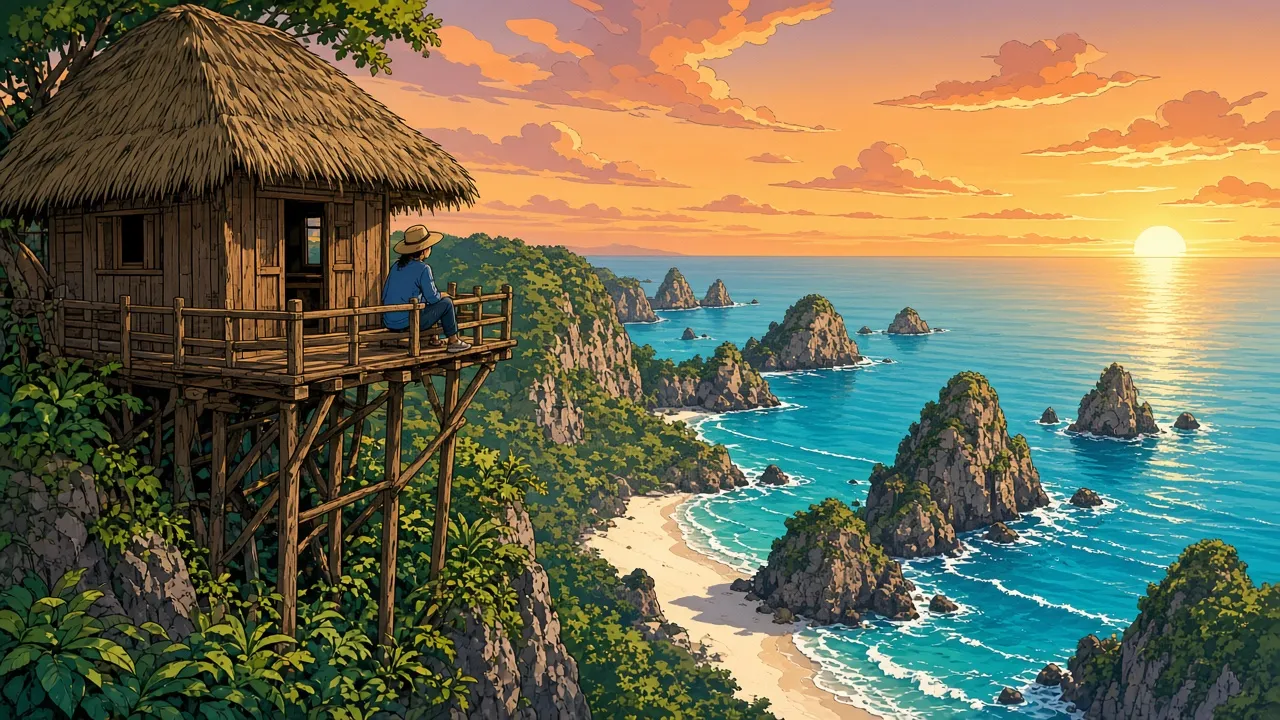
Above Atuh, a viewpoint looks over a scatter of rocky islets that gives the place its name. Nearby, a few stilted treehouses with thatched roofs, the best known at Molenteng, sit on the clifftop, and some can be booked for the night. It suits sunrise seekers and anyone staying overnight on the east coast. The limitation is the drive, roughly 60 to 90 minutes from the northern harbours.
10. Peguyangan Waterfall
Peguyangan is a sacred spring on the south coast where fresh water flows out of the cliff into pools beside a small temple, reached by a blue-painted staircase of several hundred steps, often quoted as about 700. It suits fit travellers who want a quieter sight. Visitors wear a sarong at the temple, and the bathing pools are used for blessings. The limitation is the climb back up in the heat, which takes most people 20 to 30 minutes.
11. Goa Giri Putri cave temple
Goa Giri Putri, on the north-east coast, is a Hindu temple inside a limestone cave roughly 300 metres long, entered by squeezing through a narrow opening at the top of a staircase. Inside, the cave opens into high chambers with shrines and priests. It suits anyone interested in Balinese religion. Sarongs and sashes are required and usually lent at the entrance, and visitors make a small donation. The limitation is the crowd of pilgrims on festival days.
12. Pura Dalem Ped
Pura Dalem Ped, on the north coast near Ped, is one of the most important temples in the Bali region for Balinese pilgrims, linked to the protective spirit Ratu Gede Mecaling. It suits travellers staying on the north coast, a short ride from the harbours. Visitors must dress respectfully with a sarong and sash and stay outside the inner courtyards during ceremonies. The limitation is that it is a working temple, not a tourist sight, so visits are short and quiet.
13. Tembeling forest and natural pools
Tembeling is a shaded forest valley on the south-west coast with freshwater springs, small pools and a temple, ending at a little beach. It suits travellers looking for a cooler, less crowded stop between Kelingking and Peguyangan. The limitation is the access road and track, which are steep and rough, and the final section is best walked or done with a local driver.
14. Teletubbies Hill
Teletubbies Hill is an area of rounded grassy hills in the south-east, named after the children's television show. It is greenest in the wet season, roughly December to April, and brown in the dry months. It suits a quick stop on the way to the east coast. The limitation is that, outside the green season, it is a short photo stop rather than a destination.
15. Sunset at Crystal Bay and evenings in Toyapakeh
Nusa Penida has very little nightlife. The best evening activity is watching the sun set from Crystal Bay, then eating at a warung or a small restaurant in Toyapakeh or Ped. Away from the harbours the island is dark, which makes the night sky clear. It suits couples and families. The limitation is the dark, unlit roads, which are best driven by a local.
Nusa Penida itinerary: day trip, 2 days or 3 days?
One day covers the west coast, two days add the east coast, and three days add a full day on the water. The plans below assume a base on the north coast near Toyapakeh or Ped.
Day trip from Bali
| Time | Plan |
|---|---|
| 07:00 to 08:00 | Fast boat from Sanur, 40 to 55 minutes |
| 09:00 to 10:30 | Kelingking viewpoint before the main crowds |
| 11:00 to 12:30 | Broken Beach and Angel's Billabong |
| 12:30 to 14:30 | Lunch and a swim at Crystal Bay |
| 15:00 to 16:30 | Return to the harbour and boat back to Bali |
Two days
- Day 1: West tour in the afternoon after arrival, sunset at Crystal Bay.
- Day 2: early start for the east coast at Diamond Beach, Atuh and the Thousand Islands viewpoint, with Teletubbies Hill or Goa Giri Putri on the way back.
Three days
- Day 1: arrive, Pura Dalem Ped, sunset at Crystal Bay.
- Day 2: snorkelling or diving with manta rays in the morning, Kelingking and Broken Beach in the late afternoon when the day-trippers have gone.
- Day 3: sunrise from a treehouse or the Thousand Islands viewpoint, Diamond Beach, Peguyangan Waterfall or Goa Giri Putri, then the boat back.
Travellers who want to see the island without planning the logistics can follow the timeline in the Nusa Penida day trip from Sanur guide, written for divers but useful for anyone crossing early from Sanur.
How do you get to and around Nusa Penida?
Fast boats from Sanur reach Nusa Penida in about 40 to 55 minutes, and most visitors then hire a car with a driver for the day, which costs roughly IDR 600,000 to 800,000. Scooters are cheaper but the roads are steep, narrow and potholed.
Getting there
Public fast boats leave Sanur from shortly after 07:00 and cost around IDR 350,000 return, landing at Toyapakeh, Banjar Nyuh or Sampalan on the north coast. Boats also run from Padang Bai and Kusamba on Bali's east coast, and the slow public car ferry from Padang Bai takes around one and a half to two hours. From Nusa Lembongan the crossing is only a few minutes, as the Nusa Lembongan guide describes. Boarding in Sanur is from the beach, so passengers wade in to their knees, and luggage is best kept small.
Klungkung Regency, which governs the islands, collects a visitor fee on arrival, about IDR 25,000 for a foreign adult, separate from the Bali tourist levy. The Bali travel guide covers that levy and the other entry rules.
Getting around
| Option | Typical 2026 cost | Good for | Watch out for |
|---|---|---|---|
| Car with driver | About IDR 600,000 to 800,000 per car per day | Groups, families, first visits | Agree the route and hours in advance |
| Scooter rental | About IDR 70,000 to 100,000 per day | Experienced riders staying overnight | Steep gravel, potholes, licence |
| Day tour from Bali | About IDR 700,000 to 1,500,000 per person | Day trips with no planning | Fixed route, peak-hour crowds |
| Entrance and parking | About IDR 5,000 to 25,000 per sight | Every sight | Small cash needed |
The roads deserve respect. Many are single-lane with steep gradients and loose gravel, and the drive to Kelingking alone can take 45 minutes each way from the harbours in the afternoon. Riders need an International Driving Permit with a motorcycle category, and a helmet, and those without experience on steep hills are safer with a driver. Cash is essential: ATMs exist in Toyapakeh, Ped and Sampalan, but not at the sights.
Is Nusa Penida safe?
Nusa Penida is safe for visitors who treat the cliffs, the sea and the roads with care. Most incidents happen on the Kelingking trail, at Angel's Billabong, on scooters, and when swimming outside sheltered bays.
- Kelingking trail: wear shoes with grip, carry water, go early or late, and turn back if it is wet.
- Angel's Billabong: only enter the pool at low tide on a flat sea, and never stand at the outer edge.
- Beaches: Kelingking, Diamond and Broken Beach face the open ocean, with strong waves and rip currents.
- Snorkelling: go with a boat and guide outside sheltered bays, and use fins, because currents can change quickly.
- Roads: hire a driver if not experienced on steep, rough roads, and avoid riding after dark.
- Health: carry water and sun protection, and know that serious medical care means a boat back to Bali.
That last point matters for divers in particular. There is no recompression chamber on the island, so serious diving injuries mean a transfer to Bali. The Bali safety guide covers the wider risks, from traffic to animals.
Is Nusa Penida worth it?
Yes, for most visitors to Bali. Its cliffs, beaches and manta rays are among the most striking sights in Indonesia, but a day trip is long and busy, so the island rewards a night or two more than a rushed loop.
It is worth it for travellers who enjoy dramatic scenery, snorkelling and early starts. It is less worth it for anyone prone to seasickness, travellers with limited mobility, or those who dislike long, bumpy car rides, because the famous viewpoints need both. In those cases, Nusa Lembongan or a boat trip that stays on the water may suit better.
The best time to visit is the dry season, roughly April to October, when the sea is usually calmer and the roads dry. July to October brings the mola mola season and colder water, explained in the mola mola season guide, while the wet months make Teletubbies Hill green but some roads slippery. Whatever the month, arriving at the main viewpoints before 10:00 or after 15:00 avoids the busiest period.
Example: a Nusa Penida water day from Sanur with Neptune Scuba Diving
Neptune Scuba Diving runs snorkelling and diving trips to Nusa Penida from its dive center in Sanur. The example below shows how a water day fits around the land sights; several operators run similar trips.
- Departure from Sanur is around 08:30 to 09:00, with hotel pickup in selected areas, and the speed boat takes about 45 minutes to Penida.
- Snorkellers visit manta and reef sites with a guide; the Penida snorkelling page lists the day from IDR 2,070,000 per person.
- Certified divers make two dives at sites such as Crystal Bay and the Manta Point dive site, listed from IDR 2,700,000, and non-divers can start with a try dive limited to 12 metres.
- The boat returns to Sanur in the afternoon, so the land sights are a separate day.
This day is not for everyone. It does not include the clifftop viewpoints, which need a land tour or an overnight stay. Snorkellers should be comfortable swimming in open water with fins, and divers heading for Manta Point should hold at least an Open Water certification. It is not suitable for anyone flying within 18 hours after diving, as recommended by Divers Alert Network for repetitive dives. Other dive sites around the island are described on the Nusa Penida dive sites page.
Key takeaways
- Nusa Penida's best sights are clifftop viewpoints and hidden beaches, plus manta rays and cave temples, about 40 to 55 minutes by boat from Sanur.
- The West tour (Kelingking, Broken Beach, Angel's Billabong, Crystal Bay) fits a day trip; the East tour needs a night on the island.
- Arrive at the main viewpoints before 10:00 or after 15:00 to avoid the day-trip crowds.
- A car with driver costs about IDR 600,000 to 800,000 a day; scooters suit only experienced riders.
- Only enter Angel's Billabong at low tide on a flat sea, and wear proper shoes on the Kelingking trail.
- Spend a separate day on the water for snorkelling or diving with manta rays.