
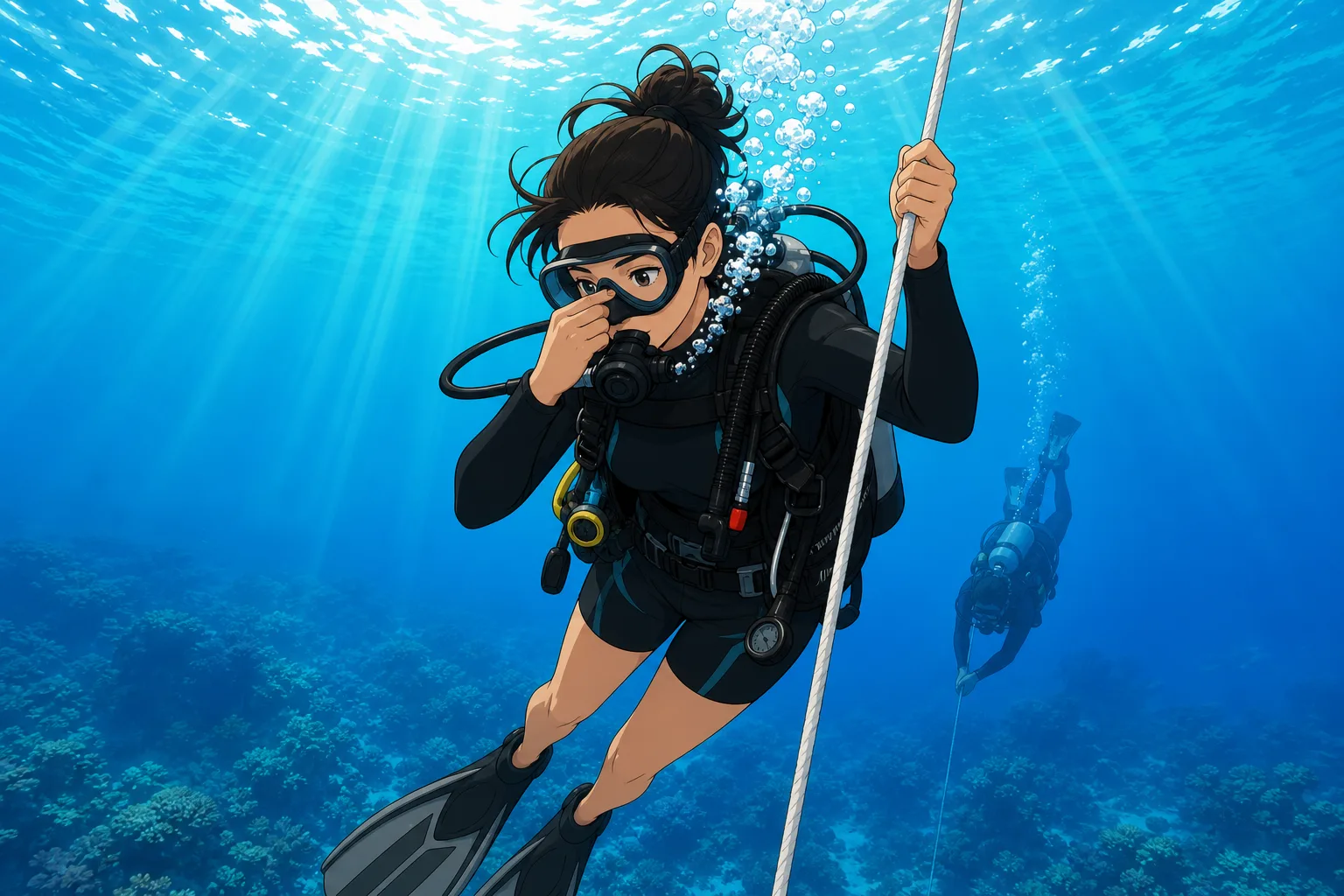
More dives get ruined by ears than by anything else. Not sharks, not currents, not running out of air. Ears. At our Sanur shop we watch it happen most weeks: a diver on their first try dive or their fourth holiday dive gets to four metres, feels that hard pressing ache, pushes through it because they do not want to spoil the group's dive, and surfaces an hour later with a headache and muffled hearing that lasts three days. Almost all of it is preventable, and almost all of it comes down to a handful of habits that take ten minutes to learn.
This guide covers the physics in plain language, all seven equalisation techniques rather than just the one everybody gets taught, and what to actually do when your right ear refuses to cooperate at six metres above a reef you paid to see. We teach this on every Open Water course we run, and we will happily spend an extra fifteen minutes in the shallows with a guest whose ears are slow, because that is far cheaper than a wrecked holiday. Where this article touches on medicine we lean on Divers Alert Network rather than our own opinions, and if you have persistent ear trouble, a doctor beats a dive instructor every time.
Why Your Ears Hurt When You Descend
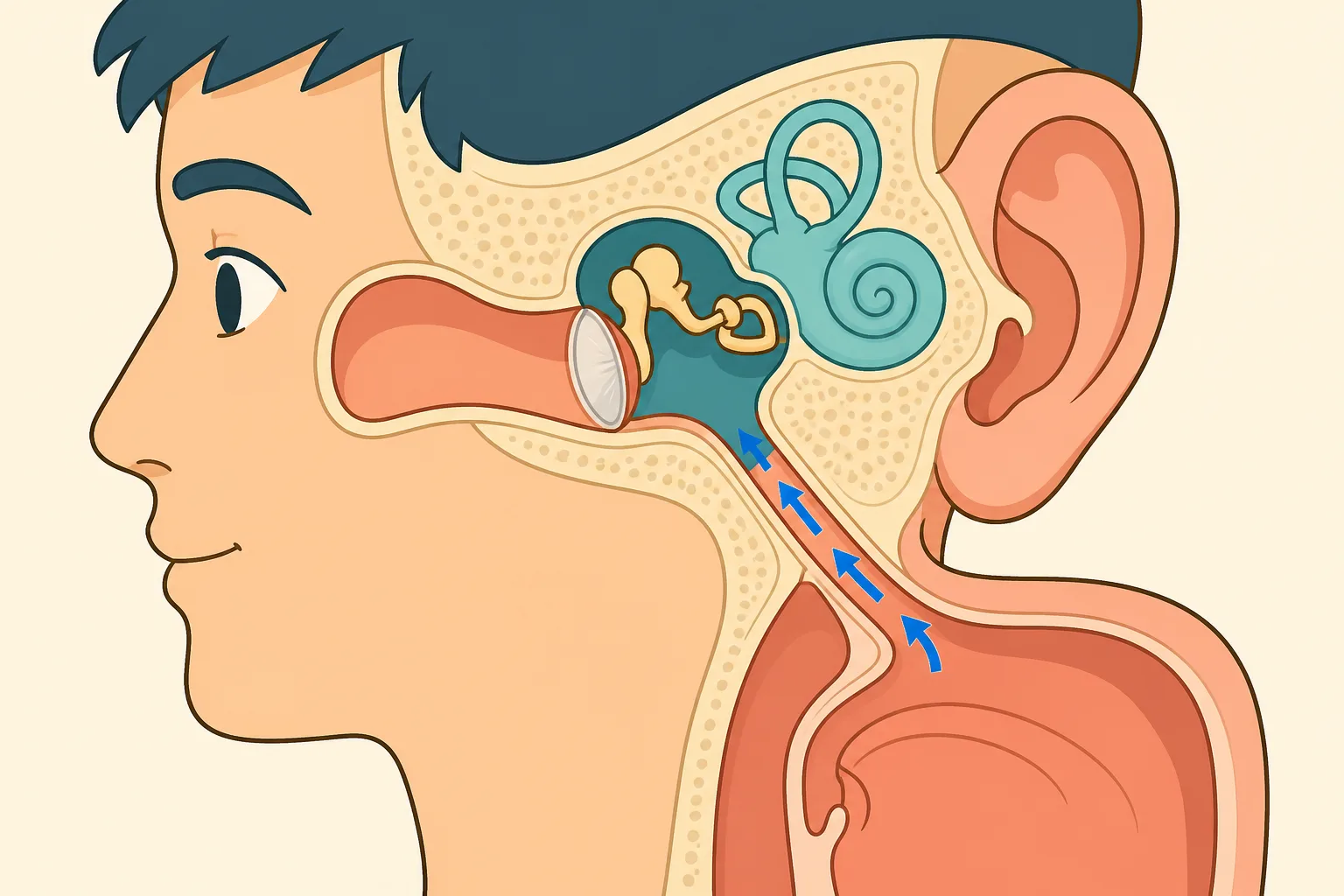
Behind your eardrum is a small pocket of air called the middle ear. It is a sealed space with exactly one way in, the Eustachian tube, a narrow passage running down and forward to the back of your nose. Those tubes sit closed by default. Every time you swallow or yawn, throat muscles pull them briefly open, which is enough to keep everything balanced in ordinary life. You have been equalising thousands of times a day without noticing since you were born.
Diving breaks that comfortable arrangement. As you descend, water pressure squeezes in on your eardrum from the outside while the air pocket behind it stays at surface pressure. The eardrum bends inward. First it feels like fullness, then pressing, then genuine pain, and if you keep going the tissue stretches beyond what it tolerates and you get middle ear barotrauma: fluid, sometimes blood, in that space, muffled hearing, and in bad cases a perforation. Equalising simply means adding air up the Eustachian tube into the middle ear to push back with equal force.
Why the first five metres are the dangerous part
Here is the bit that surprises people. The pressure change is not spread evenly through the dive. Going from the surface to 10 metres doubles the pressure, which compresses that air pocket to half its volume. Going from 10 to 20 metres, an identical distance, only reduces it by a further sixth. In practical terms the worst of it is over before you reach the reef, and the most common place for an ear injury is the shallow water most divers hurry through because nothing interesting is there yet.
This is also why divers who have no problem at 25 metres can be in trouble at three. Once you are deep, each additional metre demands relatively little. The ache people remember from the top of a dive is not weakness, it is physics, and it means the shallow part of the descent deserves your full attention. If you want the wider picture on depth and pressure, our article on how deep you can scuba dive covers the same principles from the other direction.
The Golden Rule: Equalise Early and Often
If you take one thing from this article, take this. Equalise before you feel anything. The moment you feel pressure, you are already behind, and DAN's guidance is blunt about why: if you let a pressure differential build, it presses the soft tissue at the end of the Eustachian tube together and effectively locks it shut. Blowing harder at that point does not open it. It jams it tighter. That is the single mechanism behind most ear injuries in recreational diving, and it is entirely a timing problem rather than a strength problem.
DAN recommends equalising roughly every two feet of descent, which is about every 60 centimetres. That sounds absurdly frequent until you try it, at which point it becomes a gentle rhythm you stop thinking about. Our instructors phrase it as equalise, sink a little, equalise again, and never let the gap between attempts get big enough to feel. A slow descent is not a sign of a nervous diver. It is a sign of a diver who intends to still be diving tomorrow.
Start before you get in the water
Equalise gently on the boat, before you giant stride. Equalise again at the surface before you deflate your BCD. Getting a little positive pressure into the middle ear while there is no differential at all makes the first few metres dramatically easier, and it costs you nothing. Our guides do this without thinking, which is why guests sometimes see the whole crew apparently pinching their noses at each other before a dive at Padang Bai.
Descend feet-first if you possibly can, and hold a line if one is available. Feet-first matters for a practical reason: air rises, so it travels up the Eustachian tube more willingly when your head is above your feet. Head-down descents make equalising harder at exactly the moment it needs to be easy. A line lets you control the rate to the centimetre and stop instantly, which is why we hang one off the boat on almost every trip. Beginners on our day trips use it as a matter of course, and plenty of experienced divers use it too.
The Seven Equalisation Techniques
Most divers know one method. There are seven, they suit different people, and the one taught in every entry-level course is arguably the crudest of the lot. Learning two or three gives you options when your usual approach fails, which it eventually will.
Valsalva, and its three problems
Pinch your nose and gently blow against it. This is what almost everyone is taught, it works most of the time, and it is worth understanding what is wrong with it. DAN lists three specific problems. First, it does not activate the muscles that actually open your Eustachian tubes, so it is useless once the tubes have locked shut. Second, it is far too easy to blow hard enough to injure something. Third, blowing against a blocked nose raises fluid pressure inside your inner ear, which can rupture the round window, an injury in a completely different league from a sore eardrum.
Use it gently, and follow the rule DAN gives: do not hold the pressure for more than five seconds. If a soft Valsalva does not work, the answer is never a harder Valsalva. The answer is to stop descending.
The techniques that use your throat muscles
Toynbee. Pinch your nose and swallow. Swallowing pulls the tubes open while your tongue compresses air against them, and it is particularly useful on ascent when a reverse block is brewing. Many divers find it gentler and more reliable than Valsalva once they get used to swallowing with a regulator in.
Frenzel. Pinch your nose, close the back of your throat as if straining to lift something heavy, and make a hard K sound. The back of the tongue drives air upward against the tube openings. It takes practice, it uses far less pressure than Valsalva, and it can be done repeatedly without the risk profile. Freedivers live by it. Scuba divers who learn it usually stop using anything else.
Voluntary tubal opening. Tense the soft palate and throat while pushing your jaw forward and down as though beginning a yawn, and the tubes pull open on their own. DAN notes that up to 30 percent of divers can master this, and those who do can sometimes hold their tubes open continuously and simply descend without doing anything. It is the goal worth aiming for and the hardest to learn.
Lowry. Pinch, blow gently and swallow at the same time. A combination of Valsalva and Toynbee, and a good fallback when either alone is not quite doing it. Edmonds. Push your jaw forward and down while performing a Valsalva or Frenzel. Adding the jaw movement often opens a tube that will not respond to pressure alone. Passive. Not a technique so much as what happens on ascent, when expanding air escapes on its own, which is why going up is usually the easy direction.
Which one should you learn?
Start with what you know, then add Frenzel. It is the highest-value skill on this list for a recreational diver: low pressure, repeatable, and effective. Add the jaw-forward movement from Edmonds as a modifier to whatever else you are doing, since it costs nothing and often works. Keep Toynbee for the way up. Divers working on their overall water skills often pick these up alongside the finer control taught in the Peak Performance Buoyancy course, because a diver who can hold depth precisely can also stop precisely when an ear complains.
What to Do When It Fails Mid-Descent
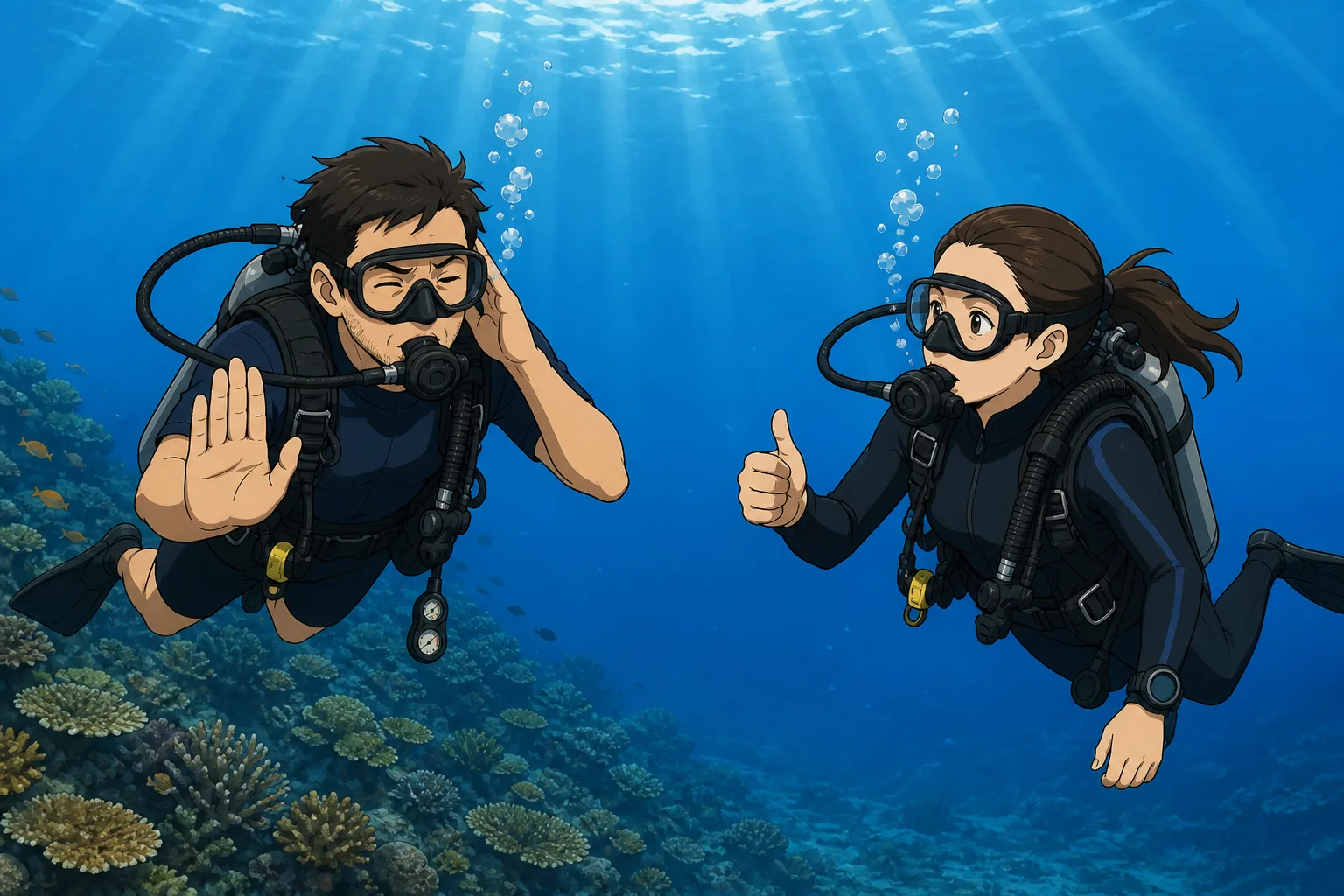
It will happen, including to people who have done it right. Here is the sequence, and it works nine times out of ten.
Stop descending immediately. Signal your buddy or guide, which is one of the standard signals covered in our guide to diving hand signals. Ascend half a metre to a metre, which relieves the differential enough for the tube to unlock. Try again gently, ideally with a different technique from the one that just failed. Tilting your head so the blocked ear points toward the surface helps more than it has any right to. Then descend again slowly, staying ahead of it.
If it clears, carry on and keep equalising more often than you think you need. If it does not clear after two or three attempts, that dive is not happening at depth, and the correct response is to accept it. Some days one ear simply will not play, for reasons as boring as yesterday's air conditioning or a bit of dust on the drive to Tulamben. Push through it and you buy yourself a week of muffled hearing and a genuine risk of a perforation, which puts you out of the water for weeks rather than one dive.
Never do these three things
Never blow harder to force it. You are pressing locked tissue together and risking your inner ear. Never keep descending while it hurts, on the theory that it will pop eventually. It might, and what pops may not be what you hoped. And never let group pressure make the decision. Our guides have seen guests visibly wincing at five metres while pointing down because they can see the rest of the group leaving. We would far rather bring one diver back up and rejoin the group late, or run a shallower dive for two of us, than have anybody finish the day with a bleeding eardrum.
Ascent Problems: Reverse Block and Vertigo
Going up is normally the easy direction, because expanding air pushes its own way out. DAN notes it escapes once middle ear pressure exceeds the surroundings by a small margin, equivalent to rising between about half a foot and two and a half feet. Occasionally, though, a tube that is swollen or congested will not let air out, and that is a reverse block: pressure building inside the middle ear as you rise, with nowhere to go.
The fix is the mirror image of a failed descent. Stop your ascent, go back down slightly until the pressure eases, then come up very slowly, using Toynbee or gentle jaw movement to encourage the tube open. It is uncomfortable and occasionally alarming, but it resolves. What makes reverse block genuinely dangerous is that you cannot stay down indefinitely to wait it out, which is one more reason to plan conservative dives with gas in reserve. Our overview of whether scuba diving is dangerous puts this class of problem in perspective.
Then there is alternobaric vertigo, which is what happens when one ear equalises and the other does not, usually on ascent. The mismatch between the two sides confuses your balance system and the world spins. DAN puts the threshold at a pressure difference of roughly two feet of water between the ears. It is disorienting and it passes within seconds to minutes once the pressures even out. If it happens, hold onto something solid or your buddy, breathe steadily, do not bolt for the surface, and let it settle. Guests who have felt it once become extremely diligent equalisers, which is a silver lining of sorts.
Colds, Allergies and the Decongestant Trap
You cannot equalise reliably through swollen Eustachian tubes, and that is the whole reason we ask about head colds at check-in. DAN lists the usual culprits: upper respiratory infections, hay fever, allergies, smoking and a deviated septum. Bali adds a couple of its own. Air conditioning set to arctic in a hotel room dries and irritates the airways, and the dry season dust on the roads out to the east coast sites bothers people with allergies more than they expect.
The decongestant question comes up constantly, and our answer is that it is a trap rather than a solution. Yes, a decongestant may open things up enough to get you down. The problem is what happens when it wears off at depth, because now the swelling returns while you still have to come up, and the reverse block you get on ascent is considerably worse than the descent problem you were trying to avoid. It also masks a signal you actually want. If you need drugs to get down, your body is telling you something.
Our position is simple: a proper head cold means no diving, and we will reschedule where we can. A mild allergy that you manage routinely at home is a conversation with your doctor, not with us. This sits alongside the wider fitness-to-dive picture we cover in the Bali health and vaccinations guide, where the same principle applies: the dive is not going anywhere, and there will be another boat tomorrow.
Training Your Ears Before the Trip
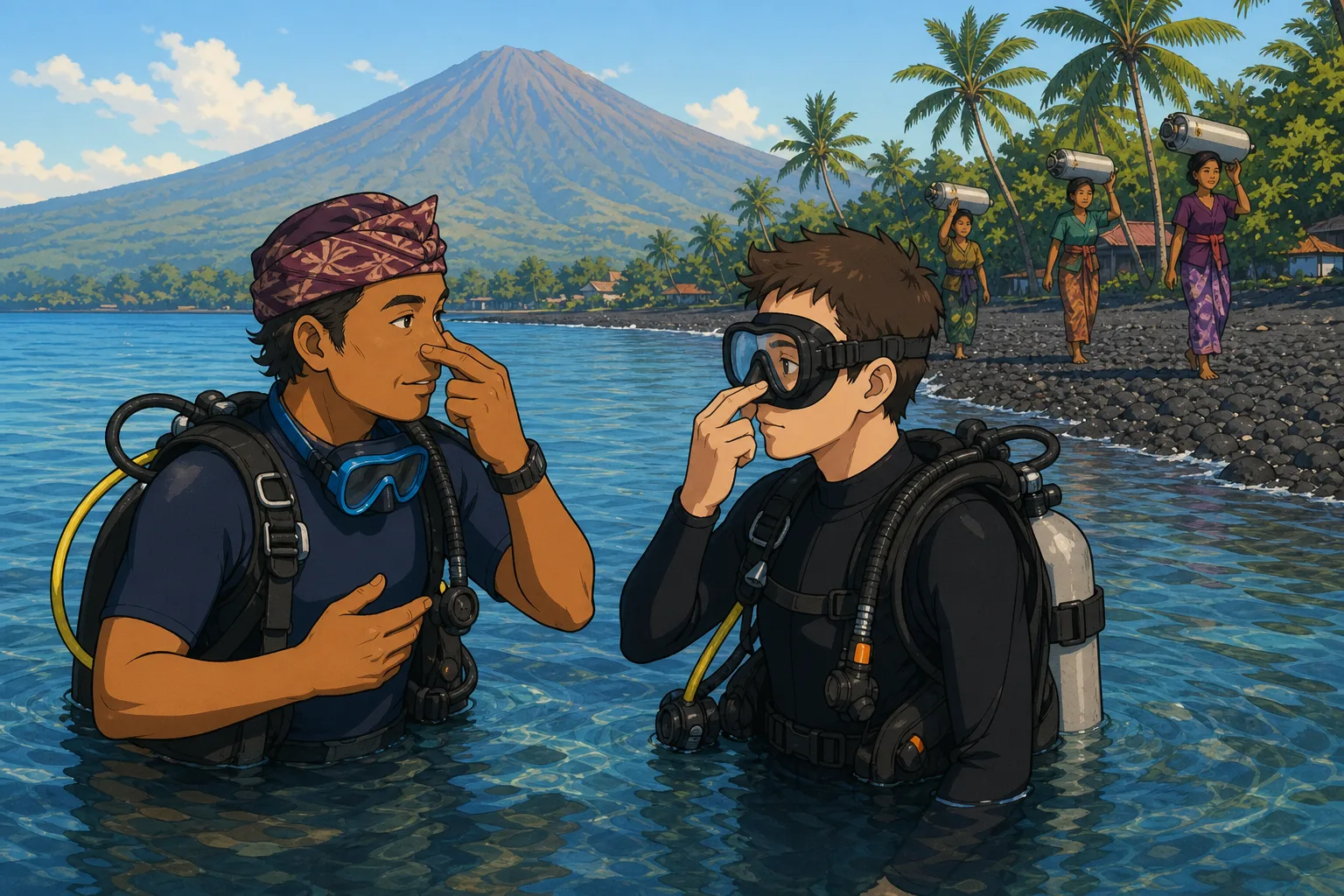
Equalisation is a skill, which means it improves with practice, and the practice does not require water. Several days before you fly, start equalising gently a few times a day on dry land. Practise Frenzel in front of a mirror until the K sound produces that small click in your ears. Chew gum on the plane. Divers with historically slow ears who do this for a week regularly report an easier first day, and while we cannot claim that as science, we have seen it enough times to keep recommending it.
In the water, the shallows are your friend. Our instructors will stand in waist-deep water with a nervous student and simply have them duck under repeatedly to a metre, equalising each time, until the rhythm is automatic. That is fifteen minutes well spent at the start of a course. The try dive format is ideal for this because there is no schedule pressure, and students on the Open Water course get the same attention. Divers coming back after years away often find their ears are the rustiest part of them, which is one of the better arguments for a structured course or a refresher over jumping straight onto a boat.
One frequently asked question we will answer plainly: no, earplugs are not the solution, unless they are the specialised vented type designed for diving. Ordinary swimming earplugs create a sealed air pocket in the outer ear canal that you cannot equalise at all, which produces an outer ear squeeze in addition to whatever your middle ear is doing. Well-intentioned, and worse than nothing.
How We Handle Slow Ears on Bali Dive Sites
Site choice matters more than most divers realise, and this is where an operator can genuinely help. Not every Bali dive site gives you the luxury of a slow descent.
The shore entry at Tulamben is the gentlest option on the island. You walk in over the pebbles, kneel in two metres of water, and take as long as you need before heading down the slope toward the wreck. Nobody is waiting on a boat, there is no current pulling you off the site, and if you need five minutes to get through the first four metres you take five minutes. The bay sites at Padang Bai and the calm profiles at Amed and Menjangan are similarly forgiving.
Nusa Penida is the other end of the spectrum. Several sites there want a prompt, committed descent because the current is moving and the group needs to arrive together at the right part of the reef. Our guide to drift diving in Bali explains why. If we know your ears are slow, we will tell you honestly before you book that a Penida day may be frustrating, and suggest an east coast day instead. Some guests do Penida later in the week once their ears have settled into the rhythm, which works well. The trip prices are similar either way, so this is about your day rather than our till.
On the boat itself, our guides watch the descent. A hand going to the side of the head is the universal tell, and you will usually find a guide already beside you giving the thumb-up-slightly signal before you have finished thinking about it. We would rather run a 12-metre dive with somebody than a 25-metre one without them, and the reefs around Sanur and the east coast are perfectly good shallow.
When It Is Not Technique, and You Should See a Doctor
Technique fixes most equalisation problems. It does not fix all of them, and knowing the difference saves people a lot of frustration. Go and see a doctor, ideally an ENT specialist with some diving knowledge, if any of the following describes you: ears that consistently fail on both sides even with good technique and slow descents, pain or muffled hearing that persists more than a day or two after a dive, any discharge or bleeding from the ear, ringing or hearing loss that does not resolve, or vertigo that lasts beyond the moment.
Structural things like a deviated septum, chronic sinus problems, scarred tubes from childhood ear infections or a previous perforation are all real and all common, and none of them can be fixed by trying harder. Some are treatable, and divers who get them sorted often find that a problem they assumed was permanent simply disappears. In south Bali there are good ENT clinics in Denpasar and Sanur, and the international clinics can refer you quickly if something happens mid-trip.
Also worth saying: none of this changes surface interval advice. Ear trouble does not extend or shorten your no-fly time, although flying with a fresh ear injury is its own kind of misery, so factor that into your last dive day. If you are unsure whether your ears are up to a particular trip, message us with the details before you book. We will tell you which sites suit and which do not, and if the honest answer is that you should spend the day snorkelling while your ears recover, we will say so. Our guides at the Sanur dive centre have all done it themselves at some point, and if you want the deeper safety training behind incidents like these, the Rescue Diver course is where it is covered properly.
Get the ears right and diving becomes what it is supposed to be: an unhurried descent into warm water with nothing on your mind. Get them wrong and it is a week of muffled hearing and a story you tell against yourself. The difference is about ten minutes of learning and the willingness to stop when your body says stop. New divers should read our guide for first-time divers in Bali next, and check the seasonal Bali diving conditions before you pick your dates.