
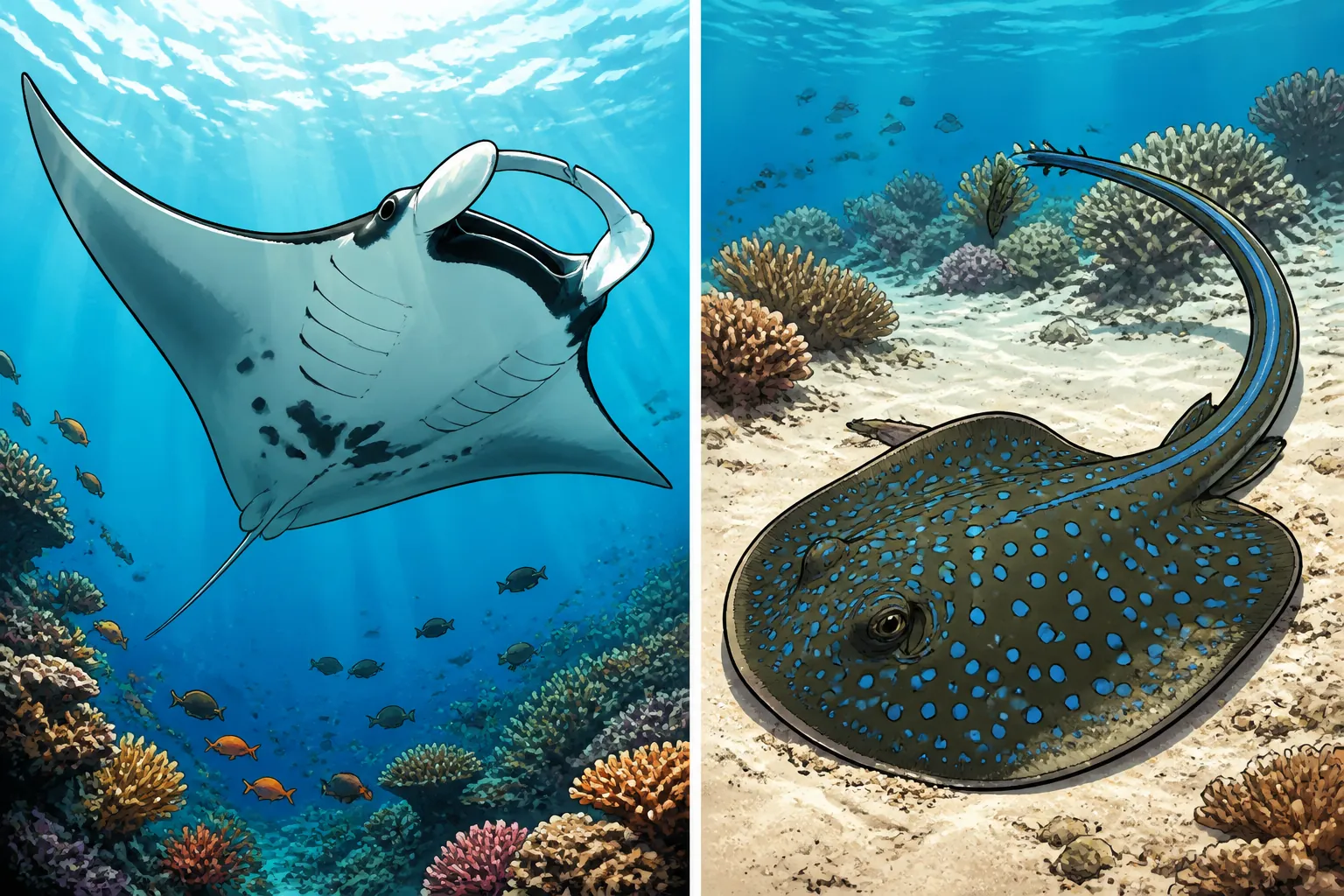
Do manta rays sting? No. Not once, not in shallow water, not if you accidentally brush a wingtip. The animal that shows up on your Nusa Penida diving trip has no barb, no stinger and no venom. We get asked this at the Sanur counter almost every morning before a Penida boat leaves, usually by someone who watched a nature documentary and then spent the night googling Steve Irwin.
What they are mixing up is a manta ray with a stingray. Both are rays. Only one of them can hurt you, and it is almost never the one you came to Bali to see. This guide is the operator version of that distinction: how to tell them apart in the water, where each one turns up on our trips, what to do if you do meet a stingray in the shallows, and why the manta etiquette at cleaning stations still matters even though they cannot sting. If you are booking a first Nusa Penida snorkelling trip, read this before you pack.
We will also cover devil rays, the "are rays dangerous" searches that land on our site, and the first aid that actually applies when a stingray barb is involved. Where medicine is concerned we stick to published guidance, not boat folklore. Where behaviour is concerned we stick to what we see on roughly nine out of ten Penida days when the mantas show.
Do Manta Rays Sting? The Short Answer
Manta rays do not sting. They do not have a serrated spine on the tail. They do not carry venom. They do not bite in any way that matters to a diver. Their mouths are built for filtering plankton, and their tails are thin steering tools, not weapons.
That is the whole medical answer. The practical answer is almost as short. On a normal day at Manta Point you will hover or drift near a cleaning station, a reef manta will cruise in, a few cleaner wrasse will pick at its skin, and you will spend ten or twenty minutes trying not to grin around your regulator. Nobody gets stung. Nobody gets bitten. The only injuries we see on those trips are the usual ones: scraped knuckles on the boat, a coral graze from bad buoyancy, or a guest who ignored the briefing and exhausted themselves chasing an animal that was already leaving.
If you want the broader safety picture on swimming with them, we already wrote whether manta rays are dangerous. This article is the comparison piece that search keeps asking for: manta versus stingray, barbs versus no barbs, and what that means in Bali water specifically.
Manta Ray vs Stingray: How to Tell Them Apart
Stand two of them next to each other and the difference is obvious. In the water, with adrenaline and a fogging mask, people still get it wrong. Use these checks.
| Feature | Manta ray | Stingray (Bali common types) |
|---|---|---|
| Size | Reef mantas often 3 to 4 metres across; oceanic mantas larger | Usually under 1 metre disc width; blue-spotted ribbon-tails are smaller still |
| Where they swim | Open water and reef cleaning stations, mid-water | On or just above sand and rubble |
| Mouth | At the front of the head, with cephalic fins that look like horns | On the underside of the disc |
| Tail | Long, thin, no barb | Thicker base, with one or more serrated barbs |
| Diet | Plankton filter feeder | Crustaceans and small bottom animals |
| Can it sting a person? | No | Yes, if stepped on or pinned |
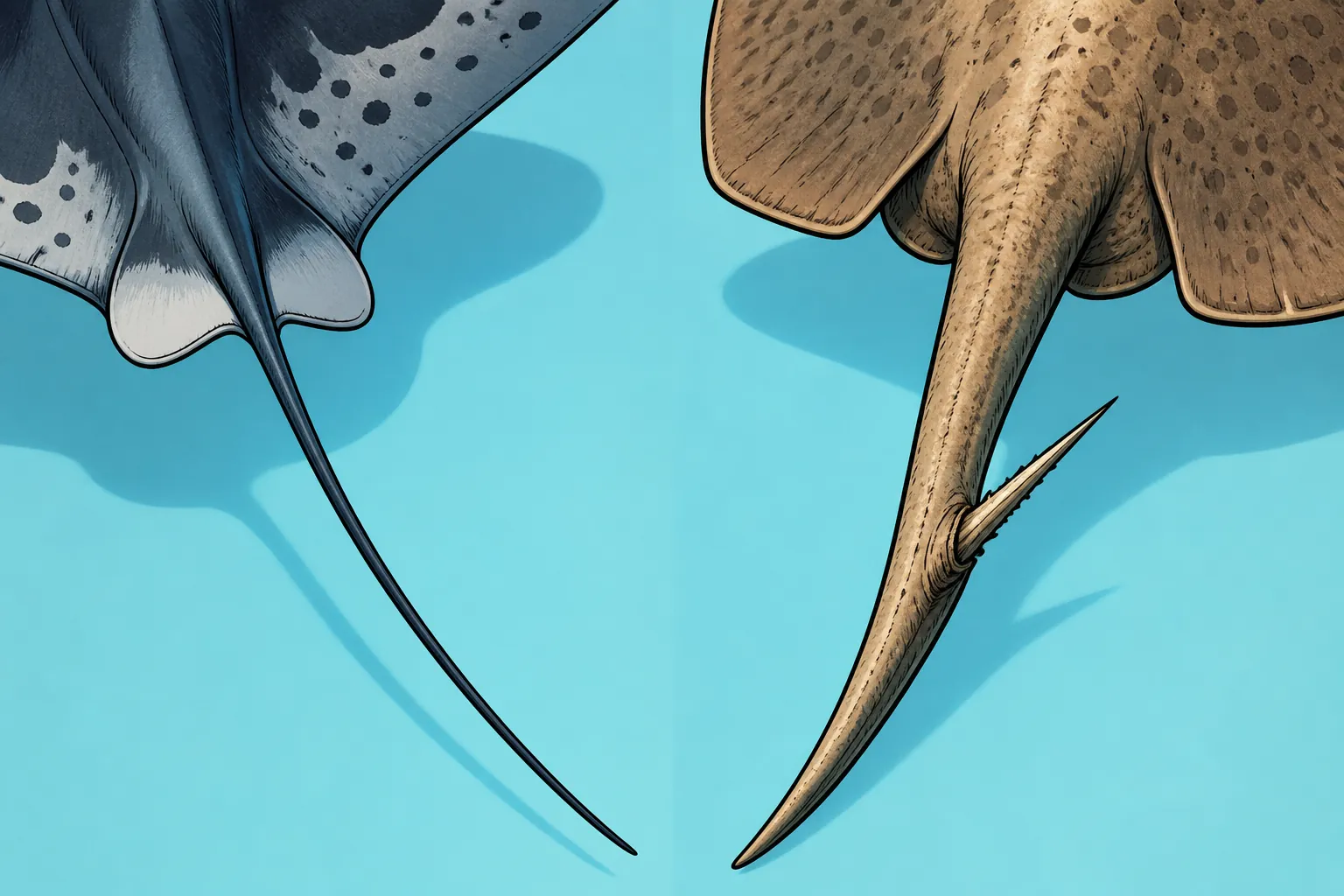
The cephalic fins are the giveaway once you know them. When a manta is travelling they roll up like scrolls. When it feeds they unfurl into paddles that funnel plankton into the mouth. A stingray never does that. A stingray also never parks itself three metres off the bottom at a cleaning station waiting for wrasse. If the animal is huge, mid-water and looking at you with what feels like curiosity, it is a manta.
Colour helps less than people hope. Reef mantas around Penida are typically black on top and white underneath, sometimes with unique belly spot patterns we use for ID photos. Blue-spotted stingrays are unmistakable once you see the neon dots, but other stingrays on Bali sand are plain brown or grey and easy to miss until you are almost on top of them. That camouflage is exactly why the shallow-water risk is about feet, not fins.
Why Everyone Confuses Mantas With Stingrays
Three reasons, and we hear all three before breakfast.
First, the names. Both end in "ray." Travel blogs and hotel staff use the words interchangeably, and once a guest has been told there are "rays at the beach" the brain fills in the dangerous version.
Second, Steve Irwin. The 2006 stingray incident sits permanently in search results next to any question about rays and humans. It was a tragic, rare event involving a large short-tail stingray and a barb to the chest. It had nothing to do with manta rays. We still get guests who arrive convinced that any ray of any size is a lethal threat. It is not fair to the animals, and it is not fair to the guest who then spends the whole dive braced for something that cannot happen.
Third, devil rays. Mobula rays look like smaller, faster mantas, leap out of the water in some parts of Indonesia, and get lumped into the same fear category. They also lack a functional sting for practical purposes in the way guests mean. More on them below.
If your worry is broader marine life rather than rays specifically, our honest ranking of dangerous sea creatures in Bali puts coral cuts and urchins at the top and famous venomous animals near the bottom. Rays sit in the middle of that list only because of the shallow-water stingray problem, not because of mantas.
Do Manta Rays Have Stingers, Barbs or Venom?
No, no and no. This is the long-tail cluster we see in Google Search Console every week: do manta rays sting, do manta rays have stingers, do manta rays have barbs, are manta rays poisonous, can manta rays sting you. Same question, five wordings.
Stingrays evolved a defensive spine because they live on the bottom and get stepped on by larger animals, including humans. Mantas evolved the opposite lifestyle. They live in the water column, they are fast for their size, and their defence is leaving. A 2022 study on reef mantas found that a large share of individuals carry scars from boats and fishing gear, which tells you what actually injures them. It is not fights with divers.
Could a manta hurt you by accident with sheer mass? In theory a panicked turn could knock a snorkeller. In practice, across years of Penida trips, we have not had a guest injured by a manta's body. What we have had is guests injuring the encounter by grabbing for a wing, kicking over a cleaner fish, or dropping onto the animal from above for a photo. That is why the briefing sounds strict even though the animal is harmless.
Are Devil Rays Dangerous?
Devil rays are mobulids, close relatives of mantas. In Bali waters you are more likely to meet reef mantas at the classic sites, but mobulas turn up on drift dives and occasionally in open water between islands. Guests search "are devil rays dangerous" after seeing a leap on social media or a dark shape under the boat.
They are not a threat to divers in the sting sense. Treat them like mantas: no chasing, no touching, give them the water column. If you are comparing destinations and wondering where big ray encounters are more consistent, our manta diving guide for Nusa Penida and the Komodo side of the same family at Komodo Manta Point cover the logistics. A multi-day look at Indonesian ray sites also shows up on King Neptune liveaboard itineraries when the routing allows.
Where You Meet Each One in Bali
Geography matters more than taxonomy once you are on holiday.
Mantas: Penida first
Reef mantas are the reason most people book our Manta Point day. South-west Nusa Penida, cleaning stations, often two tank dives with a surface interval that tastes of packed nasi campur. Encounter rates are high but not guaranteed. On a rough count across a season we are in the "nine out of ten trips see at least one" range when conditions are workable, and we will not invent a better number to sell a seat. When the swell is ugly on the south coast we move the plan, sometimes toward Crystal Bay or other sites, and we say so at 6:30am rather than at the harbour.
Snorkellers get a different geometry. You stay on the surface, the manta comes up through the water column if it chooses, and the same no-touch rules apply. Our full site notes sit in the Nusa Penida snorkelling guide and the wider day trip from Sanur piece. Divers who want the currentier east-side walls can read Blue Corner separately; that is not a manta site in the same way.
Stingrays: sand and shallows
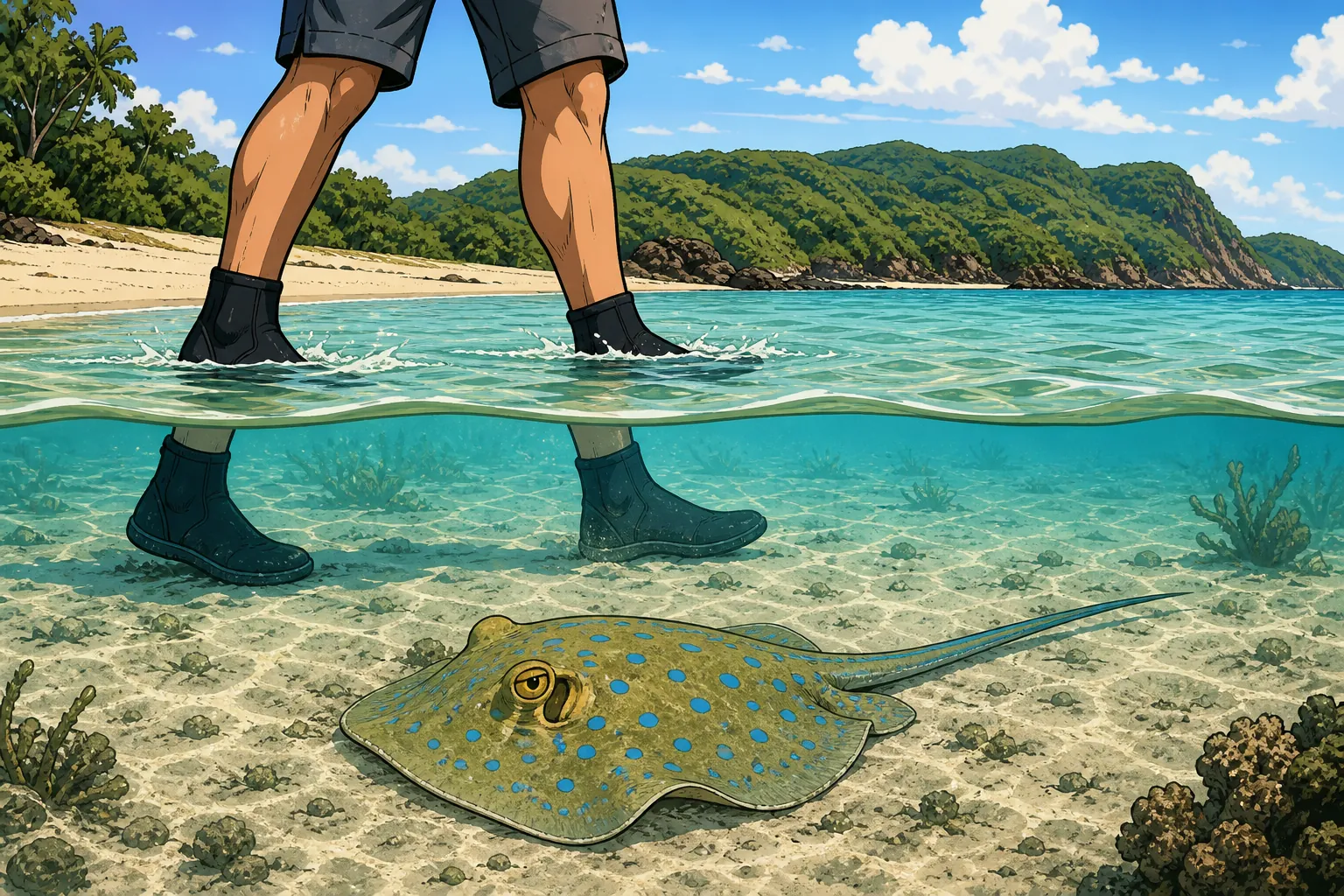
Blue-spotted ribbon-tail stingrays show up on sandy patches all over Bali. We see them on fun dives from Sanur, around Padang Bai, on the black sand at Tulamben, along Amed, and on quieter days at Menjangan. They usually move before you arrive if you are swimming. The problem case is the person standing up in knee-deep water at a shore entry, looking at the horizon, putting a heel down on an animal that was invisible against rubble.
That is also why our Sanur snorkelling briefings sound obsessive about footwear. The aquarium experience offshore is one thing. The walk-in from the beach is where the feet meet the sand.
What a Manta Encounter Actually Feels Like
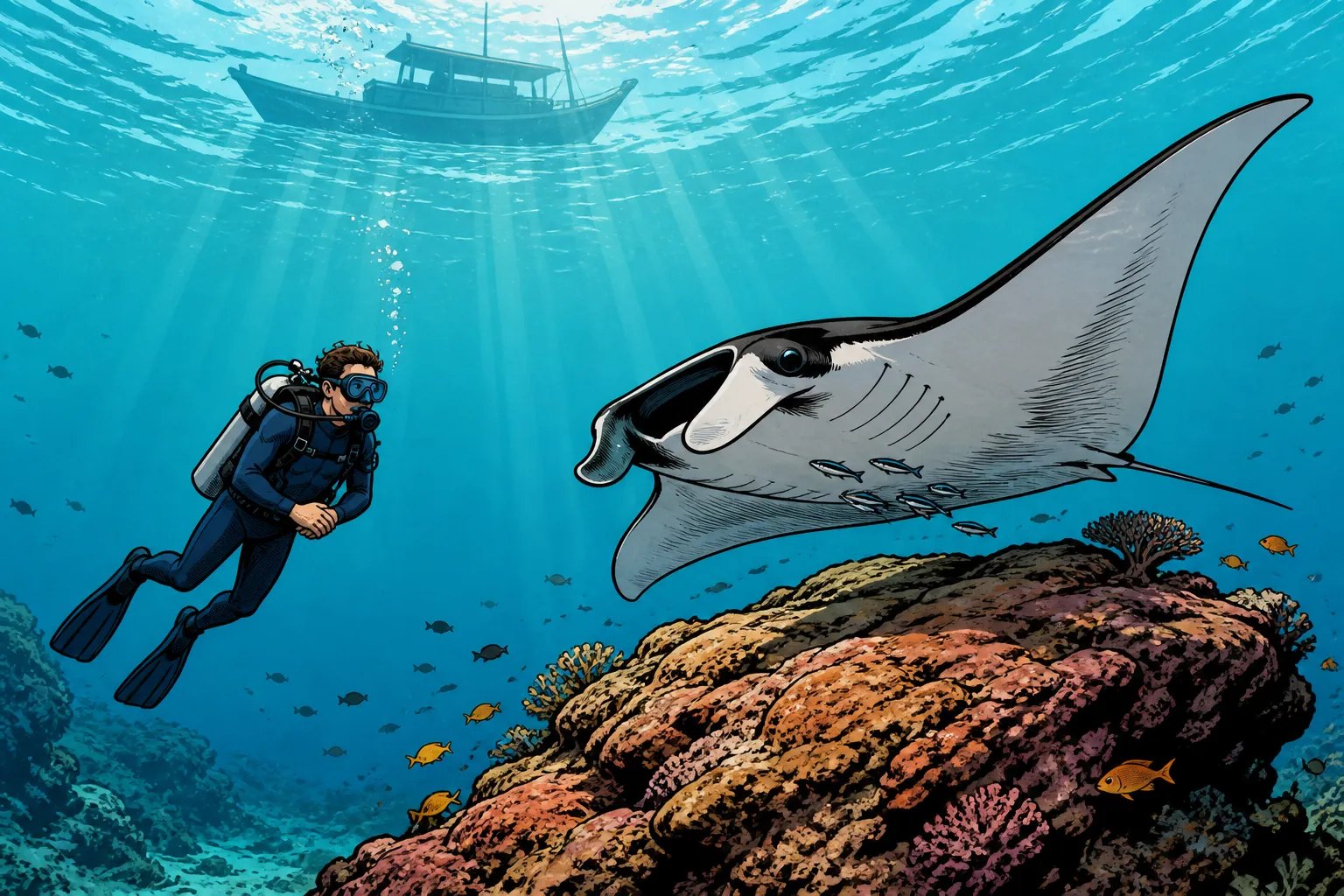
Guests expect a charge. What they get is closer to sharing a quiet room with something enormous.
You settle near the cleaning station. Visibility on a good Penida morning sits around 15 to 25 metres; on a stirred day it can drop to 8 and we still run the dive if the entry is safe. Water is usually 26 to 28°C on the south coast. A 3mm fullsuit is enough for most Europeans. Locals dive in rashies and complain we overdress them.
The first manta often arrives from deep blue rather than from behind the rock you are staring at. Guides clock it earlier than guests. You hear the tank-banger or see the hand signal, you turn, and there is a four-metre animal moving with almost no visible effort. It may make one pass and leave. It may loop the station four or five times. About one in five of our stronger encounters involves a manta that seems to inspect the group, which is the moment people forget to breathe.
We will not promise that. We also will not pretend a no-show ruins the day. Penida reefs without mantas still hold turtles, sharks at a distance, and enough fish life that first-timers leave happy. For the planning version of that honesty, use our Nusa Penida diving overview and the conditions notes in Bali diving conditions.
Photography changes behaviour more than fear does. Wide-angle, no chase, no flash in the animal's face if you can help it, and never prioritize the shot over your buoyancy. Our underwater photography in Bali guide covers the boring skills that keep both the reef and the ray intact.
Stingray Safety: The Bit That Actually Deserves Caution
Here is the honest split we give at the shop. Worry less about the manta at fifteen metres. Worry more about your own feet at half a metre.
Buy reef boots. In Sanur they run roughly IDR 150,000 to 250,000 depending on how fancy you want them. Put them on the packing list next to the adaptor and the seasickness tablets. Our Bali scuba packing list already says this, and we repeat it because guests still turn up in flip-flops for a shore entry.
Shuffle, do not step. The classic tropical advice is dull because it works. Sliding your feet along the sand pushes a resting ray ahead of you instead of pinning it under your weight. A pinned stingray does what it evolved to do: whip the tail up and drive the barb into whatever is on top of it.
Do not handle rays, ever. That includes the blue-spotted ones that look small enough to "just move." Guides who flip rays for photos are not guides you should dive with. The same rule sits inside our macro and muck diving briefings, because muck sites are exactly where people are tempted to rearrange the sand.
Keep buoyancy off the bottom. If you are crashing into sand at Tulamben, you are the incident waiting for a form. Two dives of Peak Performance Buoyancy fix more ray risk than any amount of species trivia. The same skill set shows up in Advanced Open Water.
If a Stingray Stings: First Aid Without the Myths
We hope you never need this section. Read it once anyway.
A stingray injury is a puncture wound with venom on the hardware. Pain arrives fast and climbs. There may be bleeding. Sometimes part of the barb breaks off in the wound. That last detail is why the internet advice to "just pull it out" is dangerous.
What published clinical guidance supports, including Australian first-aid material used across the region: control bleeding, leave an embedded barb in place and pad around it, immerse the injured area in hot water that is tolerable but not scalding, roughly up to about 45°C, for as long as it helps, often 30 to 90 minutes, and get medical care. Do not use a pressure immobilisation bandage the way you would for some snake bites. Fish-spine venom protocols are different.
Test the water temperature on an uninjured limb first. A person in that much pain cannot judge heat, and a burn on top of an envenomation is a real outcome we have heard about from other operators. Then hospital, not "wait and see on the boat." BIMC and the larger Denpasar hospitals are used to tourists with tropical injuries. Call local emergency services on 112 if you need transport.
Mantas do not enter this protocol because mantas do not sting. If someone on your trip claims a manta stung them, what usually happened is a jellyfish, a hydroid, or a coral cut they did not notice until later. Sort the real cause before you invent a new species behaviour.
Why You Still Should Not Touch a Manta
Harmless to you is not the same as fine to grab.
Mantas have a mucus coating that protects their skin from infection. Hands remove it. In a busy cleaning station with thirty snorkellers, repeated touching adds up to stressed animals and abandoned stations. Nusa Penida sits inside a marine protected area conversation for a reason. The short version of the code: stay at the side, let the manta control distance, never ride, never duck onto its back for a photo, and if it leaves, it leaves.
We say the same thing in the briefing for Bali snorkelling trips and for certified divers on fun dive packages. Curiosity from the animal is a privilege. Chasing turns it into harassment. If you want the etiquette spelled out in encounter-planning detail, the Penida manta guide linked earlier is the long form.
About five to ten days a year the south Penida coast is simply not a kind place to put guests, and we cancel or reroute rather than force a miserable bounce in three-metre swell. That call annoys people who flew in on a tight schedule. We still make it. A terrified first ocean dive helps nobody, and neither does a boat full of seasick snorkellers who never put their faces in.
Friendly, Harmless, Aggressive: The Other Search Questions
Are manta rays friendly? They are curious filter feeders, not Labradors. Some individuals tolerate people well at stations they use every day. That is not friendship. It is habituation plus feeding ecology.
Are manta rays harmless? To humans, yes, in the sting and bite sense. Are they immortal? No. Boats, nets and poor tourism practise harm them constantly.
Are manta rays aggressive? No. How do manta rays defend themselves? They swim away. Occasionally a startled animal makes a sudden turn. That is startle, not attack.
Can manta rays kill you? Not by stinging, biting or venom. The theoretical risk in water sports is always drowning or equipment failure, which is why we brief skills and conditions rather than mythology. For perspective on actual dive risk, read is scuba diving dangerous. For sharks specifically, which is the other fear that arrives in the same conversation, use are there sharks in Bali.
Is it safe to swim with manta rays? Yes, with a competent operator, a real briefing and the humility to follow it. That applies to a Discover Scuba try dive day that happens to include a ray sighting elsewhere in Bali, and to certified divers chasing Penida specifically. Beginners who want the wider first-trip picture can start with first time diving in Bali and the Open Water course if they want the card before the bucket-list sites.
Manta Point Logistics Without the Fairy Tale
Pickup from Sanur hotels for a Penida day usually starts between 6:30 and 7:15 depending on where you sleep. We want to be through the channel while the morning light is still kind and before the south coast wind stacks the swell. Breakfast is on the boat, coffee is instant, and the first site briefing happens with everyone still half awake. That is normal.
Certified divers run two tanks as standard on our Penida packages. Depths at the cleaning stations are often in the 8 to 18 metre band, which keeps the dive accessible for recently qualified Open Water divers who are comfortable in mild current. If you have not dived in two years, say so. We would rather put you on a refresher the day before than discover your buoyancy in front of a manta.
Snorkel groups stay with a guide in a different pattern: shorter windows in the water, tighter positioning up-current of the station, and a hard rule about not forming a human cage around the animal. Crowding is the main reason encounters go short. When three boats arrive at once we wait our turn or we leave. Guests who booked "guaranteed mantas" from someone else on the island learn that lesson the expensive way.
Cash still matters for small harbour fees and tips. Card payments at the shop are fine. On the boat, Indonesian rupiah in small notes saves the awkward moment where nobody has change for a 100,000 note after a long day. Tip what the day was worth to you. We do not publish a guilt chart.
Common Myths We Hear on the Boat
"Mantas can whip you with their tail like a stingray." No. Wrong anatomy.
"If a manta opens its mouth near me it might swallow me." A reef manta's mouth is wide and shallow, built for water and plankton. You are not plankton. The open-mouth feeding pass looks dramatic on camera and is still filter feeding.
"Night manta snorkelling in Bali is the same as Hawaii." Bali's reliable product is daytime cleaning stations around Penida, not a floodlit night circus. Other destinations do night snorkels brilliantly. We will not invent one to match a YouTube video from Kona.
"Stingrays always attack." They defend when trapped. Free-swimming rays on sand almost always leave. The injury pattern in tropical tourism is overwhelmingly from standing, not from being hunted.
"Are rays dangerous" as a single category is a bad question. It mixes animals with different bodies and different jobs in the ecosystem. Ask "do manta rays sting" or "can a blue-spotted stingray sting" and you get an answer you can use.
What We Tell Guests at 7am in Sanur
Keep this version if you remember nothing else.
- Mantas do not sting. Stingrays can, mostly when stood on.
- Big mid-water ray with cephalic fins: manta. Small sand ray with a thick tail: stingray.
- Reef boots and a shuffle for every shore entry.
- At Manta Point, you are furniture. The manta is not a prop.
- No show does not mean we lied. It means wild animals are wild.
If you want fish ID beyond rays, types of fish in Bali is the wider field guide tone. If you want Komodo as a comparison for mega fauna days, Komodo diving and our Komodo vs Bali piece spell out the trade-offs. And if you still have a specific fear you have not seen answered here, message the shop before you book. We would rather spend five minutes on WhatsApp than spend the boat ride unpicking a panic that started on TikTok.
Do manta rays sting? No. Come see why that answer is boring in person, and save your caution for the blue-spotted ray under the next sand patch, where it belongs.