
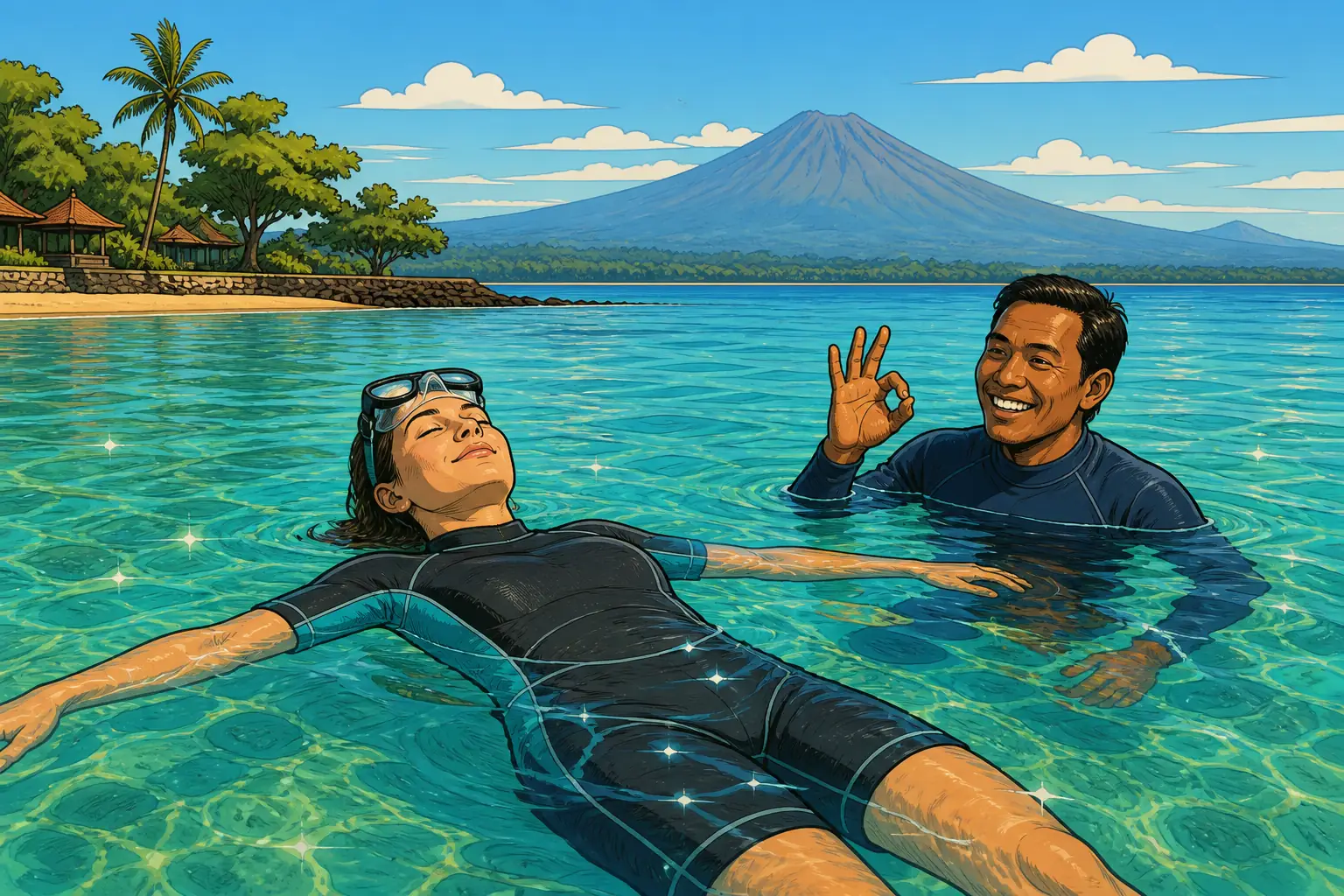
Two or three times a week somebody stands at our counter in Sanur and says a version of the same sentence, usually quietly, often looking at the floor. I really want to dive, but I am not much of a swimmer. It is one of the most common questions we get and one of the most badly answered on the internet, because the honest reply splits in two depending on what you want to be holding at the end of the week. If you want to go underwater once, with an instructor at arm's length the entire time, a try dive in Bali requires no swim test whatsoever. Not a metre, not a length, nothing.
If you want a certification card, the answer changes. Every recognised agency asks you to demonstrate basic swimming ability before you can be signed off, and the PADI Open Water Diver course we run here is no exception. But the test is almost certainly not what you are picturing. There is no stopwatch. There is no required stroke. Nobody is standing at the poolside marking your technique out of ten. This guide walks through exactly what the assessment involves, why it exists, the option that most weak swimmers do not know about, and what actually happens in our shop when someone cannot finish it.
Do You Need to Know How to Swim to Scuba Dive? The Two Honest Answers
Everything below hangs off this one split, so it is worth getting straight before anything else.
To try diving once, no. No training agency requires a swim assessment for an introductory dive. You stay within a few metres of an instructor, you never go deeper than twelve metres, and you are not certified at the end of it. What you do need is to be reasonably comfortable with your face in the water and able to stay calm when a small wave slaps the side of your head. That is a different quality from swimming ability, and it is the one that actually matters. More on that later.
To get certified, yes. PADI, SSI, SDI, NAUI and BSAC all require it. They sit under the same World Recreational Scuba Training Council framework and meet the same ISO standards, which is why the requirement looks near identical whether you learn in Bali, Bali's competition down the road, or a lake in Bavaria. The exact distances shift by a few metres between agencies. The principle does not move at all.
People hear the phrase swim test and flash back to a school gym class with a whistle and a shivering queue. Let go of that. What follows is closer to a comfort check than an exam, and the published standard is deliberately generous. You can read the requirement in PADI's own certification FAQ rather than take our word for it.
The Swim Assessment, Exactly As It Runs
Two parts. A distance swim and a float. They can be done in either order, on any day of the course before we certify you, and that flexibility matters more than it sounds. Plenty of nervous swimmers who would have frozen on day one sail through it on day three, once they have already breathed underwater a few times and stopped treating water as the enemy.
Two hundred metres, any stroke, no clock
The published standard is 200 metres, or 200 yards, without stopping, using whatever stroke you like, with no time limit at all. Breaststroke the whole way is fine. Sidestroke is fine. A lopsided doggy paddle that would make a swim coach wince is fine, and we have certified plenty of people who used exactly that. We have watched someone take a fraction over eleven minutes and pass. We have watched a triathlete finish in a shade under three and pass. Identical outcome, identical card.
The words doing the heavy lifting in that standard are without stopping. You cannot stand up on the bottom, you cannot hang on the wall, you cannot hold the boat ladder for a breather. You can go as slowly as you want. That distinction confuses people, so we say it plainly on day one: this is a test of whether you can keep yourself going, not of how fast you go.
Or three hundred metres with mask, fins and snorkel
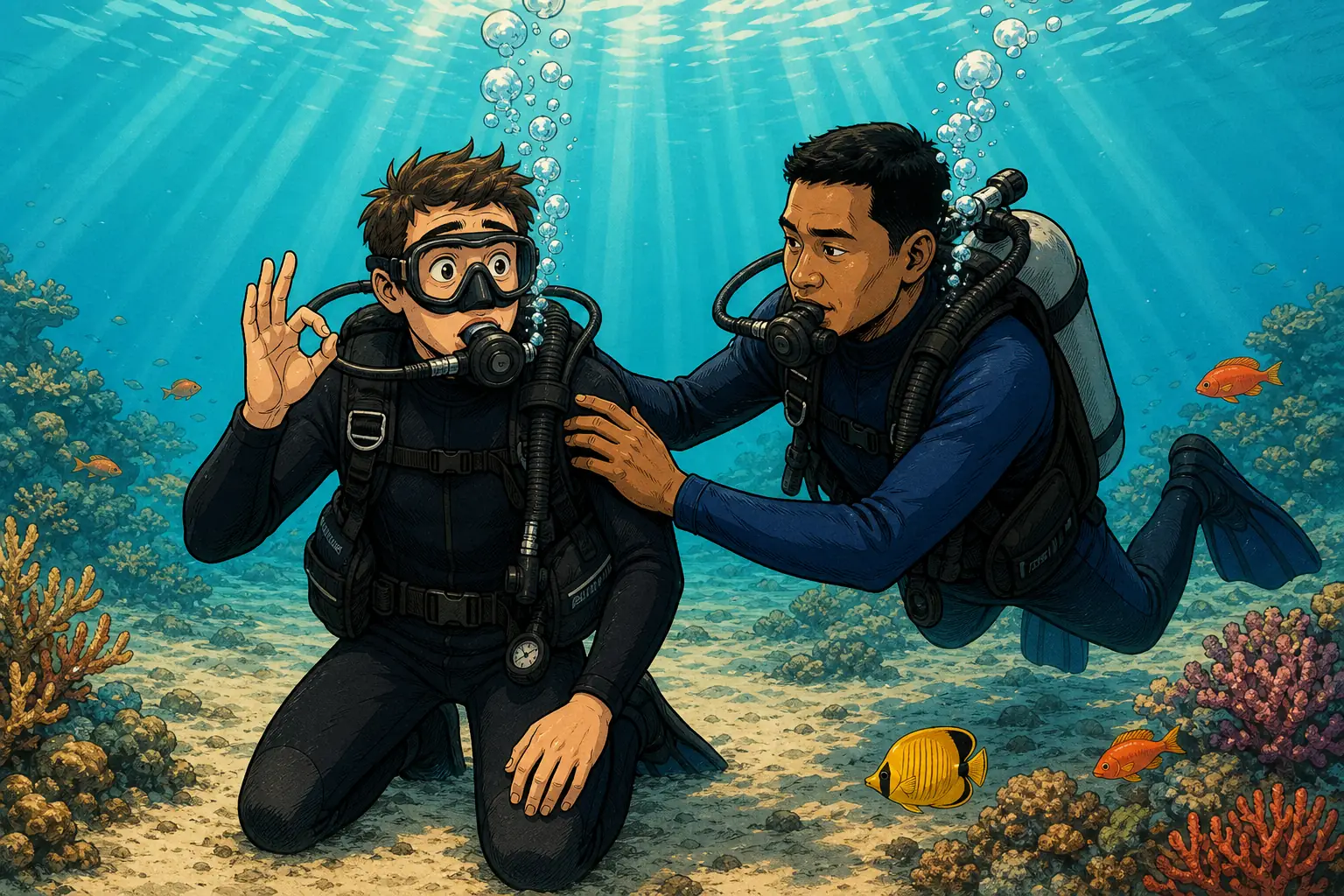
Here is the part that half the articles on this subject skip, and it is the part that changes the whole conversation for most people who describe themselves as weak swimmers. Instead of 200 metres bare, you are allowed to swim 300 metres wearing a mask, fins and snorkel.
Yes, that is a longer distance on paper. It is also dramatically easier, and not by a small margin. The fins do the propulsion, so your arms can do nothing at all. The snorkel means you never once lift your head to breathe, which removes the single thing that wrecks most adult swimmers: the panicky, rushed, half-swallowed breath at the end of every stroke. The mask removes stinging eyes. Put those three together and it stops being a swim in any meaningful sense. It becomes a float with an engine.
Rough numbers from our own courses: about nine out of ten hesitant swimmers take this option, and we cannot remember the last time one of them failed it. If your problem with swimming is breathing rhythm rather than genuine fear of deep water, and for most adults it is, this is your route. It is also decent practice for a lazy afternoon of snorkelling in Bali later in the trip, which is not nothing.
The ten-minute float
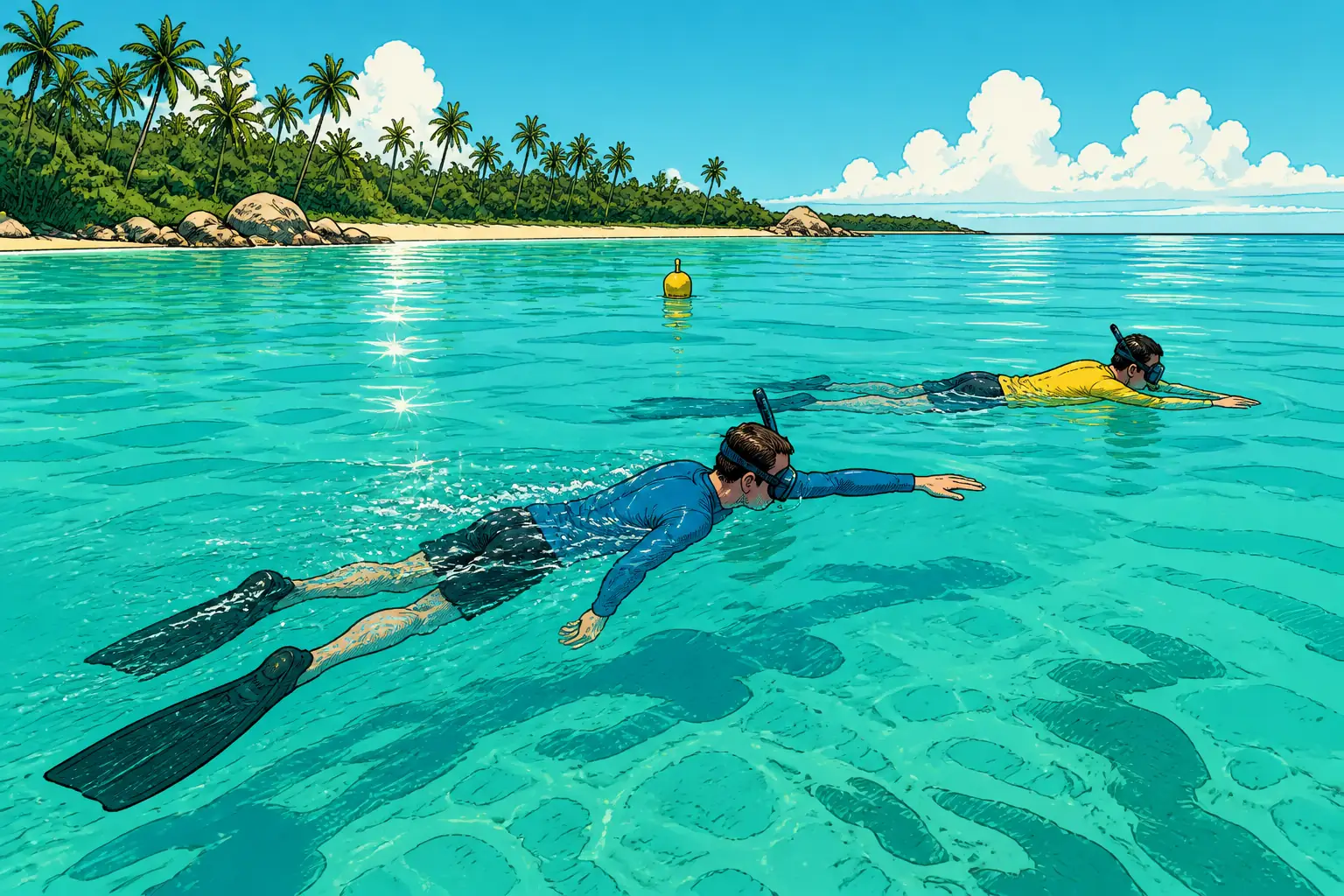
Ten minutes, floating or treading water, using any method you like. No flotation aids, no wetsuit, no holding the side. Any method genuinely means any method, including the completely undignified back float with your ears under and your nose pointed at the sky, which is what we recommend and what most people end up doing.
Ten minutes reads as a long time. The first two feel like a long time as well. Then something usually clicks, because almost everybody floats once they stop fighting and let their lungs stay full. Air in your chest is the most effective buoyancy device you own. We tell students to lie back, breathe slowly, keep the lungs topped up, and let the hands sweep gently at hip level. People who arrive convinced they sink like a brick are frequently the ones lying there looking bored at minute six.
There is one honest exception. A small number of people, usually very lean and heavily muscled, are genuinely negatively buoyant with full lungs and cannot back float. They tread instead, and treading for ten minutes is harder work. If that is you, practise sculling before you come, because it is the one part of this that rewards preparation.
Why the Requirement Exists at All
It is fair to ask. You spend the entire dive with a tank of air on your back, a jacket that inflates, and fins on your feet. Why should you need to swim 200 metres with none of that?
Because a certification card is a statement about independence, not about athletic capability. When we sign you off, we are putting in writing that you are competent to dive without a professional, with a buddy of similar experience, in conditions similar to those you trained in. That card does not expire. It might get used in eleven years' time from a small boat in a country we will never hear about, with a crew who do not speak your language.
Most diving incidents do not happen at depth in dramatic circumstances. They happen at the surface, where people get tired, get separated, get pushed by a current or run out of patience with a boat that has not spotted them yet. Being able to keep yourself going in open water for a few minutes without your gear helping you is the whole point of the assessment. It is a rough, imperfect proxy, and every instructor knows it is a rough proxy. It is also better than no proxy at all, which is why the standards bodies keep it.
This is the same logic that runs through the whole training ladder. It is why the Rescue Diver course spends most of its time on surface problems rather than underwater ones, and why we talk honestly about the real risk profile in our piece on whether scuba diving is dangerous.
The Try Dive Route: No Swim Test, No Card
If the assessment sounds like a wall right now, do not write off diving. Take the other door.
A try dive, which PADI calls Discover Scuba Diving, is a supervised introductory experience. Small ratios, one instructor with a maximum of two guests in the water on our trips, a maximum depth of twelve metres, and an instructor physically within touching distance for the whole dive. There is no swim assessment, no exam, no e-learning, and no certification at the end. There is a medical questionnaire, and there is a shallow water session first where you learn to clear your mask, recover your regulator and equalise your ears before you go anywhere near a reef.
Our full-day version runs about IDR 2,000,000 to 2,700,000, roughly 110 to 150 USD, including two dives, all equipment, lunch and pickup from a Sanur hotel. Pickup is 30 to 45 minutes before the boat, depending where you are staying. We have written the whole thing up in detail in our guide to try diving in Bali, and there is a wider price breakdown in our article on what diving in Bali actually costs.
One useful detail that nobody tells first-timers: if you do the try dive with us and then decide to carry on, the confined water portion can usually be credited towards your Open Water course, provided it happens within twelve months. So it is not money thrown away. It is the first afternoon of your certification, taken early, with the option to stop.
Water Comfort Beats Swimming Technique Every Time
Run enough courses and you stop predicting how someone will dive from how they swim. The correlation is much weaker than you would expect, and after a few hundred students you learn to watch for something else entirely.
The best single predictor we have found takes about fifteen seconds to check. Can the person put their face in the water, open their eyes behind a mask, and breathe out slowly through their nose without their shoulders creeping up towards their ears? That is it. Someone who can do that calmly will almost always be a competent diver by day three, regardless of whether they can swim front crawl. Someone who cannot do it, no matter how quick they are over 50 metres, is going to need extra time in the shallows and will probably burn through their air twice as fast for the first few dives.
We have taught competitive swimmers who hated every minute of their first two dives, because being unable to surface whenever they wanted felt like a trap. We have also certified a 58-year-old guest from Rotterdam who had genuinely never swum a full length in her life until eight weeks before she flew out, did the 300 metre snorkel option without breaking a sweat, and finished the week doing a relaxed drift at Padang Bai with better buoyancy than her son. Swimming ability is a hurdle to clear. It is not a forecast.
If you want to build the underlying comfort before you commit to anything, the cheapest way is a mask and snorkel. Spend two mornings floating over the reef at Sanur's shallow lagoon and you will learn more about being calm in water than a month of lengths in a chlorinated pool. We compare the two activities properly in snorkelling versus diving if you are still deciding.
What We Actually Do When Someone Cannot Finish
This is the question behind the question, and most dive centre websites tiptoe around it. Here is our answer, in the order it happens.
First, we move it. If you are struggling on the morning of day one, we do not keep pushing while you get more tense and more tired. We park it, get on with the confined water skills, and try again on day two or three when you are a different person in the water. This alone solves most cases.
Second, we switch options. If you started on the 200 metre bare swim, we put you in mask, fins and snorkel and let the equipment do the work. If you started on the float and could not settle, we work on the back float position specifically, which is a technique problem far more often than a fitness one.
Third, if it is still not happening by the final day, we convert the booking. You keep the dives you have already done as Discover Scuba dives, we refund the difference between the course price and the try dive price, and your e-learning stays valid for twelve months so you can finish the certification anywhere in the world when you are ready. Nobody goes home with nothing.
For scale: we run this conversion somewhere around eight to ten times a year, out of several hundred courses. It is uncommon, it is not a catastrophe, and the guests who go through it almost always come back.
What we will not do is sign the card anyway. Not as a favour, not for a tearful last afternoon, not for anyone. A certification is a promise made to every dive operator that person will ever meet, and a false one gets cashed years later on a boat where we cannot help. If that costs us a booking occasionally, so be it.
How to Get Ready Before You Fly
If you are reading this a month or two before a trip, you have plenty of time. The assessment is not physically demanding for anyone who has done a little preparation, and the preparation is boring rather than hard.
Six weeks in a local pool
Two sessions a week, half an hour each. That is the whole programme, and it is enough.
Week one, do nothing but float on your back for as long as you can manage, then get out. Genuinely, that is the session. Week two, add sculling with your hands while you float, and try to reach five minutes. Week three, buy a cheap mask and snorkel and start swimming slow lengths with your face permanently in the water, no head lifting. Weeks four and five, add fins and build the distance up, aiming to reach 300 metres unbroken. Week six, do the whole thing once, in one go, and then stop worrying about it.
People who follow something like this arrive able to pass on day one without noticing they were tested. It costs the price of a mask, a snorkel and a few pool entries.
The fortnight before you travel
Do not buy fins to bring with you. Ours come with the course and lugging fins through an airport for a four-day trip is a waste of your baggage allowance. A mask is worth owning if you have an awkward face shape or you wear a moustache, and we cover the whole kit question in our Bali diving packing list. Everything else, we supply.
Get your e-learning done at home. The theory takes eight to twelve hours and doing it on a hotel balcony in Sanur while your friends are at the beach is nobody's idea of a holiday. Finish it before you fly and your first day here is all water.
The Other Requirements People Forget About
Swimming is the requirement everybody worries about. It is not the one that stops the most courses. Two others deserve a mention before you book.
Children and the junior courses
Parents ask this constantly, usually about a child who swims like an otter but has never been told to swim a set distance. The short version: the requirement does not get softer with age.
Junior Open Water Diver starts at ten years old and carries the same water skills assessment as the adult course. Same 200 metres, same ten-minute float, same absence of a clock. There is no junior discount on the swim, which surprises people, though in practice children who are confident in water usually find it easier than their parents do because they have not spent thirty years learning to be self-conscious.
Below ten, the Bubblemaker programme takes children from eight years old to a maximum of two metres in a pool, and there is no assessment. It is a pool game with a tank on, and it is a good way to find out whether a child loves it before anyone spends money on a course. We go through ages, ratios, depth limits and what actually works for families in our family diving guide for Bali. Some children prefer the Discover Mermaid session, which involves a monofin and no tank at all, and there is nothing wrong with that as a first step.
Medical fitness, and ears
Passing the swim does not mean you are cleared to dive, and being a strong swimmer does not exempt you from anything. These are two independent checks and they catch different problems.
Every student completes a medical questionnaire before getting in the water. Most people tick every box no and that is the end of it. A yes against certain conditions, including asthma, heart problems, recent surgery, epilepsy, or some medications, means a doctor needs to sign you off first. Getting that done at home is far easier than chasing a dive-aware doctor in Denpasar on a Sunday. We wrote up the practical health side of a Bali dive trip, including the medical form and what to sort out before departure, in our health and vaccinations guide for divers in Bali.
The other thing that stops far more courses than swimming ability ever does is ears. If you cannot equalise, you cannot descend, and no amount of swimming fitness fixes it. It is worth ten minutes of reading and a bit of practice before you come, which is why we put together a full guide to how to equalise your ears when scuba diving.
Where the Assessment Happens in Bali
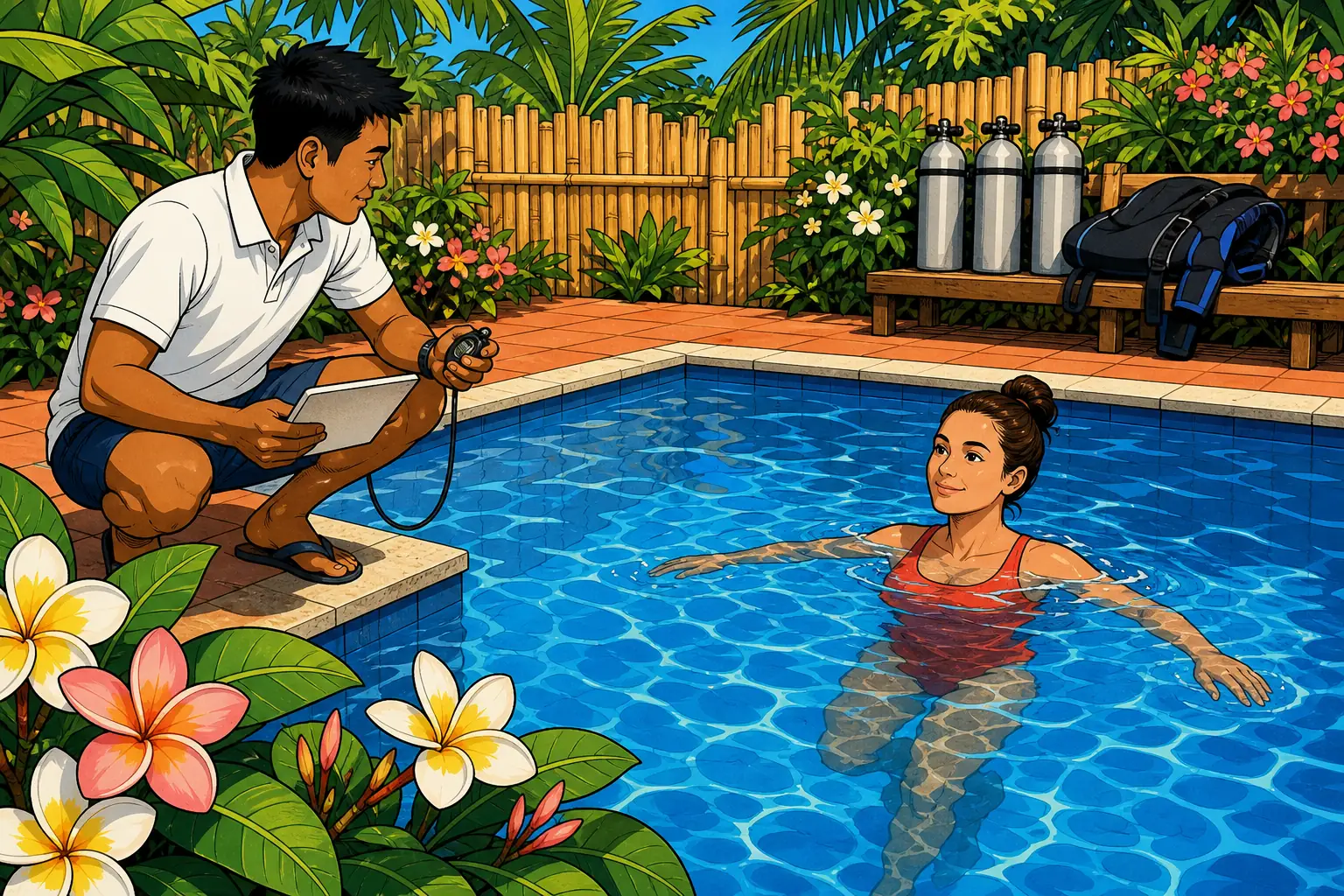
We do the swim and the float in a pool for almost everybody, because a pool has a known depth, a flat surface and an edge we can walk along beside you. It is calmer for nervous students and easier for us to supervise properly.
The alternative, permitted under the standards, is confined open water: a sheltered, shallow, pool-like stretch of sea. Sanur has exactly that inside the reef at low tide, and the water sits between 27 and 29 degrees all year, so there is no cold-shock element to worry about and no wetsuit needed for the float. On the rare occasions we use it, it is because a student specifically wants the sea rather than chlorine.
The rest of the course happens where the diving is good. Confined water skills in the shallows, then four open water dives split across the calm sites we use for training, and the reefs off Padang Bai or the black sand at Tulamben depending on the week's conditions. There is a full breakdown of how the four days run in our Open Water course guide, and a wider look at seasons and sea states in Bali diving conditions month by month.
Once you are certified, the interesting stuff opens up. The manta cleaning stations and cold blue water of Nusa Penida sit just past the entry-level depth limit, which is the usual reason people carry straight on to the Advanced Open Water course. If your buoyancy is the thing holding you back rather than your swimming, the Peak Performance Buoyancy specialty is two dives well spent.
So, Where Does That Leave You
If you can float on your back and move yourself forward, however inelegantly, you can get certified. The bar is lower than the internet suggests and there is a mask-fins-snorkel option specifically designed for people who never got on with swimming. If you genuinely cannot do either yet, take a try dive, find out whether you even like being underwater, then spend six weeks in a pool at home and come back for the card.
Part of the nerves around the swim test come from not knowing what the rest of scuba involves. Our explainer on what scuba diving is and how it works walks through the gear, the breathing and what the first breath underwater really feels like, which tends to put the swimming question in proportion.
What we would rather you did not do is quietly decide you are not the right sort of person for this. We have certified nervous swimmers, late starters, people who had not been in water deeper than a bathtub since childhood, and a fair number of guests who spent day one convinced they were about to embarrass themselves. If you are not sure which category you are in, send us a message and describe honestly what you can and cannot do in water. We will tell you straight which course to book, or whether to start with a try dive instead. It is a two-minute conversation and it saves people a lot of worry. There is more on the certification ladder and what each card actually permits in our overview of scuba diving certification types and our guide to PADI diving in Bali.