
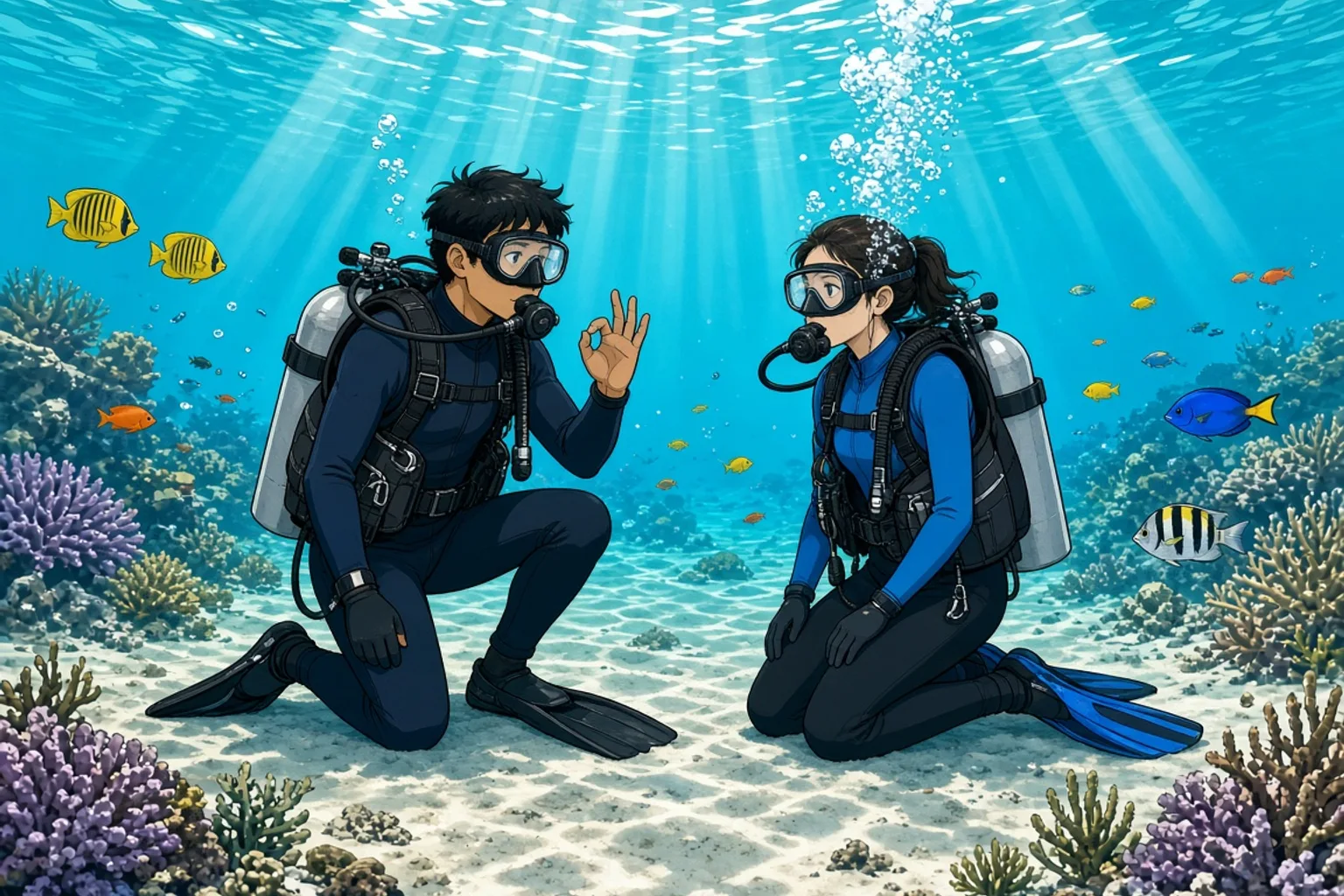
What is scuba diving? At its simplest, it is swimming underwater while breathing from a tank of compressed air you carry on your back, so you can stay down for most of an hour instead of the thirty seconds a held breath gives you. That is the textbook line. The version we give at the counter in Sanur is shorter: you breathe, you sink, you float, and the fish stop caring that you are there. Most people who ask us this question have never had a regulator in their mouth, and the fastest way to understand it is still to try scuba diving in Bali for a morning with an instructor at your shoulder.
This guide is the longer explanation, for the people who like to know how a thing works before they trust it. We cover what the letters stand for, how a tank and regulator actually get air into your lungs at depth, what the water does to your ears and your blood, how divers hang motionless in mid-water, what gear you need, and what the first breath honestly feels like. We teach this every week on the PADI Open Water course in Bali, so nothing here is theory we read somewhere. It is what we watch happen to real guests on the reef off Sanur, usually before lunch.
- SCUBA stands for Self-Contained Underwater Breathing Apparatus. You carry your own air, nothing connects you to the surface.
- The tank holds ordinary air, about 21 percent oxygen and 78 percent nitrogen, squeezed to roughly 200 bar. It is not pure oxygen.
- The regulator drops that pressure in two stages so every breath arrives at exactly the pressure of the water around you.
- Pressure doubles in the first 10 metres. That is why ears need equalising early and why you must never hold your breath.
- To start you need to be 10 or older, pass a short medical questionnaire, and either book a try dive (no card, 12 metres maximum) or a three to four day certification course.
What Is Scuba Diving, Exactly?
Scuba diving is underwater diving with a self-contained breathing supply. The word is an acronym, and most people have forgotten that it ever was one. SCUBA means Self-Contained Underwater Breathing Apparatus, a term an American army doctor called Christian Lambertsen put on his rebreather design in the early 1950s. It stuck, lost its capital letters, and now covers the whole sport.
The key word is self-contained. Before scuba, working divers wore heavy helmets and breathed air pumped down a hose from a boat. They walked on the bottom. They could not swim freely, and if the hose failed they were in serious trouble. The breakthrough came in occupied France in 1943, when naval officer Jacques-Yves Cousteau and engineer Émile Gagnan adapted a gas valve from a car into a demand regulator and called the result the Aqua-Lung. For the first time a diver could carry the air, breathe it only when they inhaled, and swim in any direction. Every regulator we rent out today works on the same principle.
It helps to separate scuba from its cousins. Snorkeling is floating at the surface breathing through a tube. Freediving is diving on a single held breath. Commercial and military diving often still use surface-supplied air. Recreational scuba, which is what we do and what this article is about, is diving for pleasure to a maximum of 40 metres, with no decompression stops required, on ordinary air or on enriched air called Nitrox. Within that there are levels, from a one-day try dive up to instructor, and our overview of scuba diving certification levels maps them out if you want the whole ladder.
What scuba is not, whatever the films suggest, is a test of strength. The fittest guest on the boat is often the worst diver on day one, because they fight the water. The calm, slightly unathletic accountant who breathes slowly and does nothing in a hurry is usually the one hovering beautifully by the second dive. We have seen that pattern hundreds of times.
How Does Scuba Work? The Breathing Part
Three pieces of kit do the work: the tank, the regulator, and your own lungs. Understand those and the rest of scuba makes sense.
The tank
The standard tank in Bali, and in most of the tropics, is an aluminium cylinder called an AL80. It has an internal volume of about 11 litres, but it is filled to roughly 200 bar, which is two hundred times the pressure of the air you are breathing right now. Squeeze that much air into 11 litres and you are carrying around 2,200 litres of it on your back. On the surface, a relaxed adult breathes somewhere between 15 and 25 litres a minute. So in theory, a tank would last the better part of two hours at the surface.
What is in it matters more than people think. It is filtered, dried atmospheric air: about 21 percent oxygen, 78 percent nitrogen, and a trace of everything else. It is not oxygen. Pure oxygen becomes toxic under pressure from around six metres, which would make it useless for most recreational diving. Tanks are filled from a high-pressure compressor through filters that strip out moisture and oil, and a fill that smells or tastes of anything is a fill you send back.
The regulator
You cannot breathe 200 bar. It would destroy your lungs instantly. The regulator is the clever part, and it does its job in two stages. The first stage screws onto the tank valve and drops the pressure to an intermediate level, roughly nine or ten bar above the surrounding water. A hose carries that air to the second stage, the piece in your mouth. The second stage is a demand valve: it stays shut until you inhale, then opens and delivers air at precisely the pressure of the water around you. Exhale, and it closes. Your breath leaves through an exhaust valve as bubbles.
That phrase, at the pressure around you, is the entire trick. At ten metres the water is pressing on your chest twice as hard as at the surface, so the regulator delivers air at twice the surface pressure. Your lungs fill normally. You never have to suck. A properly serviced regulator breathes about as easily as the air in a room, and new students are routinely surprised by how unremarkable it feels.
Every rig also carries a spare second stage, called the octopus, usually on a yellow hose, so your buddy can share your air in an emergency. There is a pressure gauge that tells you how much is left. Our rule for guests is to surface with 50 bar still in the tank. We check it, and we will end a dive early to keep it.
Why a tank does not last two hours
Because pressure changes how much air each breath uses. At ten metres every breath takes twice as much air out of the tank as it would at the surface. At twenty metres, three times. At thirty metres, four times. The same 2,200 litres that would last a sleepy hour and a half at the surface might give a nervous beginner 35 minutes at 18 metres. Relaxed and shallow, on a reef at 8 to 12 metres, most of our try dive guests get 45 to 55 minutes. Experienced divers stretch that past an hour. Air consumption is the single thing that improves most over your first twenty dives, and it improves because you stop swimming so hard.
What the Water Does to Your Body
Air weighs almost nothing. Water weighs a lot. Every ten metres of seawater adds another full atmosphere of pressure on top of the one you already live under. At the surface you are at 1 bar. At 10 metres, 2 bar. At 20 metres, 3 bar. At the recreational limit of 40 metres, 5 bar. That one fact explains almost every rule in scuba.
Your ears and the air spaces in your head
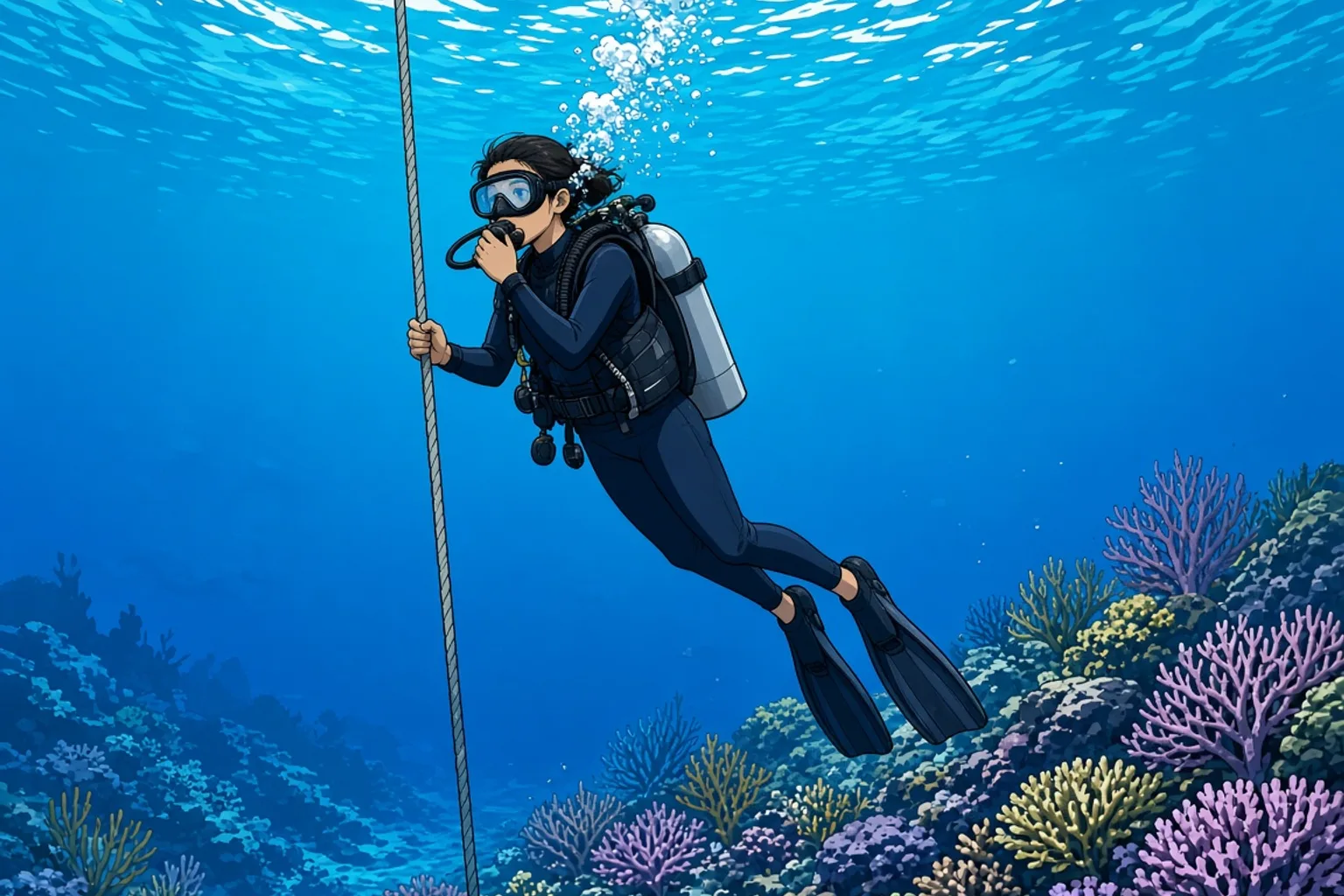
Gas squashes under pressure. Your middle ears, your sinuses and the space inside your mask are all pockets of gas surrounded by body or glass, so as you sink they get squeezed. The biggest proportional change happens in the first ten metres, where pressure doubles. Descending from 30 to 40 metres is a gentle nudge by comparison. So the ears hurt early, not deep, which surprises most people.
The fix is called equalising: pinching your nose and gently blowing against it, or swallowing, or wiggling your jaw, to push a little air up the Eustachian tubes and balance the pressure. You do it early and often, every metre or so on the way down, before you feel anything. If it will not clear, you go up a metre and try again. You never force it. Roughly one guest in ten needs a slow, patient descent to get there, and we would much rather spend five extra minutes on a line than ruin someone's holiday. Our guide on how to equalize your ears when diving goes through the techniques in detail, including the ones worth practising at home before you fly.
The one rule: never hold your breath
This is the only rule we make every student say back to us. Breathe continuously and never hold your breath on scuba. Here is why. Fill your lungs at ten metres and swim up to the surface with your mouth shut, and the air inside expands to double its volume. Lungs are not built for that. The resulting injury, a lung overexpansion, is rare and serious, and it can happen in as little as a metre or two of water. As long as you keep breathing, the extra air simply leaves as you exhale, and the problem never exists. It is also why divers ascend slowly, no faster than about nine metres a minute, which in practice means slower than your smallest bubbles.
Nitrogen: the invisible part
Under pressure, your body absorbs more nitrogen from the air you breathe. It dissolves into your blood and tissues quietly, and the longer and deeper you stay, the more you take on. Come up slowly and it leaves through your lungs, no harm done. Come up too fast, or stay too long, and it can form bubbles in the body. That is decompression sickness, the bends.
Recreational diving manages this with limits rather than luck. Every depth has a no-decompression limit, the time you can spend there and still ascend directly to the surface. On air it is about 56 minutes at 18 metres and over two hours at 12, which is why shallow Bali reefs are so forgiving. Your dive computer tracks it for you in real time. We add a three-minute safety stop at five metres at the end of every dive, whether the computer demands one or not. Our guide on how to avoid decompression sickness explains the habits that keep the risk tiny, and it is genuinely tiny when you follow them.
Nitrogen has one more effect, and it is the one divers joke about. Below about 30 metres, breathing it under pressure starts to make people slightly drunk. Divers call it narcosis. It fades the instant you rise a few metres, but it is a large part of why the limits for new divers are set where they are, and our piece on how deep you can scuba dive covers what changes at each depth. A try dive stays above 12 metres. A new Open Water diver stays above 18. None of that feels restrictive in Bali, where the best of the reef is shallower than 15 metres anyway.
Buoyancy: How Divers Float in Mid-Water
Watch an experienced diver and the strangest thing is how still they are. They hang a metre above the coral, not sinking, not rising, barely moving a fin. That is called neutral buoyancy, and it is the skill that separates people who go diving from people who are good at it.
Three things control it. First, weights. The human body floats in seawater, and a wetsuit is full of tiny bubbles that float even harder, so divers wear lead on a belt or in pockets to cancel that out. A typical adult in a three millimetre wetsuit in Bali needs somewhere around four to six kilos. Second, the BCD, the buoyancy control device, an inflatable jacket connected to the tank. Add a puff of air and you rise a little. Let some out and you sink. Third, and this is the part nobody expects, your lungs. A full breath makes you rise slightly. A long exhale makes you sink. Experienced divers make fine adjustments almost entirely by breathing.
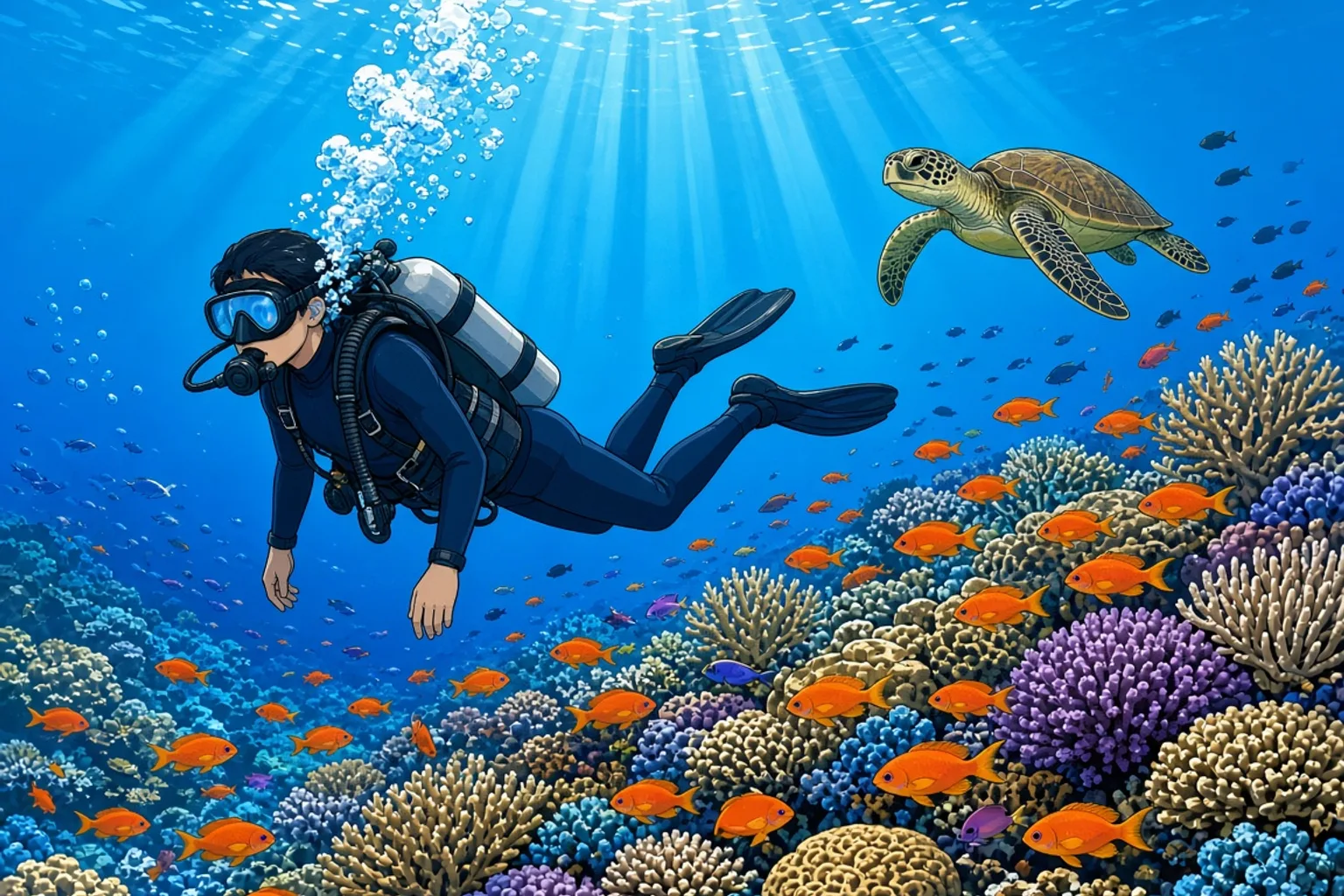
The complication is that buoyancy changes with depth. Your wetsuit and the air in your jacket compress as you go down and expand as you come up. So a diver who is perfectly balanced at five metres will be slightly heavy at fifteen and slightly light again at five. Beginners spend their first dives chasing this, overcorrecting, adding air, dumping it, bobbing up and down like a yo-yo. That is completely normal. It clicks somewhere between dive five and dive fifteen for most people, and we can usually tell the dive it happens because the air consumption suddenly drops by a third.
If you want to speed that up, read our guide to how to improve your buoyancy, and if you are already certified and still yo-yoing, the Peak Performance Buoyancy course is two dives of nothing else. Good buoyancy is not vanity. It keeps you off the coral, it saves air, and it is the reason a diver can hover beside a cleaning station at Manta Point without scaring anything away.
What Do You Need to Scuba Dive? The Gear, Piece by Piece
Less than people fear, and on a first trip you own none of it. Every dive shop worth using rents the full set. Here is what goes on your body and why.
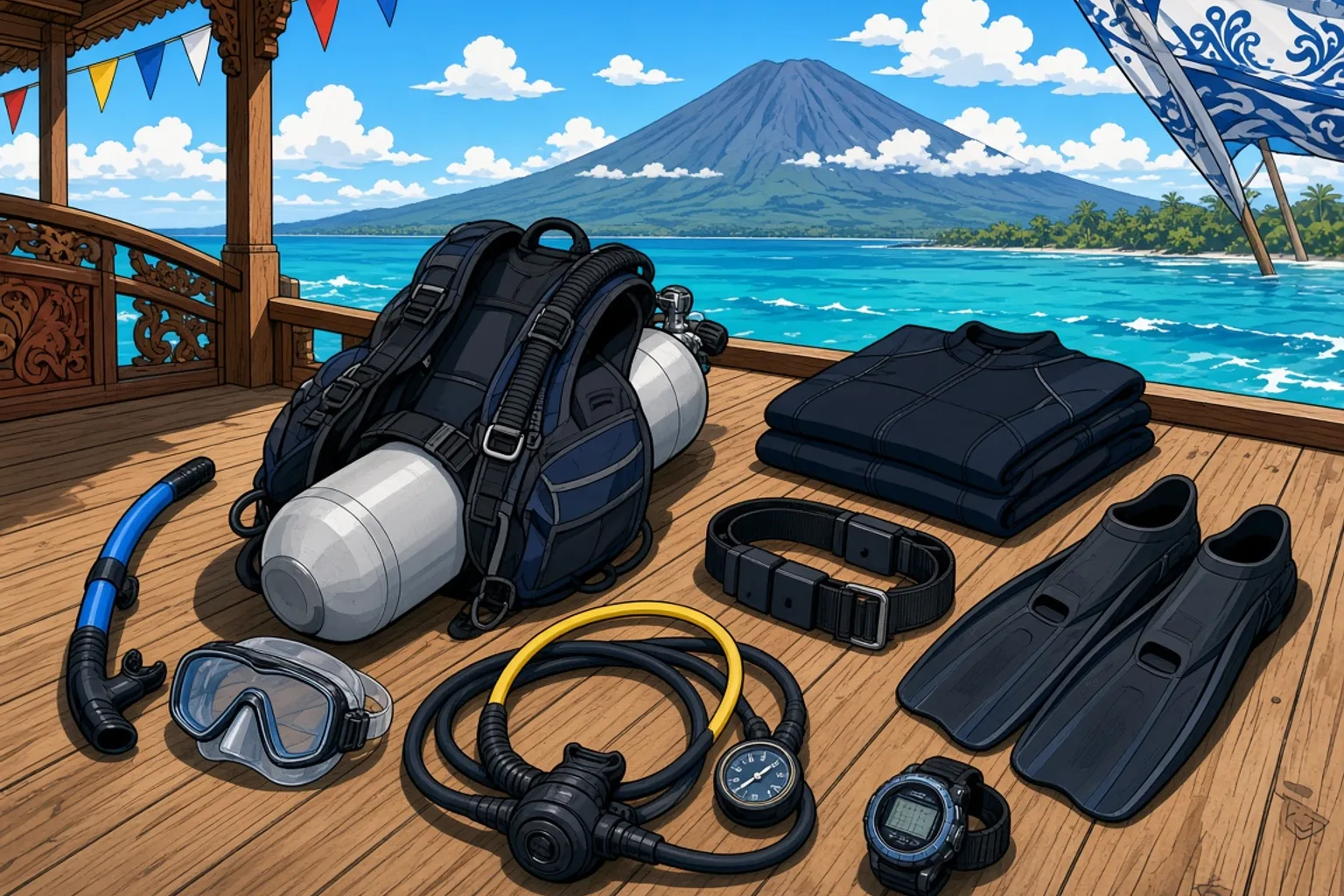
- Mask. It puts an air space in front of your eyes so you can focus underwater. The nose pocket lets you equalise it and pinch your nose. Fit matters more than price. If you wear glasses, prescription lenses are widely available, and a mask with your own lenses is worth bringing.
- Snorkel. For the surface swim to and from the boat, so you are not wasting tank air.
- Fins. Your legs do all the propulsion. Hands stay still. Open-heel fins with neoprene booties are what you want for shore entries over the volcanic stones at Tulamben and Amed.
- Wetsuit. Water loses heat from your body about twenty-five times faster than air does, so even warm water chills you over an hour. Bali sits at 26 to 29 degrees most of the year, and a three millimetre suit is plenty. The exception is Nusa Penida between July and October, where cold upwellings can drop the water to 20 degrees or below, and we hand out five millimetre suits and hoods.
- BCD. The inflatable jacket that holds the tank on your back and controls your buoyancy.
- Regulator set. First stage, primary second stage, octopus, pressure gauge and the low-pressure hose that inflates the BCD.
- Tank and weights. Usually an AL80 and four to six kilos of lead, adjusted after a quick weight check at the surface.
- Dive computer. A wrist unit that tracks depth, time, ascent speed and your nitrogen limits. On a try dive your instructor wears it for you. Once certified, you wear your own.
If you want to start owning things, buy a mask first, then a computer, then fins. Leave the BCD and regulator until you know you are hooked and you know what you like. Our dive shop in Bali services and rents everything on that list, and guests who bring their own mask are welcome to use it with our other kit. Everything we rent is serviced on a fixed schedule, and a regulator that breathes wet or free-flows on the boat gets swapped on the spot, not after the dive.
What you also need, and what no shop can rent you, is some water comfort. You do not need to be a strong swimmer. You do need to be at ease with your face in the sea. Our honest guide on whether you need to swim to scuba dive sets out exactly what the swim test asks for and what happens if you cannot finish it.
What Scuba Diving Actually Feels Like
The first breath is strange. Everyone says so. Your brain has spent your whole life insisting that breathing with your face underwater is a terrible idea, and for two or three breaths it keeps insisting. Then the air just keeps coming, calm and normal, and something in your shoulders lets go.
We do that first breath kneeling in water shallow enough to stand up in. A typical try dive day with us starts with a pickup between 06:30 and 07:15, a briefing on the gear, and then time in the shallows practising three or four skills: clearing water from your mask, finding your regulator if it falls out of your mouth, and the basic hand signals. Only then do you swim out along the reef off Sanur, somewhere between six and twelve metres, with an instructor within arm's reach the whole way.
Then there is the sound. Scuba is not silent. You hear your own breathing, loud and mechanical, a hiss on the way in and a rumble of bubbles on the way out. You hear the crackle of the reef, which is thousands of snapping shrimp. You might hear a boat engine from surprisingly far away, and you will have no idea which direction it is coming from, because sound travels four times faster in water and your ears cannot place it.
Then weightlessness, once the buoyancy starts working. People describe it as flying, which sounds like a cliché until you have done it. Colours change as you go down, because water filters out red first, so a red fish at fifteen metres looks brown until someone shines a torch on it. Everything moves slowly. You move slowly. After a dive most people are quiet for a while on the boat, and it is not tiredness.
We will be honest about the other side of it. Roughly one guest in twenty gets a wave of panic in the first few minutes and signals to go up. That is fine, it is common, and it is why try dives start where you can stand. Most of those guests sit at the surface for five minutes, breathe, and go back down. A few decide diving is not for them, and we would rather they found that out in two metres of calm water than on an expensive course. We will not push anyone to continue who does not want to. If safety worries are the thing holding you back, our guide to whether scuba diving is dangerous looks at the real statistics, and they are more reassuring than most people expect.
Scuba Diving vs Snorkeling vs Freediving
These three get confused constantly, usually by people choosing what to book on the same afternoon. Here is the short version.
| Scuba diving | Snorkeling | Freediving | |
|---|---|---|---|
| How you breathe | Compressed air from a tank | Through a tube, face at the surface | A single held breath |
| Typical depth | 5 to 18 m for new divers, 40 m limit | The surface | A few metres for beginners, much deeper with training |
| Time underwater | 45 to 60 minutes per dive | As long as you like, at the surface | Seconds to a couple of minutes per breath |
| Training | Try dive or 3 to 4 day course | None | Recommended course |
| Kit | Full scuba set | Mask, snorkel, fins | Mask, long fins, low-volume gear |
Snorkeling is the easy entry point, and for plenty of Bali sites it is genuinely enough. The turtles and reef fish at Padang Bai and the mantas at Nusa Penida are regularly seen from the surface, which is why snorkeling in Bali is such a popular half-way house for families with mixed ages. Scuba is what you add when watching from above stops being enough, and you want to be down there at eye level with the thing. Freediving is its own discipline: quieter, more athletic, entirely about breath-hold. The closest thing we teach is mermaid diving, which uses a monofin and breath-hold skills and tends to appeal to people who find the tank and hoses a bit much. For a proper side-by-side comparison of costs and training, see our piece on snorkeling versus diving.
What You Need to Start Scuba Diving
The entry requirements are simpler than the internet makes them sound. There are four of them.
Age. Ten is the minimum for both a try dive and the Junior Open Water course. Ten and eleven year olds are limited to twelve metres and must dive with a parent or a professional. There is no upper limit. We have taught people in their seventies, and they tend to be excellent students because they listen.
Health. Everyone fills in a short medical questionnaire before getting in the water. Most people answer no to every question and carry on. A yes to certain questions, about heart conditions, lung problems, recent surgery, some medications or asthma, means you need a doctor to sign you off first. Get that done at home if you can: a clinic here costs around IDR 750,000 and most of a day. Pregnancy is a firm no, and a heavy cold is a no for that day, because blocked sinuses will not equalise.
Water comfort. Not swimming ability as such. A try dive has no swim test. A certification course asks you to swim 200 metres with no time limit, or 300 metres with mask, fins and snorkel, and to float for ten minutes.
A choice between trying and training. This is the real decision.
A try dive, which PADI calls Discover Scuba Diving, is a single day with an instructor. You do a briefing, practise a few skills in the shallows, then do two real dives to a maximum of twelve metres. Our full-day version runs about IDR 2,000,000 to 2,700,000, around 110 to 150 US dollars, with gear, lunch and hotel pickup included. You do not get a card, but the skills you learn can be credited towards a full course if you carry on.
A certification course is three to four days of theory, confined water skills and four open water dives, and at the end you hold a card that lets you dive anywhere in the world with a buddy, to eighteen metres, for life. We explain the whole process, from choosing an agency to what the price should include, in how to get scuba certified. If you are ready to commit, our PADI certification courses in Bali start most days of the week from Sanur, and the Bali diving price list lays out every course and fun dive so there are no surprises at the counter.
Our general advice: if you are not sure you will like it, or you have one free day, do the try dive. If you already know you want this in your life, or you are here for a week, skip straight to the course. The course is where understanding replaces nerves, because everything in this article stops being theory and becomes something you have done with your own hands.
Where Scuba Diving Takes You in Bali
Explaining scuba in a Sanur dive shop without mentioning what is out there would be a waste of a good location. Bali is one of the best places in the world to learn, precisely because the sites you can dive on day four of a course are the sites experienced divers fly across the world for.
Up on the north-east coast, the USAT Liberty wreck at Tulamben is a 120 metre Second World War cargo ship lying on black sand, its shallowest parts only five metres down, close enough to the beach that you walk in. A little further along, diving in Amed gives you calm coral slopes that are ideal for new divers practising buoyancy. Across the strait, the Nusa Penida dive sites are where the manta rays live, seen on roughly nine trips in ten at Manta Point, with the cold-water mola mola turning up between July and October. Those currents are for certified divers with a few logged dives, and we are strict about it.
Closer to home, diving Padang Bai mixes easy reef, turtles and white-tip sharks within a short boat ride, and Menjangan Island in the far north-west has some of the gentlest wall diving and clearest water on the island. Most of our try dives and early course dives happen on the reef off Sanur, run from our dive center in Sanur. It is shallow, calm and sheltered, which is exactly what you want the first time you breathe underwater.
Once you are certified, the next steps follow naturally. The Advanced Open Water course takes you to thirty metres and adds navigation and a night dive, and the Enriched Air Nitrox course lets you breathe a mix with more oxygen and less nitrogen, which gives you longer no-decompression times on the deeper Liberty and Penida dives. None of that is required. Plenty of people dive happily for decades on an Open Water card.
So, what is scuba diving? Mechanically, it is a tank, a regulator and a few rules about pressure. In practice, it is the closest thing most of us will ever get to visiting another planet, and it is available to almost anyone healthy, calm and curious enough to try. If you want to find out what that first breath feels like, book a try dive with us and we will meet you in the shallows.
For the history, the Aqua-Lung and Christian Lambertsen entries are a good starting point. For safety data and medical guidance, Divers Alert Network is the reference the whole industry uses.