
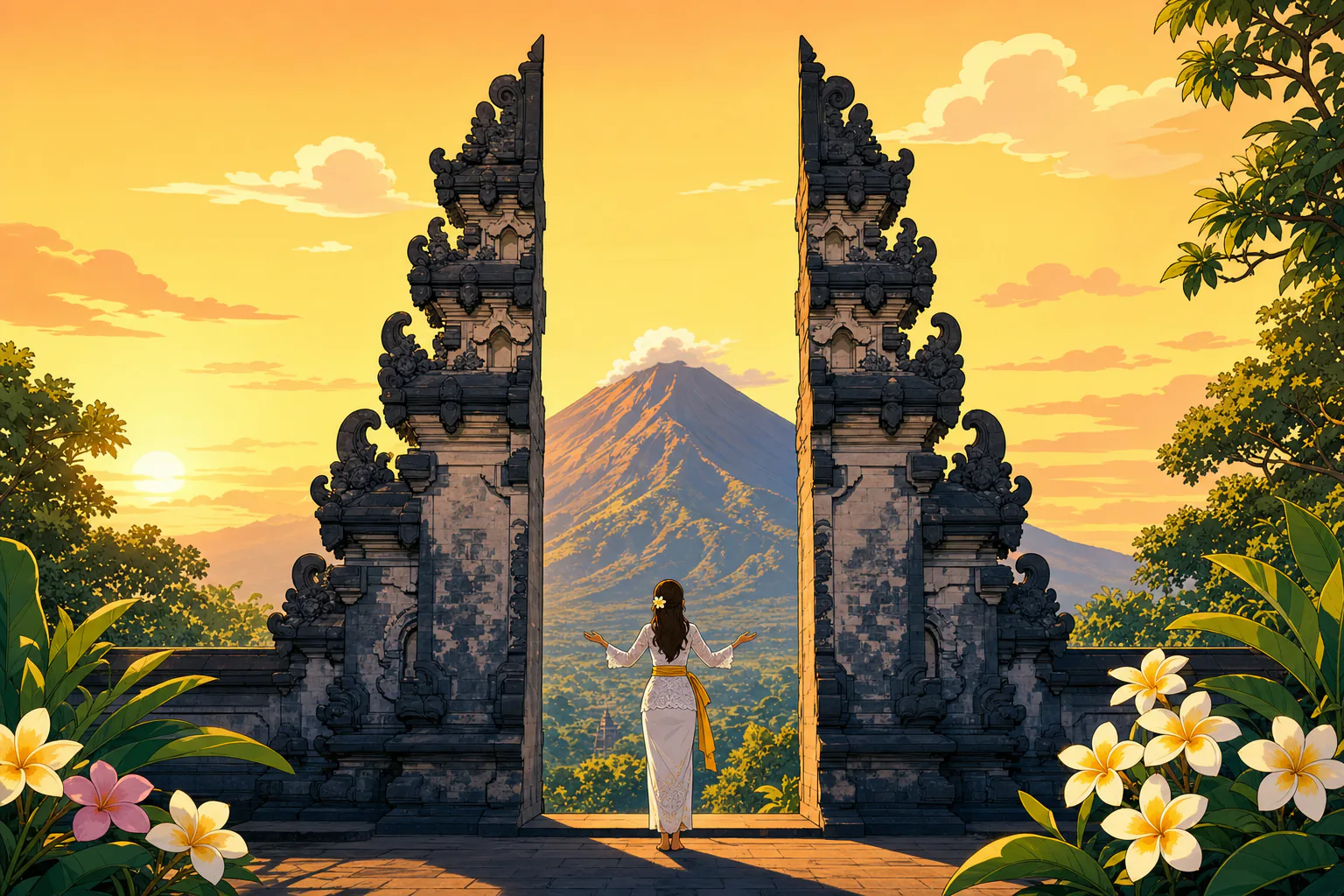
Every week at our Sanur shop, someone asks us the same question in a slightly guilty voice: is it wrong to spend a diving day on temples? Their partner wants the famous Gates of Heaven photo at Lempuyang. They want the USAT Liberty shipwreck. They have one free day left. Our answer is always the same: you do not have to choose. The Gates of Heaven and Tulamben diving sit on the same corner of East Bali, roughly 40 minutes apart by car, and a private trip can string them together into what we honestly think is the single best full day this island offers. Temples at sunrise, a volcano out the window, a shipwreck before dinner.
This guide explains exactly how we run that day: what the Gates of Heaven actually look like behind the camera (there is a mirror involved, we will get to it), what Tirta Gangga is, why the driving order matters more than you would think, and what divers and non-divers each do at the USAT Liberty wreck once we get there. Nobody in your group needs a certification card. The wreck starts five meters below the surface, which makes it one of the best snorkeling spots in Bali as well as one of the world's most famous shore dives. Mixed groups are the whole point of this trip.
Why Combine the Gates of Heaven With Diving Tulamben?
Geography, mostly. Look at a map of Bali and you will see that Pura Lempuyang, Tirta Gangga and Tulamben form a neat little triangle in Karangasem regency, the island's east, all of it sitting in the shadow of Mount Agung. From Sanur it takes about two hours to reach any of them. Most visitors make that drive twice: once on a temple tour, once on a dive trip. That is four hours of repeated car time nobody enjoys.
Do it as one loop instead and the numbers change completely. One sunrise start, one drive east, three of Bali's genuine highlights, and you are back in Sanur before dinner. We have been running dive trips up this coast for years, our crew drives the road to Amed and Tulamben several times a week, and the combined day is the trip we recommend most often to couples where one person dives and the other does not. It is also the trip we quietly recommend when someone tells us they have seven days in Bali and wants to see "everything". You will not see everything. You will see a lot.
One thing we should say up front, because we would rather lose a booking than surprise you: if you only care about maximizing dives, this is not the cheapest way to visit the wreck. Our regular Bali dive trips to Tulamben cost less and fit three dives instead of two. This day is for travelers who want Bali above and below the waterline in the same story.
The Gates of Heaven at Lempuyang Temple, Honestly Explained
Pura Lempuyang Luhur is one of Bali's six holiest temples, a complex of seven sanctuaries climbing the slopes of Mount Lempuyang. The spot everyone photographs is the candi bentar, the towering split gateway, at Pura Penataran Agung, the first temple of the complex at around 600 meters elevation. Stand between the two carved stone halves on a clear morning and Mount Agung rises exactly in the gap, perfectly centered, as if the gate had been built as a picture frame. It very nearly was: the whole temple complex is oriented toward Agung, the mountain Balinese Hindus consider the seat of the gods.
The mirror photo and the queue
Now the honest part. You have seen the Instagram version: a traveler between the gates, their reflection shimmering in a lake at their feet. There is no lake. There has never been a lake. The reflection is made by a local photographer holding a small mirror under your phone's camera lens. It takes him about fifteen seconds per group, he will shoot a burst of photos and a little video, and a tip of IDR 10,000 to 20,000 is appreciated. Some guests feel cheated when they find out. Most laugh. We tell everyone in the car beforehand so nobody stands there scanning the ground for water.
The queue is real, though, and it is the single thing that decides whether this stop is magical or miserable. There is a number system: you register near the gate, get a queue number, and wait your turn. Arrive at 7:00 AM on a weekday and you wait twenty to forty minutes, which passes quickly because the view needs no photo. Arrive at 10:30 AM in high season and you can wait two to three hours in full sun. That difference is the entire reason our day starts at 5:00 AM, and in our experience 9 out of 10 guests who grumble about the alarm clock thank us at the gate.
Beyond the gates: the climb most people skip
Almost everyone photographs the gates and leaves. Very few visitors realize that Pura Penataran Agung is only the first of seven temples, and that a jungle staircase of roughly 1,700 steps continues up Mount Lempuyang to the summit sanctuary at 1,175 meters. The full climb takes around two hours each way, passes grey long-tailed macaques and increasingly wild forest, and ends at one of the oldest and most venerated temples on the island, usually in complete silence. We do not include it on this trip, there is a shipwreck waiting, but if temples move you more than fish do, tell us and we will build you a different day around the full ascent. For everyone else, twenty minutes at the lower sanctuary beyond the photo spot is worth the detour: morning light through the frangipani, incense drifting from the shrines, and almost nobody around, because the queue only exists on the other side of the wall.
Dress code and temple etiquette
Lempuyang is a working temple, not a photo studio. Shoulders covered, sarong and sash around the waist, both available at the entrance and included with your ticket. Budget around IDR 100,000 per person for the entrance donation plus the shuttle that runs the steep final stretch of road up from the parking area. Speak softly, do not climb on the shrines, and follow your guide's lead if a ceremony is under way. Balinese temple custom also asks that women who are menstruating wait outside the inner courtyards; it is a religious rule, not ours, and the gate view itself is outside the restricted area. If your trip lands near Nyepi, Bali's day of silence, plan around it, the whole island closes, temples included.
Tirta Gangga: The Royal Water Palace Stop
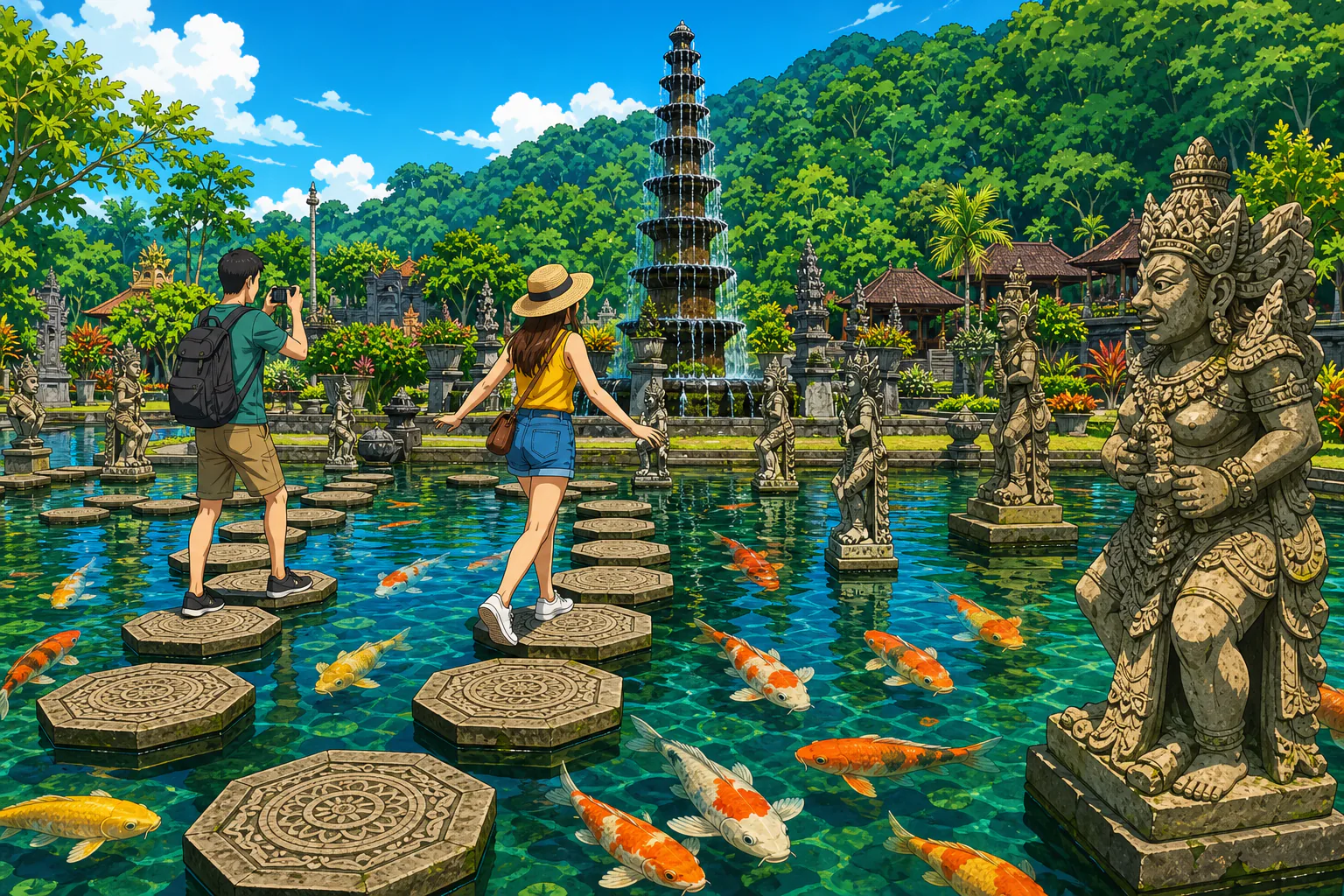
Thirty minutes downhill from Lempuyang sits Tirta Gangga, a water palace built in 1946 by the last raja of Karangasem. The name means "water of the Ganges" and the spring that feeds it is holy, which explains why a royal pleasure garden doubles as a temple site. It is a compact, easy stop: an eleven-tiered fountain, stone demons and dancers standing guard over ponds, and the octagonal stepping stones that zigzag across water absolutely packed with koi the size of your forearm. Entry is around IDR 75,000, a bag of fish food costs IDR 10,000, and the koi will make you feel like the most popular person in Bali.
We usually give it 45 minutes to an hour. By the time you arrive around 9:30 AM the light is bright, the gardens are green, and the sunrise crowd from Lempuyang has mostly not caught up yet. It is also where we do the coffee stop: there is a small cafe terrace above the ponds where a Bali kopi and a banana pancake go down very well after an early start. If you want deeper background on the region before you come, our guide to the best things to do in Bali covers Tirta Gangga's sister palace at Taman Ujung too, which we can swap in on request.

The Drive: Rice Terraces, the Coast Road and Mount Agung
Here is the part nobody puts on the itinerary but everyone remembers: the road itself. Leaving Sanur before sunrise means you watch the island wake up through the window. Warungs lighting their first woks. Offerings being laid on doorsteps. Then, past Padang Bai, the road climbs and Mount Agung starts to dominate everything, 3,031 meters of near-perfect volcanic cone, the highest point in Bali. Between Tirta Gangga and Tulamben you drive directly beneath it, through the lava fields the 1963 eruption left behind, black rock still lying in rivers where it cooled sixty years ago.
That eruption matters to divers more than most people realize. The same event that reshaped this coastline also pushed the USAT Liberty off the beach at Tulamben and into the water, creating the dive site you are about to visit. Driving past the mountain that put the wreck where it is, twenty minutes before you swim over it, connects the day in a way no separate tour can. We will be honest about one thing: we cannot promise you a clear summit. Roughly one morning in three, Agung pulls a cap of cloud over itself by 9:00 AM. Sunrise starts give you the best odds, which is one more argument for the early alarm.
Diving or Snorkeling the USAT Liberty Wreck at Tulamben
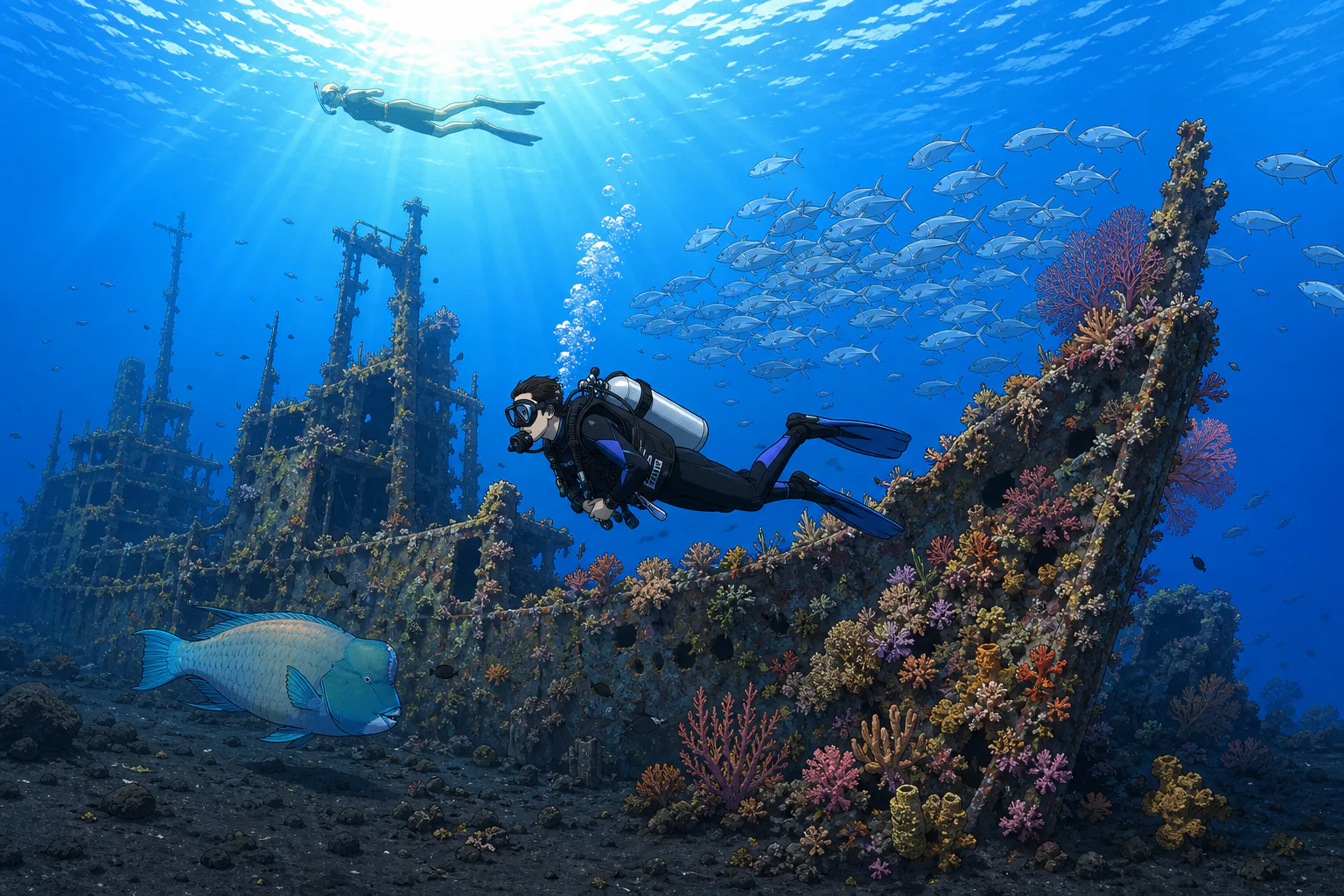
The main event. The USAT Liberty was a 120-meter American army cargo ship torpedoed by a Japanese submarine in January 1942, beached at Tulamben, then nudged into the sea by the 1963 Agung eruption. Today she lies on black volcanic sand about 30 meters from shore, starting at 5 meters depth and sloping down to around 28. No boat needed. You wade in off the beach, put your face in the water, and there is a shipwreck. After all these years it still gets us.
Sixty-plus years underwater have turned steel into reef. The hull is upholstered in soft corals, sponges and gorgonians, and the fish life is dense in a way that surprises even experienced divers: a resident school of big-eye jackfish that swirls into a silver tornado, sweetlips stacked under the cargo hold, garden eels on the sand, and more than 400 recorded fish species on this one site. Water is typically 27 to 29 degrees Celsius, dipping toward 26 in August when the season's coolest water arrives. Our full USAT Liberty wreck guide covers the history and the marine life in detail if you want the deep version.
For certified divers
We plan two dives of around 60 minutes with a maximum of three divers per guide. The first dive covers the length of the wreck at mid-depth, through the cargo holds' shadow and past the gun mount at the stern. The second is shallower and slower, the top of the wreck between 5 and 12 meters, where the light is at its best and your no-deco time is effectively endless. An Open Water certification is enough; the site has no penetration and usually little current. If wrecks light you up, this is also where we teach the PADI Wreck Diver specialty, and the deeper stern makes a good dive for Advanced Open Water students. Conditions on this coast are friendly most of the year; our Bali diving conditions guide explains the seasonal patterns.
For snorkelers and first-time divers
Because the wreck top sits at 5 meters, snorkelers see the real thing, not a rumor of it. On a calm day with 15 to 25 meters of visibility, the bow, the jackfish school and the coral gardens are all clearly visible from the surface, and our Tulamben snorkeling guides stay with a maximum of four guests each. Never breathed underwater before? Tulamben is one of the two sites where we run our try dive program, one instructor per beginner, and plenty of guests have gone home from this exact trip determined to come back for an Open Water course. If that is you, our first-time diving guide is the place to start reading.
Why We Do Temples First and Diving Second
Every version of this trip you will find online has the same two stops. The order is where experience shows. We always run it temples first, diving second, for two reasons, and only one of them is the queue.
The other is altitude. The Gates of Heaven stand at roughly 600 meters above sea level. Driving to altitude after diving is the same physiological problem as flying after diving, just milder: dissolved nitrogen in your body and dropping ambient pressure do not mix. At 600 meters after two easy dives the risk is small, but small is not zero, and "probably fine" is not how we plan diving. Do the climb before the dives and the problem simply does not exist. Read our guide on flying and altitude after diving if you want the full science; the short version is that the sunrise-temple, afternoon-dive order is not just prettier, it is the only order we will run for divers. That is a we-won't we are happy to put in writing.
The queue argument seals it anyway. Temple at 7:00 AM means a short wait and soft light. Wreck at 1:00 PM means the morning rush of day-trippers from the south has already left the water. Two crowds, both dodged, one schedule.
The Full Private Day Trip, Hour by Hour
Here is the timeline we actually run from Sanur. Pickups from Ubud, Candidasa or the east coast dive towns shift everything earlier or later by up to an hour.
- 5:00 AM, pickup in Sanur. Private car, your own driver and guide, gear already loaded. Coffee strongly advised.
- 6:50 AM, arrive Pura Lempuyang. Sarongs on, shuttle up, queue number collected.
- 7:15 to 8:45 AM, Gates of Heaven. Photos with the mirror man, time to explore the lower sanctuary.
- 9:15 AM, Tirta Gangga. Stepping stones, koi, coffee and a snack on the terrace.
- 10:30 AM, the drive under Agung, through the 1963 lava fields to the coast.
- 11:15 AM, arrive Tulamben. Early local lunch at a warung near the beach, nasi campur for around IDR 50,000, while the gear is set up.
- 12:15 PM, dive one or snorkel session one on the USAT Liberty.
- 1:45 PM, surface interval with fresh coconuts, then dive two, or a second snorkel over the Coral Garden.
- 3:45 PM, rinse, change, log the dives, last look at Agung behind the beach.
- 6:00 to 6:30 PM, back in Sanur, sandy, salty and insufferably smug at dinner.
Total driving is around four and a half hours in the loop. It sounds like a lot on paper. Spread across a day with three long stops and East Bali outside the window, nobody has ever listed it as a complaint on our feedback forms; the 5:00 AM start, occasionally, yes.
Swaps and Add-Ons: Making the Day Your Own
Because the car and the guide are yours, the loop bends. These are the changes guests ask for most, and what we honestly think of each.
Amed instead of Tulamben. Twenty minutes further up the coast, Amed trades the Liberty for the Japanese Patrol Boat wreck and the Pyramids, smaller sites with fewer people. A good swap if you have already dived the Liberty on a previous trip; a bad first choice, because the Liberty really is the better wreck. Taman Ujung instead of Tirta Gangga. The other royal water palace, ten minutes from Candidasa, grander architecture, fewer koi, usually quieter. Photographers often prefer it. A third dive. Skip Tirta Gangga entirely and we can fit a third tank at the Coral Garden or the Drop-off, Tulamben's two other classic sites, both walking distance from the wreck and both covered in our full Tulamben diving guide. Advanced divers wanting current. If your group is experienced and wants adrenaline with their culture, the trip reroutes south: temples at sunrise, then the sharks and rays of Gili Mimpang and Tepekong off Candidasa in the afternoon. Stronger diving, shorter drive, no shipwreck.
What we will not do is stack a fourth stop on top. Guests sometimes ask to add Besakih, the mother temple on Agung's southern slope, or a waterfall on the way home. On paper it fits. In reality it turns a relaxed day into a checklist march, and the whole point of running this privately is that nothing gets marched. One island, one day, three stops done properly.
What the Day Costs
Third-party costs are simple and you pay them on the spot: about IDR 100,000 per person at Lempuyang including the shuttle, around IDR 75,000 at Tirta Gangga, IDR 50,000 to 80,000 for lunch, and small change for photo tips and coconuts. Bring roughly IDR 300,000 per person in cash and you are covered with margin. There are ATMs in Sanur, not reliably along the route.
The diving or snorkeling itself is priced as our standard Tulamben trip, current rates are always on our Bali diving price list, with a private-trip arrangement for the vehicle and guide that depends on your group size, since the car is yours for the day rather than shared. Two dives, all equipment, guide, lunch and hotel transfers are part of the standard package. Message us through the contact page with your group mix, divers, snorkelers, photographers, and we will quote the exact day. Families are welcome; we regularly run this loop with kids who snorkel while parents dive.
What to Bring for a Temple-and-Dive Day
Pack light but pack twice, one small bag for temple, one for water. Modest clothing that covers shoulders for the temples, sarongs are provided. Swimwear worn under your clothes saves a changing-room hunt at the beach. Reef-safe sunscreen, applied at Tirta Gangga so it has soaked in before you enter the water. A dry change of clothes for the ride home, a hat, and your certification card if you have one. Cameras: bring everything, this is the one day in Bali where the topside photos compete with the underwater ones. Our complete Bali diving packing list covers the full kit if you are still planning your suitcase.
Best Time of Year for This Trip
The loop runs year-round, and the two halves of the day peak at slightly different times. April through October is dry season: the most reliable clear views of Agung at the gates and 20-meter-plus visibility on the wreck. July and August bring the biggest queues at Lempuyang and the coolest water at Tulamben, around 26 to 27 degrees, take the 5mm wetsuit we offer. November to March is rainy season, and it is honestly kinder to this trip than people expect: mornings are often clear before afternoon rain, the rice terraces turn violently green, and the wreck sits on the sheltered side of the island. A handful of days each rainy season the shore entry at Tulamben gets rough enough that we swap the dives to Amed's Japanese wreck or the sites around Padang Bai instead, maybe five to ten days a year. Our honest rainy season diving guide and our overview of the best time to visit Bali go deeper on the seasons.
One calendar warning: check the Balinese ceremony calendar with us before fixing your date. On major temple festivals Lempuyang fills with worshippers, which is beautiful to witness from a respectful distance but changes the visit, and on Nyepi the entire island, airport included, stops for a day.
One Day, Two Worlds
There are plenty of good single-purpose days in Bali. Three dives at Nusa Penida chasing mantas. A sunrise volcano trek. A pure temple circuit. But if we had one day to show a first-time visitor why we live here, it would be this one: standing between carved stone gates at dawn watching a volcano wake up, and six hours later hanging weightless over a shipwreck that same volcano pushed into the sea. Slot it into your Bali dive itinerary as the day your non-diving travel companions finally stop calling your hobby selfish. Then book the Tulamben trip, set the alarm for 4:30 AM, and thank us at the gate.
Frequently Asked Questions
Yes, comfortably. Pura Lempuyang and Tulamben are about 40 minutes apart in East Bali. On our private trip from Sanur you reach the Gates of Heaven around 7:00 AM, stop at Tirta Gangga water palace mid-morning, and complete two dives or snorkeling sessions on the USAT Liberty wreck in the early afternoon, returning to Sanur by about 6:30 PM.
No. The famous reflection photo is created by a local photographer holding a small mirror under your phone camera. There is no lake or pool at the gates. The view itself, Mount Agung framed between the split gateway, is completely real and worth the trip on its own.
It depends almost entirely on arrival time. At 7:00 AM on a weekday expect twenty to forty minutes. By mid-morning in high season the wait can stretch to two or three hours. This is why our combined trip leaves Sanur at 5:00 AM.
We do not run it in that order. The temple stands at roughly 600 meters elevation, and ascending to altitude after diving carries a small decompression risk, the same principle as flying after diving. We always schedule the temples first and the dives second, which removes the issue entirely.
Absolutely, it is designed for mixed groups. The USAT Liberty wreck starts at 5 meters depth, so snorkelers see it clearly from the surface with a dedicated guide. Complete beginners can do a try dive with a private instructor, and anyone who prefers to stay dry can enjoy the beach and the views of Mount Agung.
Shoulders covered and a sarong with a sash around the waist, both provided at Lempuyang with your entrance donation. Modest, comfortable clothing is ideal since you will change into swimwear later. Balinese custom asks menstruating women not to enter the inner temple courtyards.
The wreck lies between 5 and about 28 meters on a sandy slope 30 meters from shore. An Open Water certification is enough for guided dives along the hull; there is no penetration involved. Snorkelers need no certification at all, and the shallow top of the wreck at 5 meters is clearly visible from the surface.
Pickup in Sanur is at 5:00 AM to beat the queue at the Gates of Heaven, and you are usually back at your hotel between 6:00 and 6:30 PM. Pickups from Ubud, Candidasa, Amed or Tulamben itself are possible with adjusted timings.
Around IDR 300,000 per person covers everything paid on the spot: roughly IDR 100,000 at Lempuyang including the shuttle, about IDR 75,000 at Tirta Gangga, lunch at a local warung, and small tips for the mirror photographer. Diving and transport are billed as part of your trip package.
April through October offers the most reliable clear views of Mount Agung and the best visibility on the wreck, with July and August the busiest and coolest in the water. Rainy season mornings from November to March are often clear too, with greener landscapes and fewer crowds; only a handful of days a year force us to move the dives to Amed or Padang Bai.