
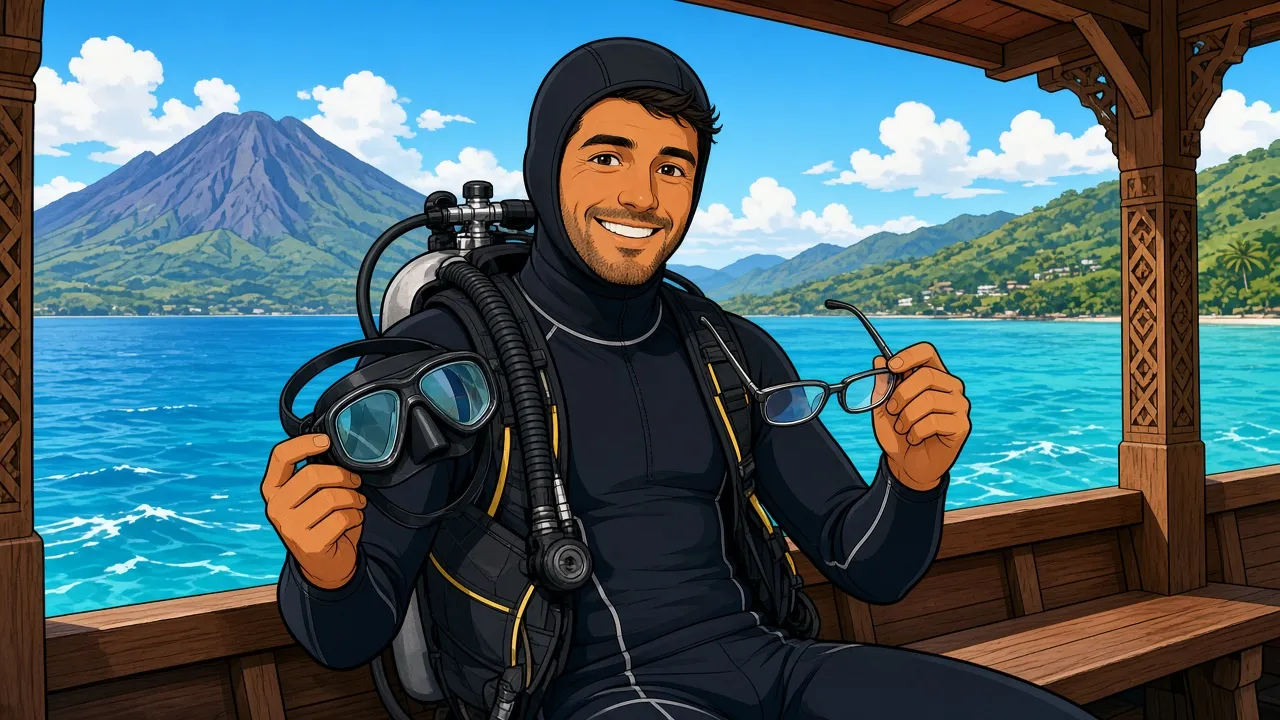
Most people who wear glasses can scuba dive with perfectly clear vision, but not with their glasses on. Anyone who wants to scuba dive with glasses usually switches to soft contact lenses or a dive mask fitted with corrective lenses, and both work from the very first try dive in Bali. Short sight, long sight, astigmatism and the reading problems that arrive after 40 can all be handled, and none of them stops someone from completing the PADI Open Water course.
The choice matters more than most beginners expect. A diver who cannot read a gauge, spot a buddy's hand signal or see a manta ray at 15 metres misses half of the dive and some of its safety checks. Prescription masks are not a standard rental item at most dive centres, so divers usually sort their vision out before the trip, and only the ordinary mask, fins and wetsuit come from the dive shop in Sanur or wherever they dive.
This guide covers why glasses cannot go under a mask, how contact lenses behave under pressure, the types of prescription mask and what they cost, reading lenses for older eyes, and how long to wait after laser or cataract surgery. It reflects published advice from eye-care bodies, the dive medicine literature and the training standards divers follow on a course.
Can you scuba dive with glasses?
Scuba diving with glasses is not possible, because the arms break the mask seal, but soft contact lenses or a prescription dive mask give clear vision underwater.
- Soft contact lenses
- Ready-made corrective lenses
- Custom prescription lenses
- Stick-on reading lenses
The correction sits either on the eye or inside the mask, never in front of the mask, and the right one depends on the prescription.
Divers usually sort it out before:
- A first snorkeling trip in Bali
- A course for PADI certification in Bali
- Bali dive trips with a guide
In short: leave the glasses on the boat and bring contacts or a corrective mask.
Glasses vs contact lenses vs prescription mask: which is better?
Contact lenses suit occasional divers with a simple prescription, and a prescription mask suits regular divers, strong prescriptions and anyone who cannot wear contacts. Glasses only belong on the boat.
Glasses
A dive mask needs its soft silicone skirt to seal against the skin all the way around the face. The arms of a pair of glasses pass straight through that seal, so the mask floods within seconds, and the frame presses against the face as the mask squeezes on descent.
Contact lenses
Soft lenses sit on the eye and work under any ordinary mask, including rental masks. They give full peripheral vision, but they can wash out if the mask floods and they bring a small infection risk if seawater gets in.
Prescription mask
A prescription mask has corrective lenses fitted into or bonded onto its windows. Nothing touches the eye, nothing can wash out, and the same mask lasts for years of diving.
Key distinction:
- Contacts correct vision on the eye and stay useful if a mask has to be swapped.
- A prescription mask corrects vision in the glass and is lost if the mask is lost.
| Option | Works for | Main advantage | Main drawback | Typical cost |
|---|---|---|---|---|
| Glasses under a mask | Nobody | None | Mask leaks and floods | Not an option |
| Soft daily contacts | Most short and long sight | Any rental mask works | Can wash out in a flood | Price of a few dailies |
| Ready-made corrective mask | Short sight, mild astigmatism | Off the shelf, affordable | Steps of 0.5 dioptres only | About USD 90 to 200 |
| Custom prescription mask | Any prescription, strong astigmatism | Exact correction | Costly, weeks to make | About USD 200 to 500 |
| Stick-on readers | Reading after age 40 | Cheap, any mask | Near vision only | About USD 15 to 35 |
The prices above are typical 2026 retail ranges at international online dive retailers for a complete mask with lenses, and they vary by brand and lens strength.
Can you wear contact lenses when scuba diving?
Yes. Soft contact lenses are the type most eye-care professionals recommend for scuba diving, and many divers wear them for years without a problem. Hard lenses need more care, and the infection risk from water means a few habits matter.
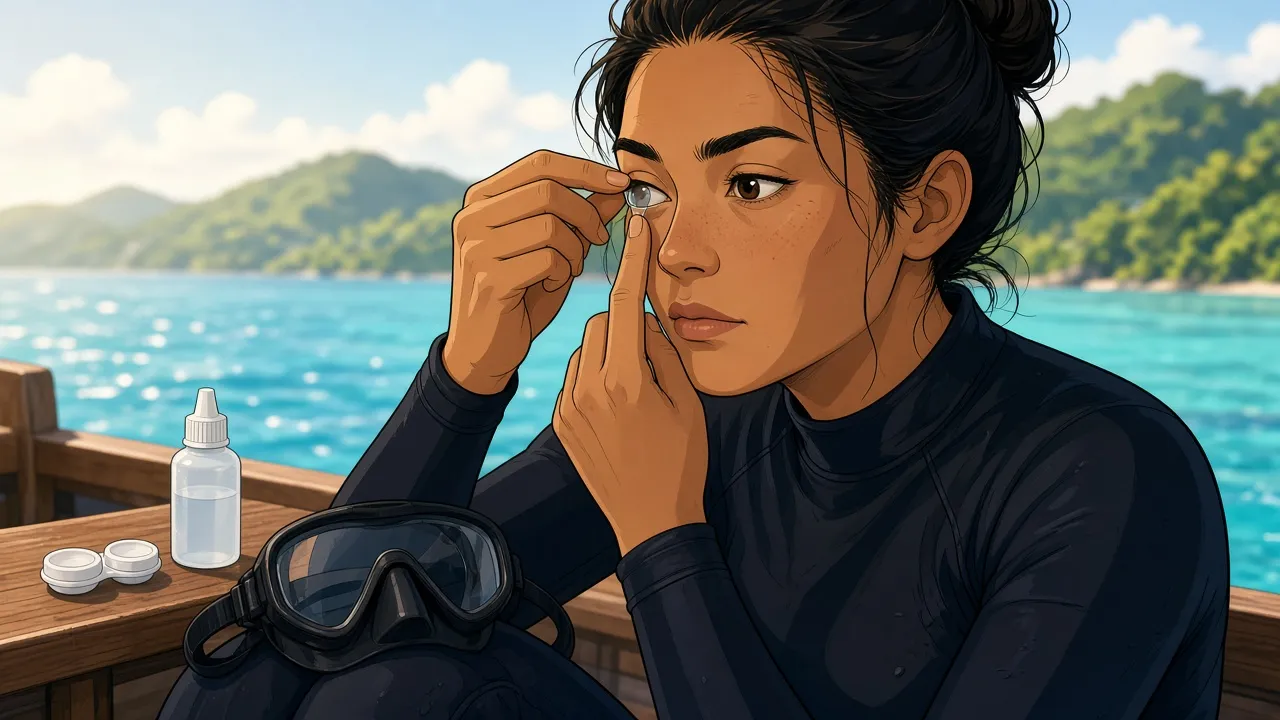
Soft lenses vs hard lenses
Soft lenses let gas pass through freely, so pressure changes during a dive do not affect them. Hard lenses are different. A 1980 US Navy study by Simon and Bradley, published in JAMA, found that divers wearing hard, non-permeable lenses developed small gas bubbles under the lens during ascent, with soreness, halos around lights and blurred vision afterwards. Divers who use rigid gas-permeable lenses should ask their optician about them before diving; fenestrated designs, with a tiny hole that lets gas escape, are sometimes suggested.
Infection risk and Bali tap water
The US Food and Drug Administration advises that contact lenses should not be exposed to any kind of water, including tap, pool and sea water. The concern is Acanthamoeba keratitis, a rare but serious eye infection; the US Centers for Disease Control and Prevention reports that about 85 percent of cases in the United States occur in contact lens users. Tap water in Bali is not drinkable, so lenses and cases should only ever meet fresh sterile solution.
Daily disposable lenses solve most of this. After the last dive, the lenses go in the bin rather than back in a case, and a fresh pair goes in the next morning. If seawater does get into the eyes, removing the lenses as soon as practical after the dive, and not sleeping in them, reduces the risk further.
Habits that keep contacts in place
- Put lenses in at the hotel with washed and fully dried hands, not on a rocking boat.
- Pack at least two spare pairs per dive day, plus glasses for the boat ride home.
- If the mask floods, close the eyes, clear the mask, then open them and blink.
- Use rewetting drops between dives, because wind and salt dry the eyes on the boat.
- Tell the instructor or guide, so they know why a diver keeps the eyes shut during mask skills.
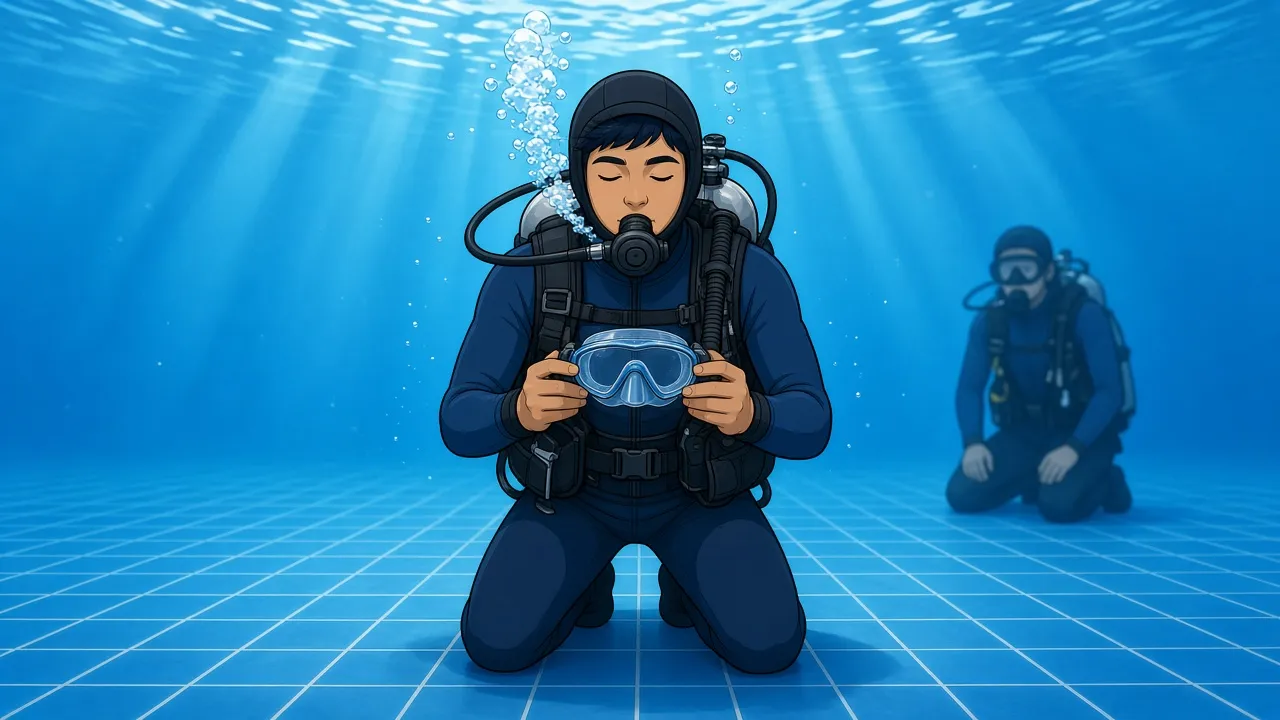
Most divers wear soft lenses through the whole course, including the skills where the mask comes off. Those skills, and a mask that fogs, are the main reasons a lens might move, so the tips in how to stop a dive mask fogging help contact wearers more than anyone.
What types of prescription dive mask are there?
There are four: masks that take ready-made corrective lenses, masks with custom lenses bonded or ground to a prescription, stick-on or bonded reading lenses, and full-face masks with optical inserts.
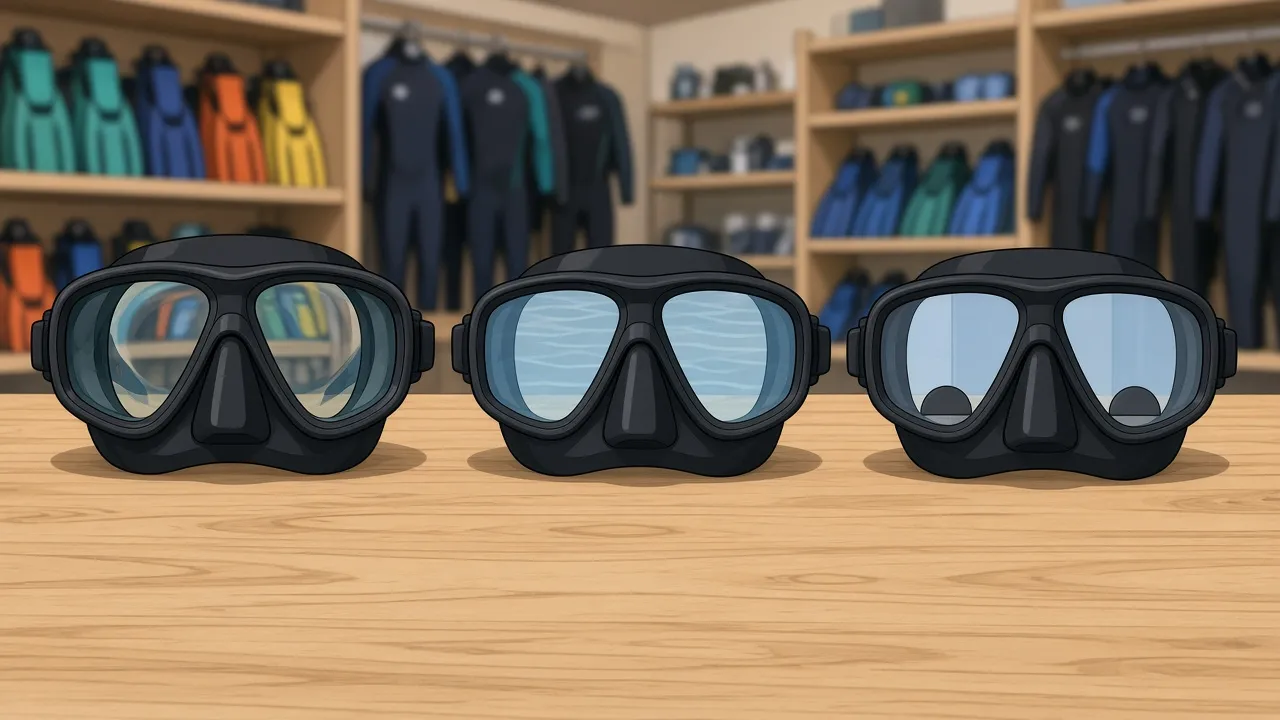
| Type | How it works | Range | Lead time | Best for |
|---|---|---|---|---|
| Ready-made lenses | Swap stock lenses into a two-window frame | Usually -1.0 to -10.0, some + lenses | Same day | Short sight, little astigmatism |
| Custom bonded lenses | Optical lens glued inside the mask glass | Almost any prescription | One to three weeks | Long sight, bifocals, strong astigmatism |
| Custom ground lenses | Mask glass replaced by a prescription lens | Almost any prescription | Two to four weeks | Strong or unusual prescriptions |
| Stick-on readers | Small magnifier stuck low on the glass | Usually +1.0 to +3.0 | Same day | Reading gauges after 40 |
| Full-face mask insert | Prescription frame clipped inside the mask | Depends on optician | One to three weeks | Divers using full-face masks |
Ready-made corrective lenses
Several major mask brands sell two-window masks whose lenses pop out and swap for stock corrective lenses, sold one side at a time in steps of 0.5 dioptres. Short-sighted ranges usually run from about -1.0 to -10.0, and a few models also offer plus lenses for long sight. Because each side is sold separately, a diver with different eyes can fit a different lens to each window.
The limitation is astigmatism. Stock lenses are spherical, so they cannot correct the cylinder part of a prescription. Opticians often say that up to about 1.0 dioptre of cylinder is comfortable with a spherical lens, while more than that is better served by a custom lens.
Custom bonded and ground lenses
Specialist optical labs either bond a thin prescription lens to the inside of the mask glass or replace the glass with a lens made to the full prescription, including astigmatism and bifocal segments. This costs more and takes weeks, so it has to be ordered well before travel. It is also the only route for strong long sight and the most complex prescriptions.
Stick-on reading lenses
Thin flexible magnifiers, usually shaped like a half moon, stick to the lower part of the mask glass with water or a light adhesive. Looking straight ahead, the diver sees normally; looking down, the gauge or computer comes into focus. They suit divers who see well in the distance but struggle with small print.
Full-face masks
Full-face masks are uncommon on recreational dives in Bali, but divers who use them can fit a small prescription frame inside. An optician has to make the frame, and it must sit clear of the visor and the nose pocket.
How to choose and fit vision correction for diving
The process is the same for everyone: read the prescription, pick the option it allows, try it in the pool, and fix any problem before the first ocean dive. The steps below take about a month for a custom lens and a day for contacts or a ready-made mask.
1. Get a current prescription
An eye test less than about two years old is a sensible starting point, because prescriptions drift. The numbers that matter are the sphere (SPH, minus for short sight and plus for long sight), the cylinder (CYL, for astigmatism) and any reading addition (ADD).
2. Work out whether stock lenses will do
Opticians usually convert a prescription with astigmatism into a single number called the spherical equivalent: the sphere plus half the cylinder. A ready-made lens close to that figure gives sharp enough vision for most divers when the cylinder is small.
3. Remember that water magnifies
The PADI Open Water manual teaches that objects underwater look about 33 percent bigger and 25 percent closer, because light bends as it passes from water through the flat mask glass into air. This does not cure short sight, but it means many divers with a mild prescription, around -1.0 to -1.5, find they can manage without correction, and a slightly weaker lens often feels more comfortable than a stronger one.
4. Allow for lens distance
A mask lens sits a little further from the eye than a pair of glasses. For prescriptions stronger than about 4 dioptres, that distance changes the effective strength, which is another reason opticians often round a short-sighted diver down to the weaker lens.
5. Test it before the ocean
Try the mask or contacts in a pool or calm shallow water. The test is simple: can the diver read the gauge or computer at arm's length, recognise a buddy's hand signals at 3 to 4 metres, and look around without headaches or dizziness?
6. Prepare the lenses like any other mask
Corrective lenses fog exactly like plain glass, and many are coated, so they need the same scrub, defog and rinse routine described in the mask fogging guide, using a cleaner the manufacturer approves.
Worked example
A 34-year-old short-sighted diver books an Open Water course in Sanur. The prescription reads right eye SPH -4.50 CYL -0.75, left eye SPH -5.25 CYL -0.50, with no reading addition.
- Right eye spherical equivalent: -4.50 plus half of -0.75 equals -4.875, so a stock -4.5 lens (the weaker neighbour) fits.
- Left eye spherical equivalent: -5.25 plus half of -0.50 equals -5.50, which matches a stock -5.5 lens exactly.
- Both cylinders are under 1.0 dioptre, so spherical lenses are likely to be comfortable.
- The diver buys a two-window mask with -4.5 and -5.5 lenses, tests it in the 5-metre training pool on day one, and wears daily contacts as a backup.
If the same diver had CYL -2.00 in one eye, a stock lens would leave noticeable blur, and a custom bonded lens ordered a month before travel would be the better answer.
Reading gauges after 40: what are the options?
Divers who see well in the distance but struggle with small print can fit stick-on readers, order a bifocal mask, or choose a dive computer with a large, high-contrast screen. Any of these fixes the most common vision complaint among older divers.
The American Academy of Ophthalmology describes presbyopia, the loss of near focus, as starting for most people after the age of 40. On land it means holding a menu further away. Underwater it means a diver can see a turtle 10 metres off but cannot read the remaining gas pressure or no-stop time held at arm's length, which is a safety problem rather than an inconvenience.
- Stick-on readers in +1.5 to +2.5 suit most people who wear reading glasses of similar strength on land.
- Bifocal masks combine a distance lens on top and a reading segment below, made to measure.
- A computer with large digits and a bright screen helps, which is worth weighing when choosing one, as covered in what a dive computer is and how to choose one.
- Holding the console or wrist slightly lower and further away helps a little, but only a lens fixes it properly.
Near vision also matters for macro diving. The critters on the black sand at Tulamben and in muck diving sites around Bali, such as pygmy seahorses and nudibranchs, are often under 2 centimetres long. Divers who take photos, as described in underwater photography in Bali, also need to read camera settings on a small screen, and readers make a large difference there.
Distance vision matters at the big-animal sites. Manta rays at Nusa Penida dive sites often cruise at the edge of visibility, and the guide in diving with manta rays at Nusa Penida notes how quickly they appear and disappear. A diver with uncorrected short sight will see a grey shape where everyone else sees a manta.
Can you scuba dive after LASIK or eye surgery?
Yes, once the eye has healed and the surgeon has cleared it. Waiting periods range from about two weeks after PRK to several months after a corneal transplant, and divers with a gas bubble in the eye must not dive or fly until it has gone.
The figures most often repeated in dive medicine come from a review of diving and ophthalmology by Dr Frank Butler, a US Navy diving physician, published in the journal Survey of Ophthalmology in 1995. They are conservative guidance, not a rule, and the operating surgeon's advice always comes first.
| Procedure | Commonly cited wait before diving | Main concern |
|---|---|---|
| PRK | About 2 weeks, once the surface has healed | Infection while the epithelium regrows |
| LASIK | About 1 month | Flap shifting under mask squeeze |
| SMILE | Ask the surgeon; often treated like LASIK | Little diving-specific data |
| Radial keratotomy | About 3 months | Weakened cornea |
| Cataract surgery | About 2 months, often less with modern incisions | Wound healing |
| Corneal transplant | About 6 months | Graft strength |
| Retinal surgery with a gas bubble | Not until the gas is fully absorbed | Gas expands and compresses with depth |
Why mask squeeze matters after surgery
As a diver descends, the air in the mask is compressed. If the diver does not breathe a little air out through the nose into the mask, it pulls on the face and eyes like a suction cup. Mask squeeze is a form of barotrauma, explained in barotrauma in diving, and after eye surgery it is the main reason to wait. A diver returning after surgery should equalise the mask early and often.
Gas bubbles in the eye
Some retinal operations leave a bubble of gas inside the eye to hold the retina in place. Gas changes volume with pressure, so diving, flying and even driving over high mountain roads are off limits until the surgeon confirms it has gone, which can take several weeks.
Divers who have had any recent eye surgery should mention it when they fill in the diver medical questionnaire before a course, and carry written clearance from the surgeon. Glaucoma surgery and other procedures that change pressure inside the eye are individual cases that need a specialist's view.
What to look for in a prescription dive mask
A prescription mask has to fit the face first and the eyes second. The checks below apply to any mask, plus the extra ones that matter when lenses are involved.
1. A seal that fits the face
Hold the mask to the face without the strap and breathe in gently through the nose; it should stay on by itself. A perfect lens in a leaking mask is useless, so fit always comes before optics.
2. A two-window frame for stock lenses
Ready-made lenses only fit two-window masks that the manufacturer designed for them. Ask which frames take the brand's optical lenses before buying.
3. Lenses close to the eyes
Low-volume masks sit closer to the face, which keeps the lens near the eye and makes the correction more accurate. They are also easier to clear.
4. Tempered glass and a clear label
Dive mask lenses should be tempered glass. Ask the supplier to mark the strength of each lens, because it is easy to swap them later when cleaning.
5. Eye alignment
The optical centre of each lens should sit in front of each pupil. Specialist suppliers ask for the pupillary distance from the prescription for this reason.
6. Room for reading segments
Divers over 40 may want readers now or later. A mask with enough glass below the line of sight leaves room for stick-on segments or a bifocal.
7. A spare plan
A lost or broken prescription mask cannot be replaced at a dive centre the same day. Regular divers often carry daily contacts as a backup, and divers heading out on a week-long trip such as the King Neptune liveaboard should bring a spare, as recommended in the Bali scuba diving packing list.
Example: diving in Bali with Neptune Scuba Diving if you wear glasses
Neptune Scuba Diving runs courses and dive trips from its dive center in Sanur, which has a 5-metre training pool. The example below shows how a diver who wears glasses fits into one operator's programme; it is one way to do it, not the only one.
- The Discover Scuba Diving programme starts with mandatory pool training and goes no deeper than 12 metres, and the course page lists it from IDR 2,700,000 per person.
- The three-day Open Water course, listed from IDR 8,100,000, spends day one in the classroom and pool, where mask clearing and removal are practised with the eyes closed by contact wearers.
- Ordinary masks are among the items available to rent at the Sanur equipment centre, and they work with contact lenses.
- Day trips to Padang Bai and Amed leave time to set up equipment before the first dive.
This format is not for everyone. It does not include prescription mask fitting, so divers who need corrective lenses must bring contacts or their own mask. It is not suitable for anyone inside the waiting period after eye surgery, or who still has a gas bubble in the eye. Divers who have not dived for a long time can practise mask skills again in the pool, and the full first-day experience is described in first-time diving in Bali.
Divers who progress further can carry on to the Advanced Open Water course, where the deep and navigation dives make good vision even more useful, or to the Night Diver specialty, where reading a gauge by torchlight is part of every dive.
Key takeaways
- Glasses cannot be worn under a dive mask, but contacts or a corrective mask give divers clear vision underwater.
- Soft daily disposable contact lenses are the simplest option and work with any rental mask.
- Ready-made corrective lenses suit short sight with little astigmatism, while strong or complex prescriptions need custom lenses.
- Stick-on reading lenses fix the most common problem after 40: reading the gauge or computer.
- Wait until the surgeon clears the eye after LASIK, PRK or cataract surgery, and never dive with a gas bubble in the eye.
- Keep tap water away from contact lenses, carry spares, and close the eyes whenever the mask floods.