
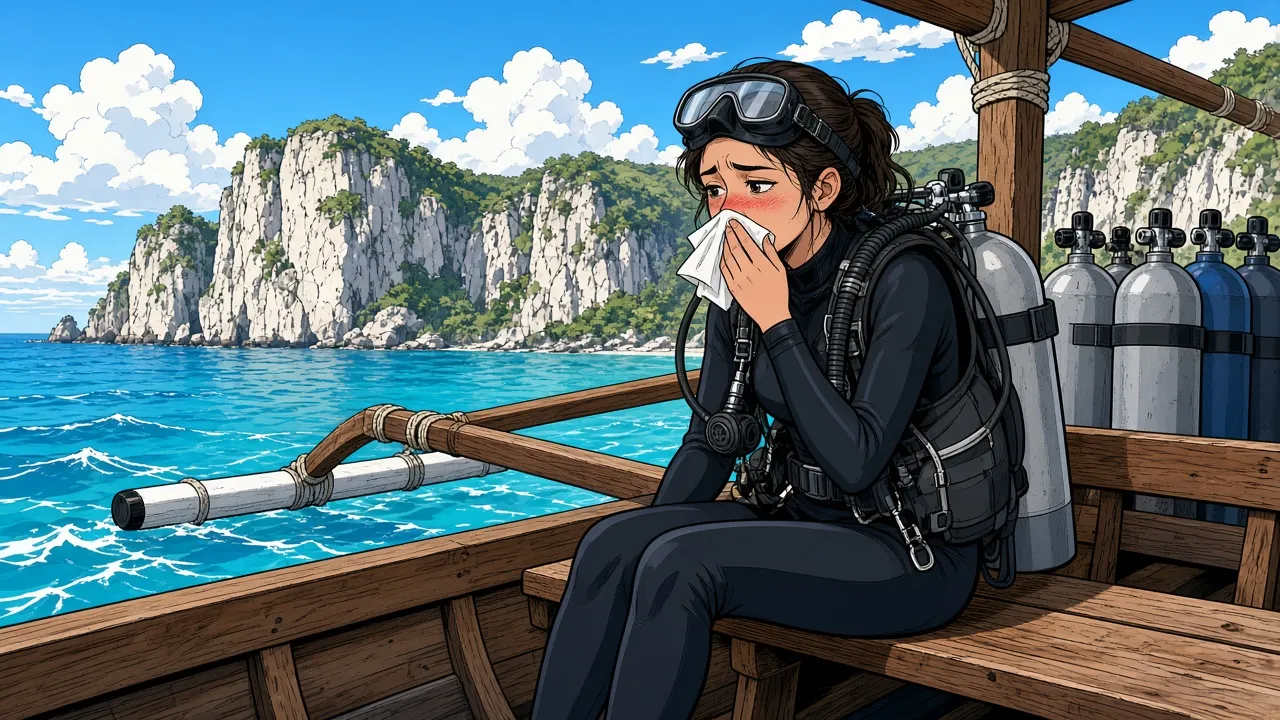
Ask a dive doctor or a training agency "can you scuba dive with a cold?" and the answer is the same: not while the nose and ears are blocked. A cold swells the lining of the nose, sinuses and Eustachian tubes, and those are the passages a diver needs open to equalise. That applies on a first try dive in Bali just as much as on the fourth day of a PADI Open Water course, and no amount of experience changes the anatomy.
The decision usually lands at the worst moment, on the morning of a booked trip, after a flight and a few nights of air conditioning. Diving with a cold rarely ends in an emergency, but it is one of the most common reasons a diver loses the rest of a holiday to a damaged ear. Missing one day of Bali dive trips costs far less than missing five, and the manta and reef sites of Nusa Penida diving will still be there two days later.
Colds, allergies, sore throats and the decongestant question all lead back to one skill. Readers who want the full technique first can read how to equalise your ears when diving, then come back for the illness-specific detail below.
Can you scuba dive with a cold?
Diving with a cold is not recommended, because congestion blocks the Eustachian tubes and sinus openings that must vent air as pressure changes, risking ear and sinus injury.
- Ear squeeze on descent
- Reverse block on ascent
- Sinus squeeze and nosebleeds
- A perforated eardrum
The risk is greatest in the first ten metres, where pressure doubles, and on the way back up, when trapped air cannot escape.
A diver with a cold usually switches to:
- A surface-only snorkelling trip in Bali
- A rest day, then a gentle check dive
- A pool session at a dive centre in Sanur once symptoms clear
In short: if the ears will not clear easily on land, they will not clear at five metres.
How a cold affects your ears and sinuses underwater
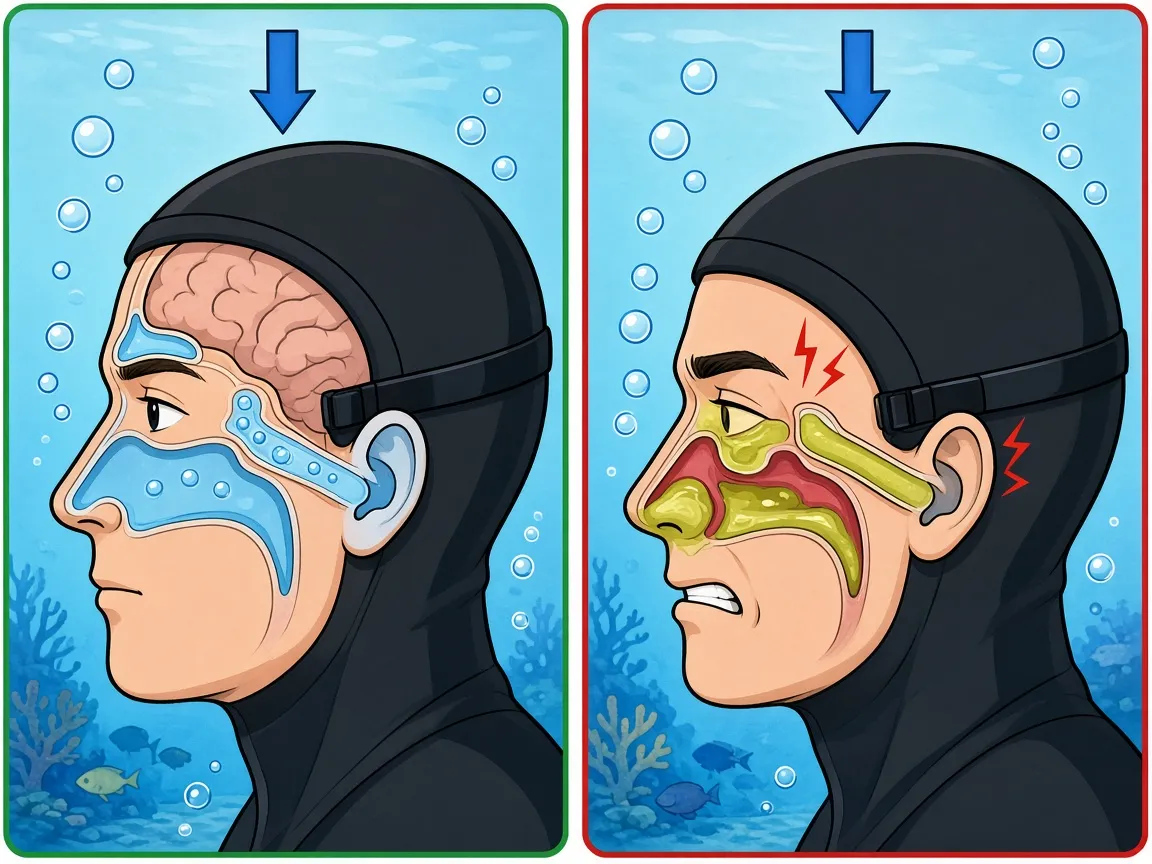
A cold matters to a diver because of a handful of small air spaces in the head that are joined to the throat and nose by narrow passages. When those passages swell shut, the air inside cannot keep up with the changing water pressure.
1. Pressure changes fastest near the surface
At sea level the body sits under 1 bar of pressure. Every 10 metres of seawater adds another bar, so a diver at 10 metres is under 2 bar and at 18 metres, the Open Water limit, under 2.8 bar. By Boyle's law, a pocket of air that is not topped up shrinks to half its volume between the surface and 10 metres, which is why most ear trouble starts in the first few metres of a descent and not at the bottom.
2. The Eustachian tube is the only way in
The middle ear is a rigid, air-filled space behind the eardrum. Its only connection to the outside is the Eustachian tube, a passage about 3.5 centimetres long in adults that opens at the back of the nose. Equalising means pushing air up that tube, by pinching the nose and blowing gently or by swallowing and moving the jaw. In a healthy diver the tube opens with a soft pop. In a diver with a cold, the swollen lining can hold it shut.
3. The sinuses have narrow doorways too
The frontal, maxillary and other sinuses are air spaces in the bones of the face that drain into the nose through small openings. These equalise on their own when the openings are clear, so most divers never think about them. Mucus and swelling from a cold can block an opening completely, leaving the air inside to be squeezed on descent and to push outward on ascent.
4. Small pressure differences do damage
The amount of unbalanced pressure the ear can tolerate is small. Diving and Subaquatic Medicine, the standard textbook by Edmonds and colleagues, describes discomfort beginning at a difference of around 60 mmHg and the Eustachian tube locking shut at around 90 mmHg, which is roughly the pressure of the first metre of water. Eardrums can rupture at differences from about 100 mmHg upward, under two metres of unequalised descent.
5. Worked example: a descent at Crystal Bay
Take a certified diver with a two-day-old cold on a morning dive at Crystal Bay, a common first site on Nusa Penida trips. At the surface the right ear clears with effort, the left only on the third try. At three metres the left ear stops responding. A diver who keeps descending here, even slowly, adds pressure to an ear that is already locked, and by six metres the pressure difference can be several times the figure at which the eardrum is known to tear.
The correct move is to stop, rise a metre, try again gently, and end the dive if the ear still will not clear. The worked example has a second half. Suppose the diver forces both ears open with a hard blow and reaches 18 metres. Forty minutes later, as the decongesting effect of the cool water and adrenaline fades, the tubes swell again. Air inside the middle ear is still at 2.8 bar, while the water at the five metre safety stop is at 1.5 bar. The trapped gas presses outward on the eardrum, and unlike a descent, the ascent cannot be put off for long because air in the tank runs out.
What happens if you dive with a cold?
Most divers who dive with a cold either abort in the first few metres or get away with it, but the injuries that do happen tend to end the diving for the rest of a trip. The table below sets out what can go wrong, where in the dive it happens and how long it usually takes to recover.
| Injury | When it happens | Typical signs | Usual recovery |
|---|---|---|---|
| Middle ear squeeze | Descent, first 1 to 5 m | Pain, fullness, muffled hearing | Days to two weeks |
| Reverse block | Ascent, often near the stop | Pain, pressure, sometimes vertigo | Days to two weeks |
| Sinus squeeze | Descent or ascent | Forehead or cheek pain, nosebleed | A few days to a week |
| Perforated eardrum | Descent after forcing | Sharp pain, then sudden relief, vertigo | Weeks, no diving until healed |
| Inner ear barotrauma | Forceful equalising | Ringing, hearing loss, spinning | Needs urgent specialist care |
Middle ear squeeze
This is the most common diving injury of all. Reviews in the dive medicine literature list middle ear barotrauma as the injury divers report most often, and it is especially frequent during training, when students are still learning to equalise. With a cold, the eardrum is pulled inward and the lining of the middle ear swells and may bleed, leaving a blocked, muffled ear that can take a week or more to settle.
Reverse block
A reverse block is the same problem in the opposite direction, and it is the one divers with a cold fear most. Air that went into the middle ear at depth cannot get out on the way up. Divers usually feel a growing pressure in one ear as they near the surface. Swallowing, slowing the ascent and descending a metre to relieve it can help, but the ascent has to happen eventually.
Sinus squeeze
Sinus squeeze shows up as a sharp ache across the forehead or under the eyes, usually on descent, and a blood-streaked mask is a common sign afterwards. It is rarely dangerous on its own and most cases settle within days, but it is a clear sign that the sinuses were blocked and that the next dive should wait. Persistent pain, fever or thick discoloured mucus after diving can point to a sinus infection that needs a doctor.
Vertigo and the inner ear
When the two middle ears are at different pressures, the balance organs receive mismatched signals and the diver can feel the water spin. This is called alternobaric vertigo, and it most often appears on ascent in divers who equalise unevenly, which a one-sided cold makes more likely. It usually passes in seconds or minutes, but disorientation underwater is dangerous in its own right. Hard, repeated blowing against a blocked tube can also damage the inner ear itself, and ringing, hearing loss or lasting vertigo after a dive need a specialist the same day. The guide to diving barotrauma in Bali explains where to get checked.
Should you take a decongestant before diving?
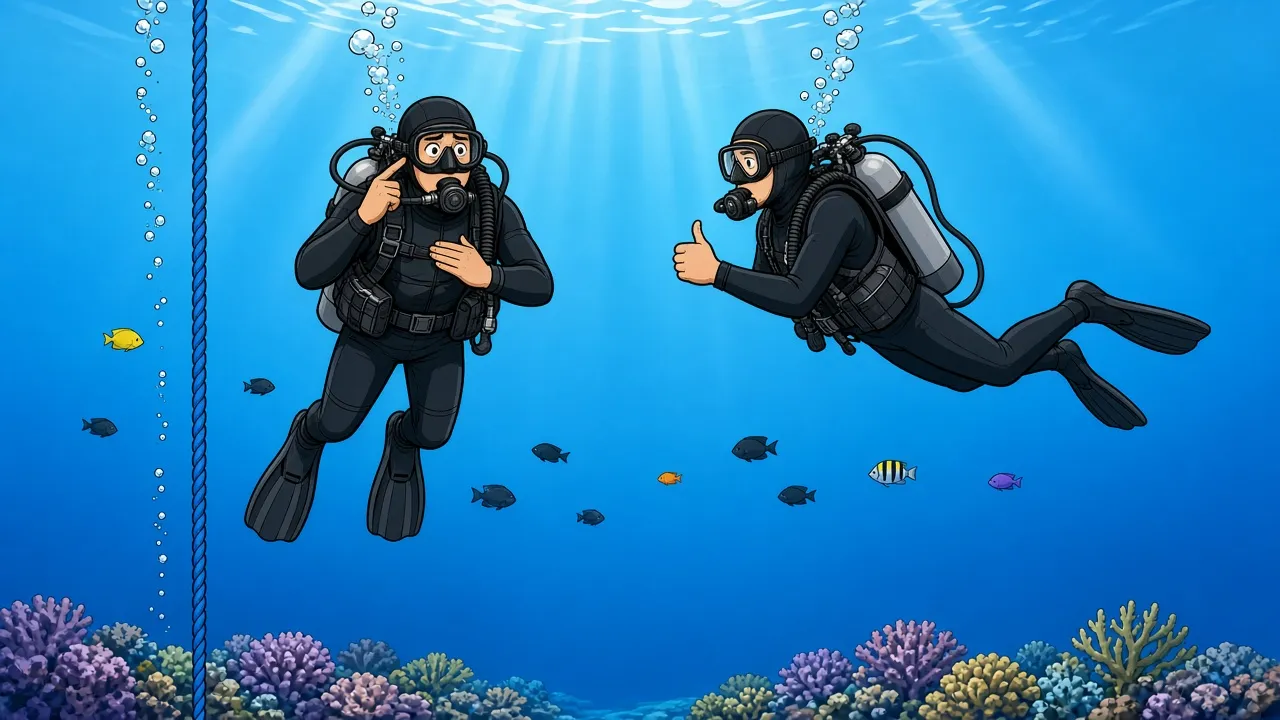
Most dive physicians advise against using a decongestant to dive through a cold, because the medicine can wear off underwater and turn a descent problem into a reverse block on ascent. A decongestant that is used at all should be one the diver has already tried on land, and only for mild, nearly resolved congestion.
Divers Alert Network (DAN) gives the same caution in its guidance on ears and medication: a decongestant may make it possible to get down, but it does nothing to reduce the risk of being unable to come back up comfortably. The table compares the medicines divers most often ask about.
| Medicine | Examples | Effect lasts | Main concern for divers |
|---|---|---|---|
| Oral decongestant | Pseudoephedrine | 4 to 12 hours, by formula | Wears off mid-dive, raises heart rate |
| Nasal spray decongestant | Oxymetazoline, xylometazoline | Up to about 12 hours | Rebound congestion after a few days |
| Sedating antihistamine | Chlorphenamine, diphenhydramine | 4 to 8 hours | Drowsiness, adds to narcosis |
| Non-sedating antihistamine | Loratadine, cetirizine, fexofenadine | About 24 hours | Treats allergy, not a cold |
| Steroid nasal spray | Fluticasone, mometasone | Builds over days | Too slow for a cold on dive day |
Why the timing goes wrong
A two-dive day on a Bali boat trip lasts six to eight hours from pickup to return, including boat rides and a surface interval of an hour or more. A short-acting tablet taken at breakfast can be fading by the second dive, which is exactly when the diver is ascending from it. The same logic applies to nasal sprays, which work well for some hours and then let the swelling return.
Rebound congestion
Nasal decongestant sprays carry a warning not to use them for more than about three days. Beyond that, the lining of the nose can swell more each time the spray wears off, a condition doctors call rhinitis medicamentosa. A diver who uses a spray every morning of a week-long trip can end up more congested than when they started.
Side effects underwater
Pseudoephedrine raises heart rate and can cause jitteriness, and sedating antihistamines cause drowsiness that may add to the dulling effect of nitrogen narcosis at depth. Any medicine that is new to the diver should be tried on a non-diving day first. Divers with heart conditions or high blood pressure, or anyone taking other prescription medicines, should ask a doctor before using decongestants at all.
Buying cold medicine in Bali
Pharmacy chains such as Kimia Farma and Guardian, and the many independent apotek in Sanur, Kuta and Ubud, sell cold remedies that often combine a decongestant, an antihistamine and paracetamol in a single tablet. Brand names differ from those in Europe, Australia or the United States, so the active ingredients on the box are the only reliable guide. A pharmacist can usually point out which products contain a sedating antihistamine.
Can you dive with a stuffy nose, allergies, sore throat or cough?
Whether a symptom matters depends on whether it stops air moving through the nose and ears, or signals an illness that affects the lungs or the whole body. A blocked nose matters a great deal, a dry throat hardly at all.
| Symptom | Dive? | Why |
|---|---|---|
| Stuffy or blocked nose | No | Equalising will be difficult or impossible |
| Runny nose, ears clear easily | Possibly, shallow and cautious | Tubes may still be open; test on land |
| Hay fever, controlled with tablets | Usually yes | Non-sedating antihistamines are widely used |
| Mild sore throat only | Usually yes | Does not affect equalising |
| Chesty or wet cough | No | Possible chest infection, lung risk |
| Fever or body aches | No | Dehydration, fatigue, poor judgement |
| Recent COVID-19 or flu | Not until recovered | Some cases need a medical check first |
Stuffy nose
A stuffy nose is the clearest no. If air does not move freely through both nostrils, the tissue around the openings of the Eustachian tubes is almost certainly swollen too. Diving with a stuffy nose is the most common route to the ear and sinus injuries in the table above.
Allergies
Divers with hay fever or dust allergy often dive comfortably on a non-sedating antihistamine, provided they have used it before and their ears clear normally. Allergy differs from a cold in one useful way: it tends to be steady and predictable, so a diver knows on land whether today is a good day. Itchy eyes and sneezing with clear ears are a different situation from a blocked head.
Sore throat
A sore throat on its own does not block the ears, and many divers start a cold with a scratchy throat a day before the congestion arrives, so it is worth watching. A sore throat after scuba diving is common and usually comes from breathing dry, filtered tank air through the mouth for an hour, not from an infection. Drinking water between dives and rinsing the mouth usually settles it within hours.
Cough
A dry tickle is a nuisance underwater, and coughing through a regulator is safe as long as it stays in the mouth. A wet, productive cough is different. It can mean a chest infection, and mucus in the airways could in theory trap air in part of the lung during ascent, the same mechanism that makes dive doctors cautious about some lung conditions. The article on scuba diving with asthma explains how dive medicine treats airway problems.
Fever, flu and COVID-19
A fever means no diving. It brings dehydration and fatigue, both of which are linked to a higher risk of decompression sickness, and it dulls the judgement a diver needs. After flu or COVID-19 with chest symptoms, guidance published by DAN and dive medicine bodies since 2020 has advised a medical check before returning to diving rather than relying on feeling better.
Sneezing underwater
Sneezing underwater is harmless as long as the regulator stays in the mouth. The sneeze goes out through the exhaust valve, and the diver may need to clear a little water or mucus from the mask afterwards. A diver who expects to sneeze often should hold the regulator lightly in place with one hand.
When can you dive again after a cold?
A diver can usually return to the water once the nose is clear, the ears equalise easily on land, and there is no fever, chest cough or sinus pain. For many people that is a day or two after the last symptoms, but the test matters more than the calendar.
The land test
Pinch the nose and blow very gently with the mouth closed. Both ears should pop at the same moment, without force. Then swallow with the nose pinched, the Toynbee method, and feel both ears respond. If one side takes several attempts, needs a hard blow or feels blocked afterwards, it is not ready.
The first dive back
Make the first dive after a cold an easy one, ideally a shore entry with a sloping bottom, such as the black sand slopes of Tulamben diving or the shallow bays of Amed. These allow a slow, controlled descent and an easy turnaround. Fast negative entries from a boat in current, common at Nusa Penida, leave little room to stop at two metres and try again.
- Start equalising on the surface before going down, and every metre for the first ten.
- Descend feet first along a line, the reef slope or the instructor.
- Stop and rise a little the moment an ear hurts; never push through pain.
- Ascend slowly and swallow on the way up to help the ears vent.
- End the day after one dive if anything felt difficult.
How long after an ear or sinus injury
An injury changes the timeline. A mild middle ear squeeze may settle within a week, while a perforated eardrum usually keeps a diver out of the water until a doctor confirms it has healed, often several weeks. Persistent hearing loss, ringing or vertigo needs an ear specialist before any return to diving, and the clinics and chambers available locally are listed in the guide to hyperbaric chambers in Bali.
How to handle a cold on a Bali dive trip
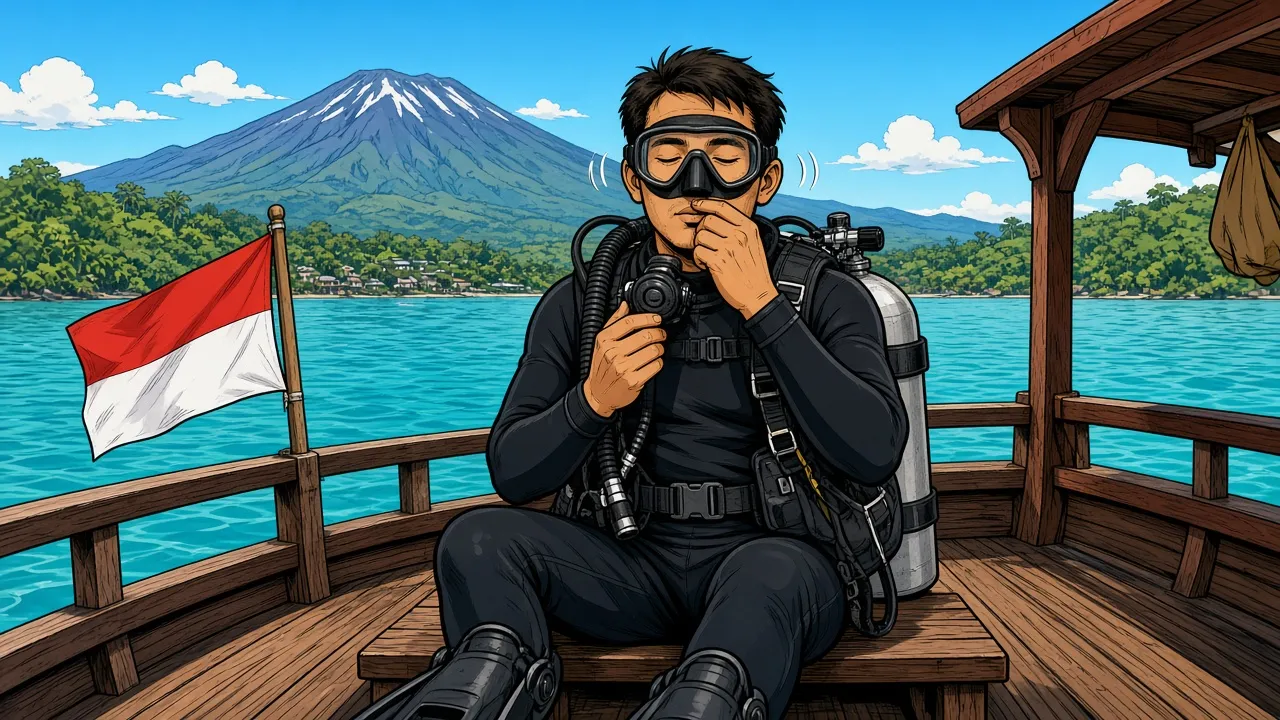
The right move with a cold on a Bali trip depends on what was booked: a single try dive, a course, a run of fun dives or a liveaboard. Bali adds a few local factors, from cold upwellings to the boat crossing to Nusa Penida, that are worth knowing before the trip starts.
Not yet certified
A beginner with a cold should move the try dive to another day. The programme goes no deeper than 12 metres, but first-time divers are still learning to equalise, and a congested ear turns a first dive into a struggle. Most operators can reschedule a try dive with a day's notice, and the same applies to the open water course.
In the middle of a course
Course students who fall ill partway through the Open Water course are not usually forced to start again. PADI's referral system lets a student who has finished the knowledge development and pool training complete the open water dives later, with another PADI dive centre, within 12 months. Anyone on the Advanced Open Water course can generally move the remaining adventure dives to the end of the trip instead.
Certified fun divers
Certified divers on a multi-day dive package can often shuffle dives to the end of the trip. The deeper and more current-swept sites, Manta Point and the Penida drift dives among them, are the ones to leave until the ears feel normal. Divers whose last dive was months ago may want to combine the first dive back with a refresher, described in the guide to the PADI ReActivate refresher in Bali.
Liveaboards
A cold on a liveaboard is harder to work around, because the boat sails on whether or not a guest dives. On a trip such as the King Neptune liveaboard, with three or four dives a day, the usual approach is to sit out dives until the ears clear easily, rather than risk an injury on day two that ends the week.
Bali-specific factors
- Cold water at Nusa Penida. From roughly July to October, upwellings can bring the water at Crystal Bay and the south coast down to 18°C or lower, against 26 to 29°C at most Bali sites, and diving cold makes a recovering diver tire faster. Seasonal conditions are covered in the guide to Bali diving conditions.
- Air conditioning and flights. Many visitors pick up a cold on the long-haul flight or from sleeping under air conditioning in a humid climate, and the first two days of a trip are when colds most often appear.
- The boat crossing. A fast boat to Penida takes 40 to 55 minutes, and spray, wind and a long day in the sun take more out of someone who is unwell.
- Snorkelling as a fallback. Surface snorkelling needs no equalising, so a diver with mild cold symptoms who feels well can often join the boat and snorkel instead. Duck diving below a metre or two brings the ear problem straight back.
Flying home with a cold
A cold also affects the flight home. Divers Alert Network recommends a minimum of 12 hours before flying after a single no-decompression dive and 18 hours after multiple dives or multiple days of diving, as explained in the article on flying after scuba diving. A blocked nose makes the descent into the arrival airport painful too, so a diver who caught a cold at the end of the trip may need to plan the final day with both limits in mind.
Example: a Nusa Penida trip with a cold, from Sanur
Neptune Scuba Diving runs day trips from its dive centre in Sanur, and the example below shows how a diver with a cold could fit into one operator's schedule. It is one way to handle the situation, not a recommendation for every diver.
- Certified divers on Nusa Penida dive trips make two dives at sites such as Crystal Bay and Manta Point, with the trip listed from IDR 2,700,000.
- Non-divers and divers sitting out a day can join snorkelling tours in Bali, listed from IDR 2,070,000 per person for the manta snorkelling day at Nusa Penida and from IDR 1,350,000 for Padang Bai or Tulamben.
- Divers who want an easier return after a cold can choose a shore-entry day at Padang Bai or Tulamben among the day trips around Bali.
- Beginners can move a Discover Scuba Diving session, which starts in the pool and goes no deeper than 12 metres, or the three-day Open Water course, listed from IDR 8,100,000.
This format is not suitable for anyone with a blocked nose, a fever, a chesty cough or ear pain on the day of the trip, or for anyone who needed a decongestant to equalise on land. Divers who have had an ear injury need a doctor's clearance before booking. Divers flying home within 18 hours of the last dive should not plan a final dive day at all. Those wanting to understand the wider risk picture can read whether scuba diving is dangerous, and anyone looking to handle problems underwater with more confidence can look at the PADI Rescue Diver course.
Key takeaways
- A cold swells the passages that let air into the ears and sinuses, so diving while congested risks ear and sinus injury.
- The danger is highest in the first ten metres of descent and on ascent, when a reverse block can trap expanding air.
- Decongestants can wear off mid-dive and are not a safe way to dive through a cold.
- A sore throat or controlled hay fever is usually fine; a blocked nose, fever or chesty cough is not.
- Return when both ears clear gently on land, starting with an easy shore dive and a slow descent.
- On a Bali trip, move the dives, snorkel instead, and keep the 18 hour no-fly interval in mind.