
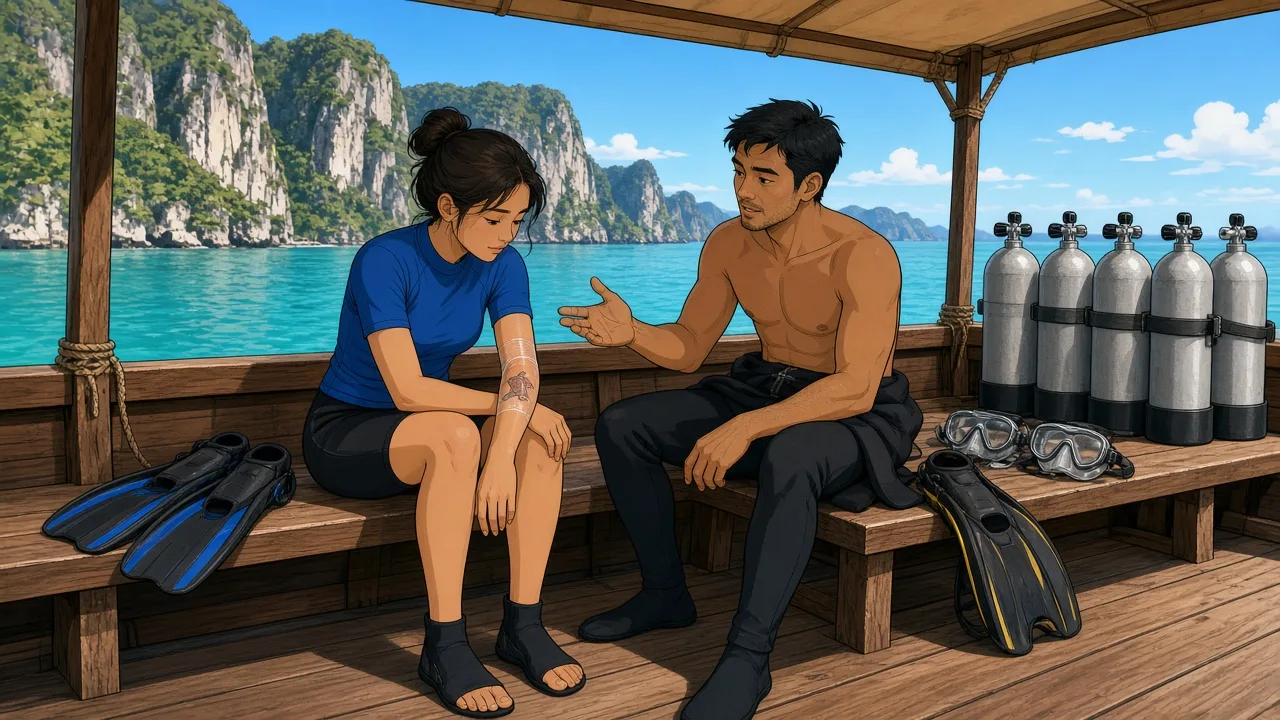
Can you scuba dive with a new tattoo? Not until the skin has healed, which for most tattoos means waiting at least two to four weeks before any dive, swim or snorkel. A fresh tattoo is an open wound, and seawater, a training pool and a tight neoprene suit all work against it, whether the plan is a short Discover Scuba Diving session or a full week of Bali dive trips.
The same logic applies to a new piercing, with one difference: healing times vary far more by placement, from about six weeks for an earlobe to nine months or longer for ear cartilage or a navel. Holiday timing is where most people get caught out. Tattoo and piercing studios cluster in the same beach towns as dive centres all over the world, and a PADI Open Water course booked for the day after a new piece is one of the most common clashes instructors see.
None of this applies once the skin has healed. Divers with full sleeves, back pieces and several piercings dive every day, and a healed tattoo has no effect on pressure, equalising or decompression. The risk sits almost entirely in the healing window, so the real questions are about timing, infection and how equipment sits on the skin.
Can you scuba dive with a new tattoo?
Diving with a new tattoo is not recommended until the skin has fully closed, usually two to four weeks, because seawater and pool water can infect the open wound.
- Bacterial infection from the water
- Faded or patchy lines
- Scabs pulled off by neoprene
- Sunburn on damaged skin
The deciding factor is the condition of the skin, not the calendar: no scabs, flaking, shine, redness or tenderness left anywhere on the tattoo.
Once it has healed, a diver can return to:
- Snorkelling trips as a first swim back
- A pool session at a dive centre in Sanur or at home
- Boat dives such as a Nusa Penida day trip
In short: if the tattoo still peels, shines or hurts, it is not ready for the sea.
How long after a tattoo can you dive or swim?
Most tattoo artists consider a tattoo healed on the surface after two to four weeks, according to Healthline's review of tattoo aftercare, and that is the realistic minimum before diving. Large, heavily shaded pieces and tattoos in places that bend or rub take longer, and full healing of the deeper skin can take up to six months.
Divers Alert Network has answered this exact question. Asked by a diver planning to dive two days after a new thigh tattoo, DAN's medical team advised against it and recommended keeping the tattoo out of the water, other than showering, until the skin is no longer flaking, which they noted can take several weeks.
1. Days one to six: an open wound
A tattoo needle deposits ink into the dermis, the layer under the surface skin, through thousands of small punctures. For the first few days the area is red, swollen and weeping a little. Cleveland Clinic dermatologist Dr. Shilpi Khetarpal describes the oozing in this stage as "a mix of blood and ink". Any immersion now exposes raw tissue directly to whatever is in the water.
2. Weeks two to four: itching, scabs and flaking
Cleveland Clinic's aftercare guidance says itching, flaking and light scabs are normal during the first two weeks, and that after about three weeks the scabs heal and the flaking eases. This is the stage when a tattoo looks almost finished and divers are most tempted to get back in. The skin under the flakes is still thin, and soaking it softens the scabs so they lift off early, taking ink with them.
3. Week five onwards: surface healed, deeper skin still repairing
By about two months, Cleveland Clinic says, the top layer of skin is usually healed and the colours look bright again, although the deeper layers can take several more months. At this point most artists and doctors are comfortable with swimming and diving, as long as nothing on the tattoo is still raised, shiny or sore.
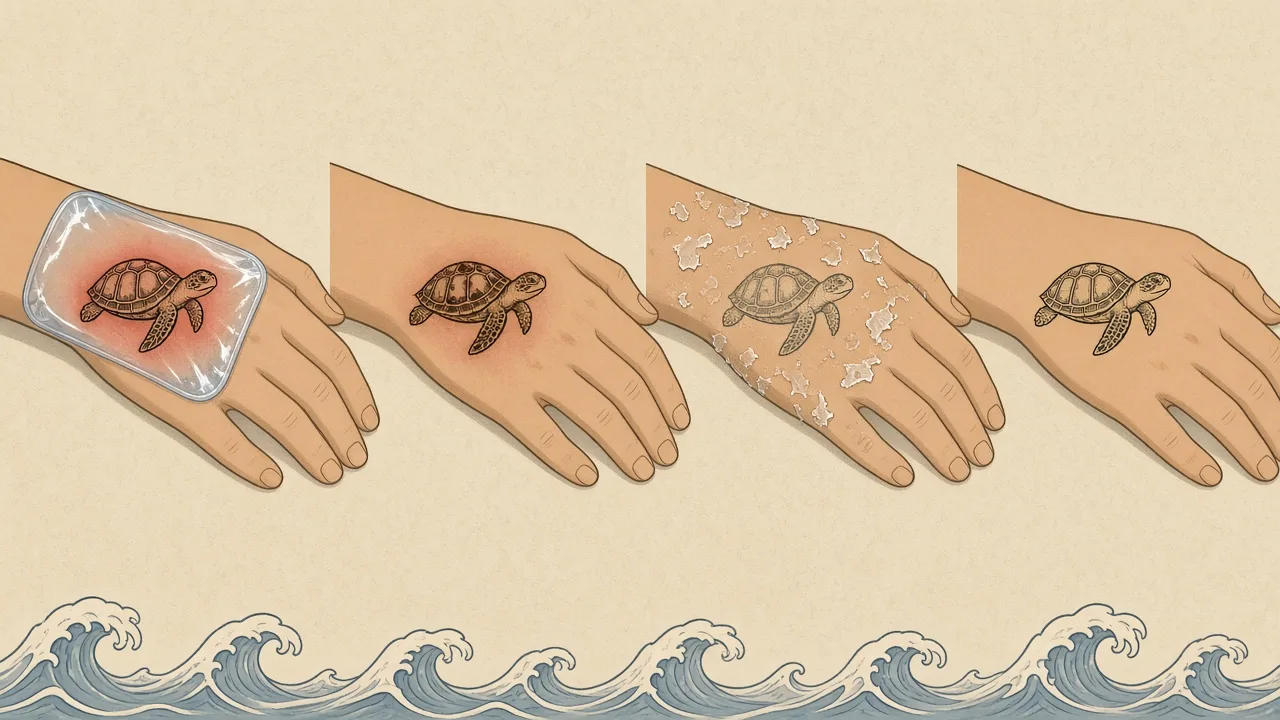
The table below gives typical waiting times before diving by tattoo type. They are based on the healing stages above, and the artist's instructions for a specific piece take priority over any general figure.
| Tattoo | Typical wait before diving | Why it varies |
|---|---|---|
| Small fine-line piece on the arm | 2 to 3 weeks | Little shading, good blood supply |
| Medium colour piece | 3 to 4 weeks | More ink packed into the skin |
| Large shaded piece, back or thigh | 4 to 6 weeks or longer | Bigger wound, heals unevenly |
| Ankle, foot, wrist or hand | 4 weeks or longer | Fin straps, booties and computer straps rub |
| Touch-up of a healed tattoo | About 2 weeks | Smaller area of fresh work |
A tattoo is ready for the water when all of these are true:
- No scabs or flakes remain, even at the edges.
- The skin is flat, with no raised or swollen lines.
- The surface is matte, not shiny or tight.
- There is no redness, heat or tenderness when pressed.
- Nothing has wept or bled for at least several days.
A worked example shows how the timing plays out on a holiday. A diver on a ten-day trip who gets a palm-sized forearm tattoo on the first afternoon will still be in the flaking stage on day ten, so every planned dive is lost. Reverse the order, with dives on days one to eight and the tattoo on day eight, and nothing is lost: the diver keeps the tattoo dry for the last two days and flies home with it covered. The 18-hour no-fly interval applies to diving, not to tattoos, so a tattoo on the final day does not affect the flight.
Why seawater, pools and wetsuits are a problem for fresh ink
Water is the main problem because it carries bacteria into the wound and softens the healing skin, and diving adds hours of soaking, tight neoprene and strong sun on top. Each factor is manageable on healed skin and risky on fresh skin.
Bacteria in warm seawater
The best-known risk is Vibrio vulnificus, a bacterium that lives naturally in warm coastal water. The US Centers for Disease Control and Prevention reports about 150 to 200 V. vulnificus infections a year in the United States, says about one in five people with the infection die, sometimes within one or two days, and lists recent tattoos and piercings among the open wounds through which it enters. A 2023 study in Scientific Reports put the death rate for wound infections from seawater at around 18 percent, with about one case in ten needing surgical tissue removal or amputation.
These infections are rare, and the numbers above come from US surveillance, but the conditions that favour Vibrio are common on tropical dive trips. A study of nearly 3,000 US cases reported between 2000 and 2022 notes that the bacteria grow in water above 13 °C and thrive above 20 °C. Tropical reefs are warmer than that all year, as the guide to water temperature in Bali shows with readings of 27 to 30 °C on the north and east coasts.
Other water-borne organisms matter too. Cleveland Clinic lists nontuberculous mycobacteria, Pseudomonas aeruginosa, Staphylococcus aureus and Streptococcus among the bacteria found in tattoo infections, and notes that many people need antibiotics for up to six weeks. Mycobacterium marinum, the cause of so-called fish tank granuloma, enters through broken skin in fresh or salt water and can take weeks to show.
Swimming pools are not a safe substitute
Chlorine reduces bacteria but does not kill all of them, and Pseudomonas in particular survives in pools and hot tubs. Chlorinated water also dries and irritates healing skin, which slows healing and can dull the colours. Cleveland Clinic's aftercare advice is to avoid pools, hot tubs and baths until the tattoo is fully healed, which rules out the pool sessions that begin most Open Water courses and confined water training.
Neoprene friction and equipment straps
A wetsuit is designed to fit tightly, and pulling one on and off drags across the skin twice per dive. On a healing tattoo that friction lifts scabs early, which is the main cause of patchy lines and blurred edges after a dive trip. Rental suits are also worn by many people in a week, and while operators rinse and disinfect them, they are not sterile.
Placement matters. Fin straps and booties rub ankles and feet, BCD shoulder straps and the cummerbund press on the shoulders and stomach, a weight belt sits on the lower back, and a wrist-mounted dive computer presses on the forearm for an hour at a time. A tattoo in any of these spots needs more time than the same design on the upper arm.
Sun at the surface
Dive boats offer little shade, and surface intervals between dives are often spent in direct sun. Ultraviolet light fades new ink faster than healed ink, and Cleveland Clinic advises keeping a healing tattoo out of the sun entirely. Sunscreen should not go on broken skin either, so the only real protection for a fresh tattoo is clothing.
Waterproof film dressings
Clear adhesive films such as Saniderm and Tegaderm are often suggested as a way round the problem. The Association of Professional Piercers does say a waterproof transparent film can protect a healing piercing if immersion cannot be avoided. For scuba, though, a film rarely survives an hour at depth under a wetsuit: the edges lift as the suit moves, water gets underneath and is then trapped against the wound. A film is reasonable for a short shower or a brief paddle, not as a reason to dive.
Can you scuba dive with a new piercing?
Not until it has fully healed, which takes about six to eight weeks for an earlobe, tongue or septum and six to nine months for ear cartilage, a nostril or a navel. Piercings heal from the outside in, so they often look finished weeks before the channel inside has closed over.
The Association of Professional Piercers (APP) publishes minimum healing times by placement and advises against submerging a healing piercing in lakes, pools, oceans or hot tubs. Its aftercare guidance warns that "a piercing may seem healed before the healing process is actually complete", because the tissue heals from the outside in. The table pairs the APP minimums with the piece of dive equipment most likely to cause trouble.
| Placement | APP minimum healing time | Dive equipment that affects it |
|---|---|---|
| Earlobe | 6-8 weeks | Hood, mask strap |
| Tongue or septum | 6-8 weeks | Regulator mouthpiece, mask nose pocket |
| Lip | 2-3 months | Regulator mouthpiece seal |
| Ear cartilage (helix, tragus, daith) | 6-9 months | Hood pressure, mask strap |
| Nostril | 6-9 months | Mask skirt, pinching to equalise |
| Navel or nipple | 3-9 months | BCD cummerbund, chest strap, wetsuit |
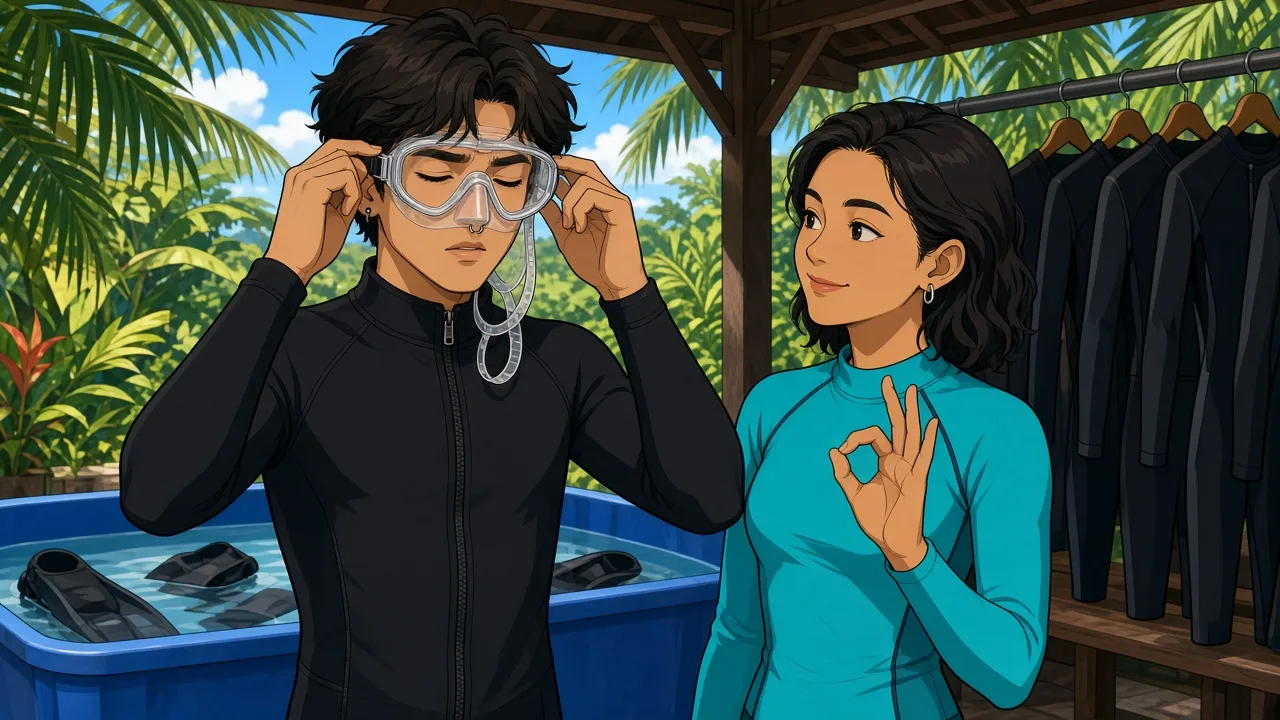
Tongue and lip piercings and the regulator
A diver holds the regulator by gripping rubber bite tabs between the teeth and sealing the lips around the mouthpiece. A long tongue bar or a lip ring can push against the mouthpiece, break the lip seal or click against the teeth for a whole dive. A 2007 instructor column in Scuba Diving magazine judged leakage through the piercing itself very unlikely and said the real issue is jewellery that gets in the way of the mouthpiece, solved by removing it or switching to a lower-profile piece. Once the piercing has healed, the practical test is to fit the regulator on land, breathe through it for a few minutes and check that nothing rubs or loosens.
Threaded balls can work loose, and a loose ball in the mouth while breathing compressed air is a choking hazard. Divers who keep a healed tongue bar in usually check the ends with clean hands before each dive.
Nose and face piercings and the mask
A dive mask seals with a silicone skirt that runs across the upper lip and under the nose, and the nose pocket has to be pinched for equalising. A septum ring or nostril stud can sit right under that skirt, letting water in, and pinching a healing nostril hurts. A diver who cannot pinch the nose cannot equalise the ears properly, which is the skill described in the guide on how to equalise your ears when diving. Healed septum rings can often be flipped up out of the way, and flat-backed studs sit more comfortably than hoops.
Ear piercings and hoods
Hoods press on the ears for the whole dive and snag on hoops when they are pulled off. Earlobes usually cope once healed, but cartilage piercings are sensitive to pressure for months, and a hood can push the jewellery at an angle. Small studs are the usual choice, and valuable earrings are better left ashore, since jewellery lost underwater is rarely found.
Navel, nipple and surface piercings
A BCD cummerbund wraps tightly round the stomach, the chest strap crosses the upper chest, and a weight belt sits low on the hips. All three press on healing body piercings, and a navel piercing under a cummerbund is one of the slowest placements to settle. Once healed, a flat or curved bar tends to cause less trouble than a ring.
Healed tattoos and piercings: does anything change at depth?
No. A healed tattoo or a healed piercing with solid jewellery has no effect on pressure, equalising, nitrogen loading or decompression, and divers with extensive tattoos and piercings dive under the same rules as everyone else.
Pressure only affects air spaces, such as the ears, sinuses, lungs and the inside of a mask. Tattoo ink sits as solid pigment in the skin with no air around it, so it does not squeeze or expand as a diver descends. Most body jewellery is solid metal and behaves the same way. Hollow or air-filled pieces, such as some acrylic plugs, are uncommon and are better swapped for solid ones before a dive.
There is no evidence that healed tattoos change the risk of decompression sickness. The diver medical questionnaire used by PADI and the other major training agencies asks about conditions such as asthma, heart problems and ear surgery, and has no question about tattoos or piercings.
Small things still matter over years of diving. Hours of sun on boat decks fade tattoos, so a long-sleeved rash guard and a reef-safe sunscreen are standard items on the Bali scuba diving packing list. Wetsuits rub less on healed skin but can still chafe a raised scar or keloid. Jewellery can loosen, catch on a hood or BCD strap, or slip off in the water, so divers usually check threaded ends before kitting up.
What to do if you already booked a dive trip
Move the tattoo or piercing to the end of the trip or after returning home. If it is already done, postpone the dives until it has healed rather than hoping a dressing will protect it. Most dive operators will reschedule if they are told in good time.
| Situation | Usual best option |
|---|---|
| Trip not started, tattoo planned | Book the tattoo after the last dive |
| Tattoo done, dives in a few days | Postpone the dives, keep the tattoo dry |
| Tattoo two to three weeks old | Check every healing sign before diving |
| New cartilage or navel piercing | No swimming for the rest of the trip |
| Course already started | Pause and finish once healed |
Getting tattooed at the end of a holiday works well for divers, because the tattoo and the dives no longer compete. The no-fly guidance in the guide to flying after scuba diving applies to the dives, while the tattoo only needs keeping clean and covered for the flight. Long flights in dry cabin air and tight sleeves are uncomfortable on fresh ink, so loose clothing helps.
Students partway through a course have options. PADI's referral system lets a student complete pool and theory work in one place and the open water dives somewhere else, usually within twelve months, so a tattoo halfway through a holiday does not have to waste what has already been done. Operators offering PADI certification in Bali and elsewhere can explain how they handle referrals. The same applies to continuing education such as an Advanced Open Water course, where dives can be spread over separate trips.
Bigger trips need more care. A week on a liveaboard such as the King Neptune liveaboard or a Komodo trip from Bali involves three or four dives a day with no dry days, and a tattoo even two weeks old will not cope with that. For these trips the tattoo is best booked at least a month before departure, or after it. First-time divers planning their first trip can find the wider timeline in the guide to diving in Bali for the first time.
The studio itself matters as well. Cleveland Clinic notes that infections can come from contaminated ink, non-sterile needles or studios that skip sterilisation between clients, with a small risk of blood-borne infections such as hepatitis. A licensed studio using single-use needles and sealed ink is worth the extra cost in any country, and the same applies to piercers using implant-grade titanium or steel.
Signs of an infected tattoo or piercing after diving
Spreading redness, heat, worsening pain, pus or a bad smell, red streaks running from the area, or a fever are signs of infection and need a doctor the same day. Normal healing gets steadily better; an infection gets worse.
Cleveland Clinic lists fever, skin that is hot to the touch, odour or heavy drainage, pain that increases instead of improving, and redness that spreads or forms streaks as the warning signs of tattoo infection. The same signs apply to piercings. Mild itching and light flaking are normal and are not reasons for alarm.
After seawater exposure, speed matters. The CDC describes Vibrio vulnificus wound infections as fast-moving, with painful swelling and blisters, and notes that people with liver disease, diabetes or weakened immunity face the highest risk. Anyone with a fresh tattoo or piercing who develops rapidly spreading redness, blisters or fever within a day or two of a dive or swim should go to a hospital rather than wait, and should tell the doctor about the seawater contact, because it changes which antibiotics are used.
Divers sometimes mistake an infected tattoo for other dive-related skin problems. Coral cuts and scrapes, covered in the guide to dangerous sea creatures in Bali, carry the same infection risk as any open wound. The outer ear infection described in the guide to swimmer's ear after diving is another example of skin that stays wet for too long. Divers who want to handle these situations with more confidence on a trip can take an Emergency First Response course, which covers basic wound care and when to escalate.
Example: planning a tattoo around a Bali dive trip from Sanur
A common pattern for divers who want both a tattoo and a week of diving is to dive first and get tattooed at the end. The example below uses day trips that leave from Sanur, with the tattoo appointment on the last full day.
- Day one: a try dive for beginners or a refresher dive for certified divers who have been out of the water for a while.
- Day two: shore dives at Tulamben and Amed on the north-east coast.
- Day three: boat dives at Nusa Penida, where the water can be cooler and a hood is useful.
- Day four: two dives at Padang Bai, then a rest afternoon.
- Day five: a morning snorkelling day or a dry day, with the tattoo appointment in the afternoon.
- Days six and seven: dry sightseeing, keeping the tattoo clean, covered and out of the hotel pool, then the flight home.
This plan is not suitable for anyone who already has a tattoo or piercing that is still healing, who should push the dives to a later trip. Nusa Penida's drift dives suit certified divers with some logged dives better than first-timers, the minimum age for a PADI try dive or Junior Open Water course is 10, and Divers Alert Network recommends at least 18 hours between the last of several dives and a flight. Day trips and prices for the sites above are listed under Bali dive prices.
Key takeaways
- A new tattoo is an open wound, so it should stay out of the sea, pools and hot tubs until the skin has fully closed, usually two to four weeks.
- Judge healing by the skin, not the calendar: no scabs, flakes, shine, redness or tenderness.
- New piercings need six to eight weeks for an earlobe or tongue and six to nine months for cartilage, a nostril or a navel.
- Waterproof film dressings do not reliably survive a dive and are not a reason to dive early.
- Healed tattoos and solid jewellery have no effect on pressure, equalising or decompression.
- On a dive holiday, schedule the tattoo or piercing after the last dive, not before the first.