
The question in the title is one of the most searched things in recreational diving, and it is almost never asked out loud at a dive shop counter. So here is the plain answer before anything else: yes, you can dive on your period, and most of what you will read online about why you cannot is either exaggerated or invented. We run Nusa Penida day trips most weeks of the year, and this comes up quietly, usually by message the night before, usually with an apology attached that is not needed.
What follows is the research rather than the folklore, because the folklore on this topic is unusually bad. We have pulled the figures from the Divers Alert Network, the Diving Diseases Research Centre in Plymouth and a NASA review of sex differences in decompression sickness, and where the evidence is thin we say so instead of filling the gap with confidence. It covers diving through your cycle, hormonal contraception, whether women are genuinely at higher decompression risk, pregnancy, and returning to the water afterwards. If you are booking a try dive or a PADI Open Water course with us and something on this list applies to you, none of it needs to be raised at the desk in front of other guests. A message works.
The short answers, before the detail
Most people arrive at an article like this wanting one line, not eleven sections. So:
On your period: yes. There is a weak signal in the data that the first week of the cycle carries slightly more risk than the third, and we will show you the actual numbers below, but no agency and no diving physician tells menstruating divers to stay out of the water. On hormonal contraception: yes, and the research linking the pill to decompression sickness has not held up. Pregnant, or actively trying to conceive: no. This is the one firm answer in the whole article, and the reasoning is genuinely interesting rather than merely cautious. Breastfeeding: yes, and the reason is simple physics. After giving birth: yes, on a timeline that depends on how you delivered, roughly four weeks to twelve. Endometriosis, PMS, breast implants: none of these rules you out.
The rest of this is the detail behind those answers, because in our experience the detail is what actually settles the question in someone's head.
Diving on your period: what the research actually shows
The largest dataset on this comes from the Diving Diseases Research Centre, which tracked 34,625 dives across 21,165 dive days and 11,461 menstrual cycles. That is a serious sample by diving research standards, where studies of a few dozen people are common.
What they measured matters, so read the next sentence carefully. They recorded reported post-dive discomfort, not confirmed decompression illness. Those are different things, and conflating them is how this topic gets distorted. Post-dive discomfort is the aches, unusual fatigue and niggles divers report after a dive, most of which are never diagnosed as anything.
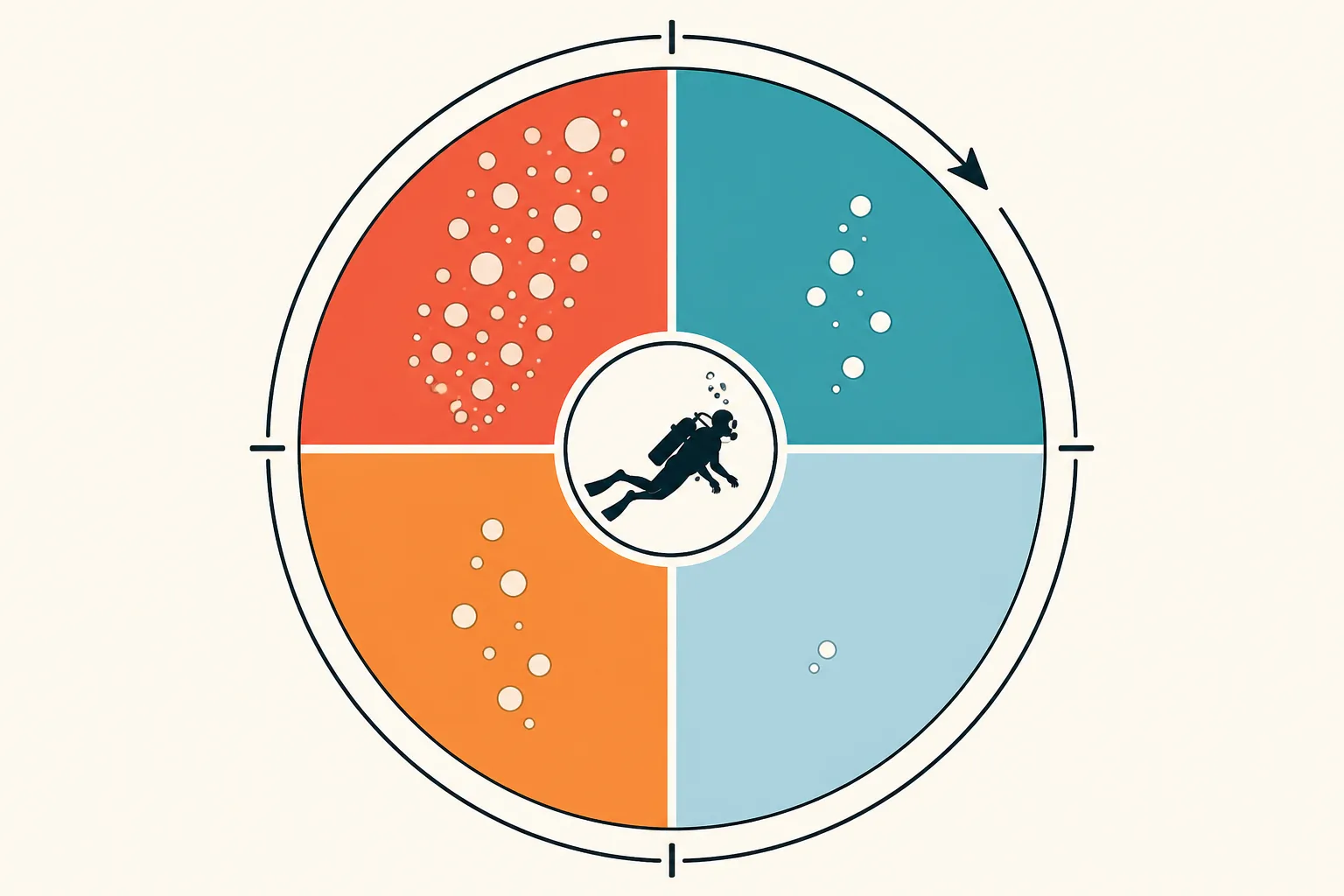
The overall rate was 28.3 reports per 1,000 dives. Spread across the cycle, it was not even: 39.2 per 1,000 in the first week, falling to 19.7 in the third week, then rising to 31.9 at the end of the fourth. The relationship was statistically significant and not linear. Several smaller studies going back to the late 1980s, including work on altitude decompression, found a similar uneven pattern, which is why the finding is taken seriously despite the soft endpoint.
There is a second figure that gets quoted a great deal, so it is worth handling properly. A retrospective review of 956 women divers who had decompression illness found 38 per cent were menstruating when they were injured. That sounds striking until you notice the denominator problem. A period covers somewhere between a fifth and a quarter of a typical cycle, so 38 per cent is elevated, but it is nothing like the fourfold effect the figure is sometimes presented as, and a retrospective review cannot separate the cycle from everything else happening on those dives.
The proposed mechanism is fluid retention and tissue swelling making it marginally harder to offload dissolved nitrogen. It is plausible. It has never been demonstrated directly.
So what do we actually do with this? Nothing, unless you want us to. Nobody at our shop gets a different dive plan because of where they are in their cycle, and no diving physician we know would prescribe one. If you would like to dive more conservatively that week, the levers are the ordinary ones available to everyone: fewer dives in the day, less depth, a longer safety stop, or enriched air on a profile where it buys you margin. Those are choices, not corrections.
The shark story, and why it refuses to die
Someone raises this on maybe one trip in fifteen, sometimes as a joke and sometimes not. There is no evidence that menstruating divers attract sharks or are at greater risk of a shark encounter going badly. None. DAN's position is unambiguous on it.
The arithmetic helps. Total menstrual flow over a full period is a small volume released gradually across several days, a good part of it shed tissue and mucus rather than blood, and most of it retained by a tampon or a cup. Compare that to the amount of fish protein and oil in the water around any reef at feeding time. Several shark species show no interest in menstrual flow in testing.
Worth saying plainly for anyone diving here: Bali is not a destination where sharks are a meaningful safety concern for anybody, regardless of cycle. We cover what actually lives in this water in our guide to sharks in Bali, and the honest summary is that white tips and black tips at Padang Bai are a highlight people pay for rather than a hazard.
Managing a dive day in Bali when you are on your period
The medical question is usually settled quickly. The logistics question is the one that actually decides whether someone enjoys the day, and almost nothing written on this topic addresses it, so here is our specific operation.
A Penida day trip from Sanur starts with a hotel pickup around 06:30 on a rolling loop, and the crossing of the Badung Strait is 12 km and takes 35 to 45 minutes on our speedboat. You are back at the shop in the early afternoon, where there are hot showers and somewhere private to change. That is the shape of the day, and the useful implication is that you sort yourself out at the hotel and again at the shop, with a stretch of boat time in between.
Be aware that privacy on a day boat is limited, on ours and on everyone else's. That is worth knowing in advance rather than discovering at 09:00, and if it is a deciding factor for you, ask any operator you are considering exactly what is on board before you book rather than assuming. A shore-entry day changes the maths considerably: Tulamben and Padang Bai are driven rather than crossed, with facilities on land within walking distance of the entry, which some guests specifically choose for that week.
Two practical notes from the water rather than from a textbook. A cup or a tampon is the workable option under a wetsuit, and plenty of divers here use a cup specifically because the interval between changes covers the whole trip. And thermal comfort deserves attention: most Bali sites sit at 26 to 29°C and we provide 3 mm suits, but Penida runs thermoclines that drop to 16 to 22°C at depth, and cramps and cold together are miserable in a way that neither is alone. Ask for a 5 mm. We stock them, and there is no charge for a thicker suit.
There is one knock-on effect worth mentioning because it catches people out and has nothing to do with decompression. Fluid retention in the days before a period can come with mild nasal and sinus congestion, and plenty of divers report that their ears clear less easily that week. This is commonly described rather than firmly established, so treat it as something to watch rather than a rule. The practical response is the ordinary one: start equalising at the surface, go down slowly, and stop if it is not working. Our guide to equalising covers the techniques, and the barotrauma guide explains what happens when a descent outpaces the ears. A blocked ear is the single most common reason a guest here pauses diving mid-trip, and it is almost entirely preventable with a slower descent.
One honest admission, since we make a point of these. We will not talk anyone out of a dive day they want, and we also will not pretend a dive boat is a comfortable place to be if you are having a genuinely bad first day. Perhaps five or six times a year a guest moves a booking back 48 hours for this reason. We move it without a fee and without a conversation about why, and nobody has ever regretted that call.
The pill, the implant, and decompression risk
The theory ran like this: hormonal contraception reduces venous tone and increases water retention, which could slow circulation and make nitrogen harder to clear. It is a reasonable hypothesis. It has been examined for over thirty years.
DAN's summary of the research is that no study has found evidence supporting it. The Plymouth group puts it as the jury still being out. The NASA review of sex and decompression sickness found no compelling evidence that hormonal contraception raises decompression risk in divers, though it did note a slightly elevated signal in altitude decompression, which is a different exposure with different physiology.
There is one figure worth putting in context because it circulates without it. In that review of 956 injured divers, 85 per cent of those on oral contraceptives were menstruating at the time of the incident. Taken alone it looks alarming. But it describes the timing of injuries within a group, not the risk of that group compared with anyone else, and many people on the pill deliberately shift or skip their cycle, which makes cycle-day analysis unreliable in exactly this population.
The practical position, then. Hormonal contraception is not a barrier to diving, it does not require a medical sign-off, and the diver medical questionnaire specifically excludes the contraceptive pill from the question about medication, which saves a surprising number of people an unnecessary trip to a doctor. If you want to trim your exposure during your period while on the pill, the conservative options listed earlier are all available. The evidence supporting that choice is weak, and we would rather tell you it is weak than dress it up.
Are women at higher risk of decompression sickness?
This deserves its own section because we have published a number on it ourselves, and the number needs company.
In our guide to avoiding decompression sickness we reported a study in which female divers showed an odds ratio of 4.63. That is a real published result and we are not walking it back. But it came from a model of real-world diving behaviour that was not adjusted for suit thickness, thermal exposure, body composition, workload against current, or who was buddied with whom, and the same model produced clearly behavioural artefacts, such as pre-dive tiredness appearing protective.
Set against it, the broader literature points the other way. The Plymouth researchers conclude that women do not appear to be at greater risk than men for the same dive profiles. The NASA review reached the same conclusion for scuba diving, and then found something genuinely counterintuitive in the altitude chamber data: under an identical decompression dose, women produced fewer venous gas emboli than men, and fewer of the highest-grade bubbles.
The honest synthesis is that sex, on its own, is not a useful predictor of decompression risk, and the things that are useful predictors apply to everyone: depth, time, ascent rate, thermal stress, exertion and repetitive loading. That is the same list we would give any diver, which is rather the point. If you want the detail on what does move the needle, it is all in that article, and the hyperbaric chamber guide covers what treatment in Bali actually involves.
Pregnancy: the one clear no, and the reason behind it
Every training agency, DAN's guidance to physicians, and every diving medicine centre we are aware of agree on this: do not dive while pregnant, at any stage, or while actively trying to conceive. It is the one place in this article where there is no grey zone, and we apply it without exception. It is also worth understanding why, because the reason is specific rather than a general shrug about caution.
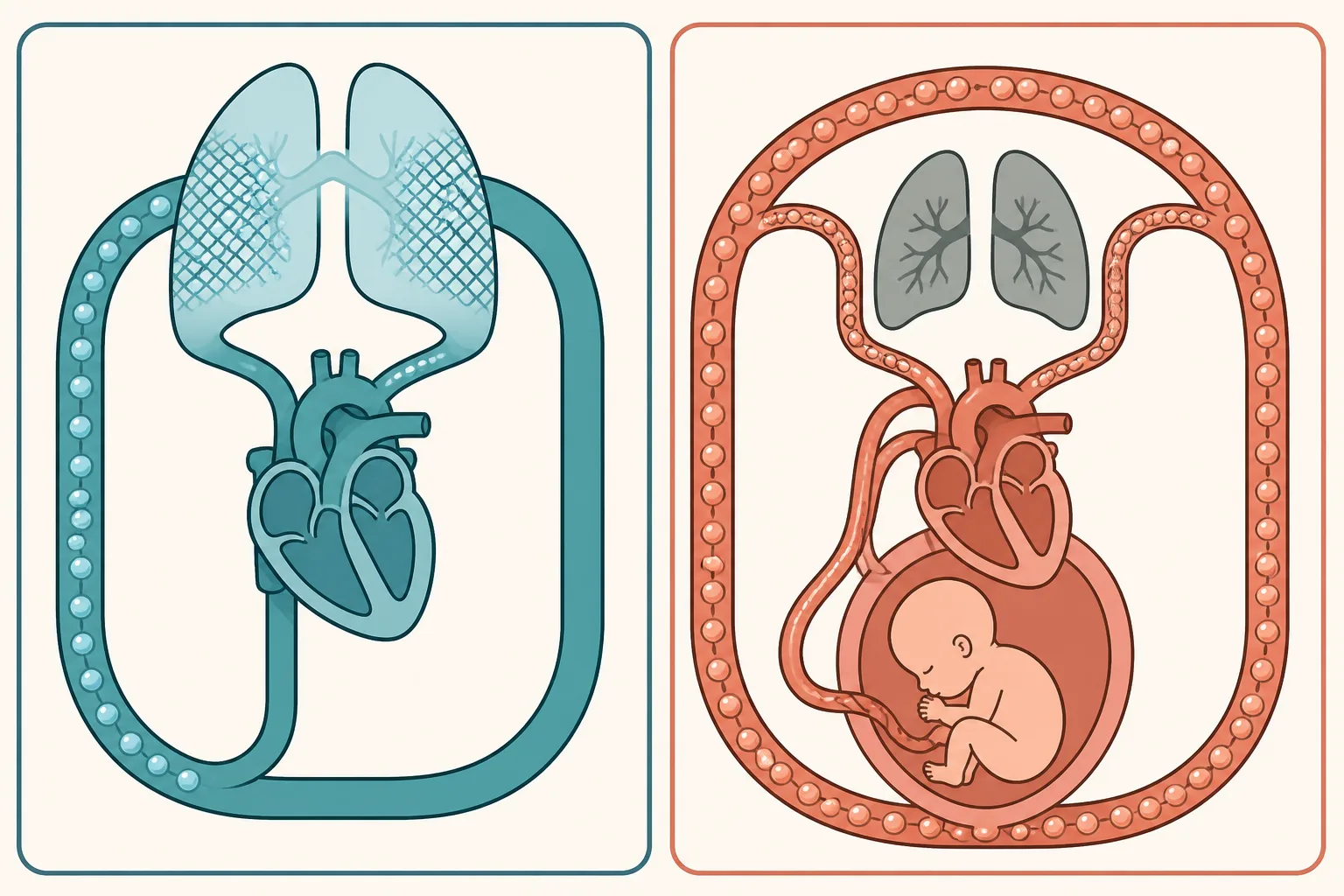
In an adult, almost all blood returning to the heart passes through the lungs, and the lungs act as a filter that catches the small bubbles that form after any dive. Nearly every diver produces some. The filter is why they almost never matter.
A fetus does not have that filter. Fetal circulation deliberately bypasses the lungs through two shunts, the foramen ovale and the ductus arteriosus, because the lungs are not yet doing the work of breathing. So a bubble that forms in a fetus is not intercepted on its way through. It can pass into the arterial circulation and travel anywhere, which is the definition of an arterial gas embolism. The mother can be entirely without symptoms while this is happening.
The evidence base is thinner than that clear recommendation might suggest, and it is worth being straight about why. Animal studies have been contradictory. Human studies can only be retrospective questionnaires, which depend on accurate recall. The Plymouth group's own 2006 work gathered 157 pregnancies and 1,465 dives from 129 participants and could draw no conclusion. Their statisticians calculated what a definitive study would take: roughly 4,000 women diving consistently throughout their pregnancies. No ethics committee on earth would approve it, so the study will not happen.
Which leaves the position most physicians take with anything where the pregnancy evidence is incomplete. If there is no compelling reason to accept an unquantified risk, do not accept it. Diving is a discretionary activity with an excellent alternative, and the downside is not one you can undo.
That alternative is worth spelling out, because guests are often surprised we offer it. Surface snorkelling involves no compressed gas and no decompression obligation, which removes the mechanism this entire section is about. It is not automatically suitable for every pregnancy, so it is a question for your own doctor rather than for us, but plenty of expectant guests spend the day on the boat with us and get in the water at the surface. Padang Bai snorkelling starts at IDR 1,350,000 for two sites and stays in sheltered, shallow bays, and Nusa Penida snorkelling is IDR 2,070,000, though Penida's currents make it the less relaxed of the two. The full range is on our Bali snorkelling page.
If you dived before you knew you were pregnant
This search happens at two in the morning and it deserves a calm answer, so we are going to quote DAN closely rather than paraphrase loosely.
DAN's published position is that there is insufficient evidence to warrant termination of a pregnancy on the basis of diving, and that women who dived before knowing may take some reassurance from the substantial anecdotal record of uncomplicated pregnancies after inadvertent diving. Their guidance to physicians states explicitly that discovering a pregnancy after diving is not considered grounds for termination.
What that does not mean is that it did not matter, or that anyone should keep diving now. It means the sensible next step is a conversation with your own doctor or midwife, with the actual dive profiles in front of them: how deep, how long, how many days, and whether you had any symptoms. Take your computer or your logbook to that appointment. Specific numbers are far more useful to a clinician than a general worry.
One related point, because it surprises people. If emergency hyperbaric oxygen is ever needed during a pregnancy, for something like carbon monoxide poisoning, the evidence indicates the risk to the fetus is lower with treatment than without. Hyperbaric medicine and recreational diving are not the same exposure, and a pregnancy does not rule out treatment that is genuinely needed.
Coming back to diving after giving birth
Here the guidance is refreshingly concrete, and it is driven as much by wound healing and load-bearing as by anything to do with decompression.
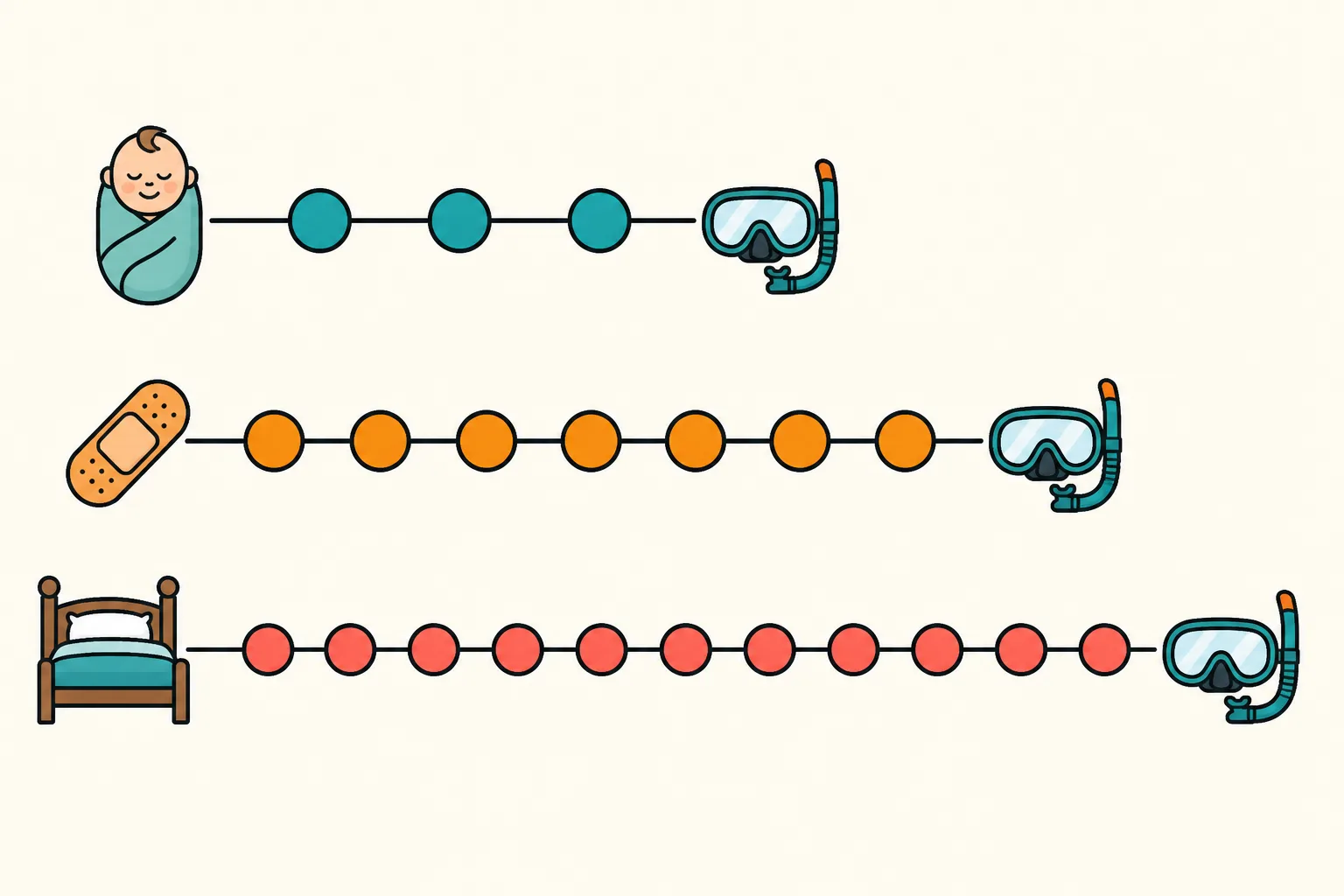
After an uncomplicated vaginal delivery, the usual advice is a minimum of 21 days and a practical rule of thumb of four weeks. The 21 days is about allowing the cervix to close, which lowers the risk of introducing infection, and immersion is the specific concern rather than exertion. After an uncomplicated caesarean, the recommendation is at least eight weeks. Obstetricians often clear normal activity at four to six weeks, but diving is not normal activity: most post-caesarean advice includes not lifting anything heavier than your baby for six to eight weeks, and a cylinder with a BCD comfortably exceeds that. Where there were complications, twins, pre-term labour, or a period of bed rest, twelve weeks is the figure, with medical clearance first, because extended bed rest costs real aerobic capacity and muscle mass. After a miscarriage, the guidance is to return once your physician has cleared you for unrestricted activity.
DAN adds a point we would echo from experience: caring for a newborn is itself a period of broken sleep and sustained fatigue, and that has a bigger effect on how a first dive back feels than most people anticipate. Fatigue and diving interact badly. There is no prize for going early.
When you do come back, a refresher session is worth the half day if it has been a year or more, and Padang Bai or Tulamben are gentler reintroductions than Penida's currents. Some guests bring the whole family and split the day, which we cover in our family diving guide. If you are considering picking up where you left off with a PADI Advanced Open Water course, build in more surface time than you would have needed before.
The other questions, and the form at the desk
A cluster of things come up often enough to answer directly.
Breastfeeding. Not a barrier. The nitrogen you absorb on a dive is inert, plays no part in metabolism, and washes out quickly, and the amount appearing in breast milk is insignificant with no route for an infant to accumulate it. The one genuine caveat is an active breast infection or inflammation, which is a reason to see a doctor and to wait, the same as any infection would be.
Breast implants. Not a contraindication once healed with no infection risk. Chamber testing found bubble formation inside implants produced volume changes of only one to four per cent, not enough to threaten the implant or surrounding tissue, and any bubbles resolve. Two practical notes instead: saline implants are close to neutrally buoyant while silicone is heavier than water, so larger implants can shift your trim, which is a weighting and buoyancy adjustment rather than a problem. And avoid a BCD with a tight constrictive chest strap.
Endometriosis and PMS. Neither rules out diving. Both come down to whether symptoms on the day would affect your comfort, focus or capacity for exertion, which is the same standard we apply to a diver with a migraine or a bad night's sleep. PMS affects something like a quarter to a half of women and can include reduced mental alertness and fatigue, and reduced alertness is worth taking seriously on a dive in a way that bloating is not.
Heavy periods and iron. This one gets missed, and it matters more to how a dive feels than anything else on this list. Persistent heavy bleeding is a common route to iron deficiency, and low iron shows up as reduced exercise capacity and breathlessness on exertion well before anyone calls it anaemia. Diving is exertion, sometimes against current at Penida, and it is also an activity where working hard raises your gas consumption and your decompression stress at the same time. If you get winded on stairs, that is worth a blood test at home rather than a discovery on a dive. It is a fixable thing, and general aerobic fitness matters far more to your diving than any of the hormonal questions above.
The form. The Diver Medical Participant Questionnaire asks about pregnancy directly, and a yes there is one of the few answers with no route to a same-day sign-off. It does not ask about your cycle, and it excludes the contraceptive pill from the medication question. If you need a dive medical or a specialist opinion while you are here, the Hyperbaric and Diving Medicine Centre at Kasih Ibu Hospital in Saba, Gianyar is the specialist option on the island, a DAN preferred provider running a multiplace chamber since July 2019, open Monday to Saturday for non-emergency appointments. RSUP Prof. dr. I.G.N.G. Ngoerah in Denpasar, still called Sanglah by most residents, is the closest chamber to Sanur. Neither is an obstetric service, so for a pregnancy question you want your own doctor, not a dive medicine clinic.
If you are planning a trip around any of this, two scheduling notes. Leave a clear gap between your last dive and your flight home, which we cover separately and which is not negotiable regardless of anything in this article. And if you are choosing an operator, the things worth asking about are the same ones any diver should ask, covered in how dive schools here differ and on our FAQ page. Course options and what each one involves are set out under our Bali diving courses, with current rates on the price list.
Worth knowing too that scuba is not the only way into the water with us. PADI Mermaid courses are breath-hold rather than compressed gas, which sidesteps the decompression question entirely, and they have become genuinely popular with guests who want the water without the cylinder.
The last thing, and the reason we wrote this. None of the above needs to be discussed at a counter with other guests within earshot. Send a message, note it on the booking form, or say it to a guide on the boat once you are underway. Our team at the dive centre in Sanur handles this every week and treats it as unremarkable, which is what it is.